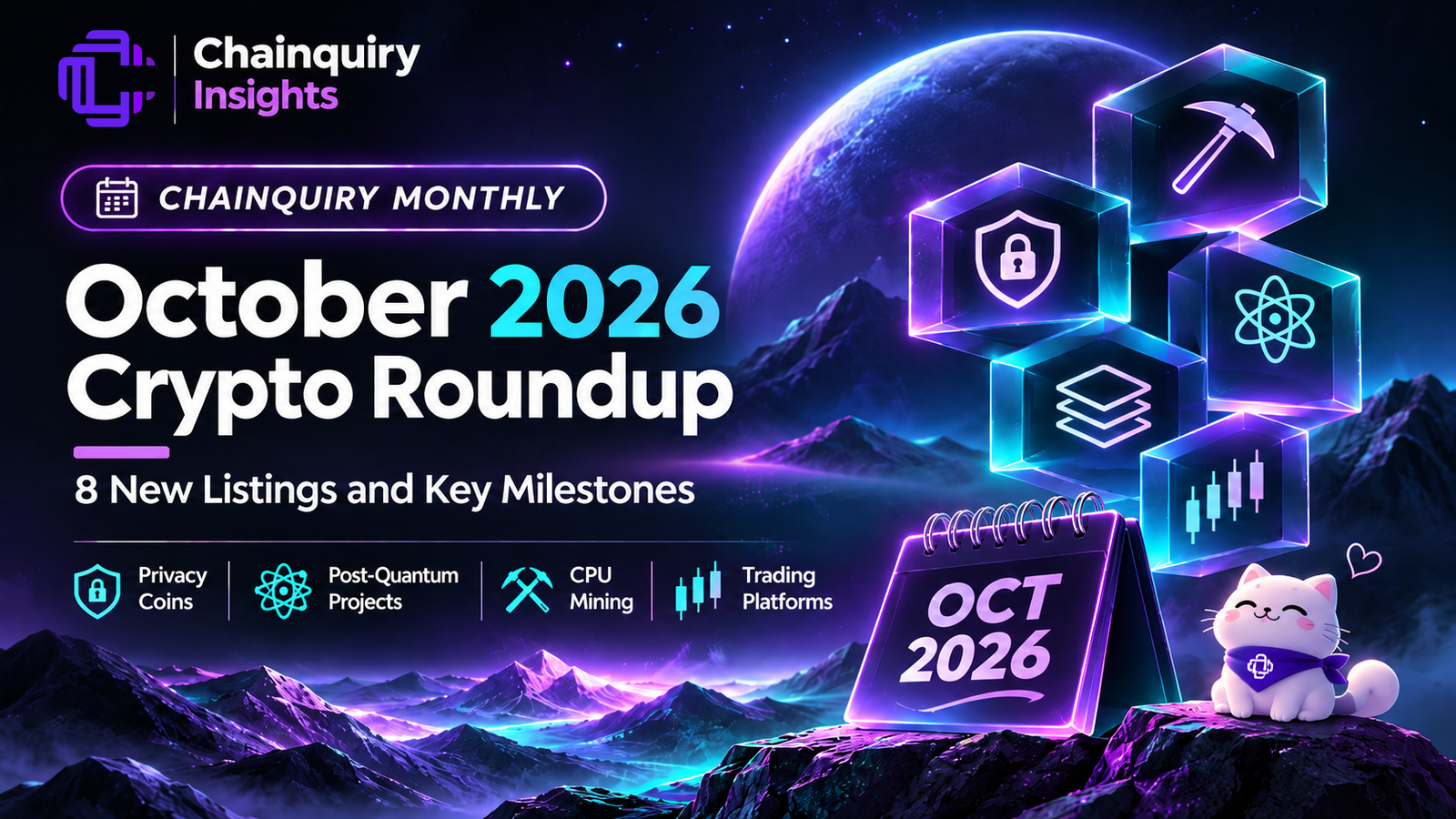
From privacy-focused networks and post-quantum security to CPU mining and new trading platforms, here’s what joined Chainquiry this October.
October brought a diverse collection of blockchain projects to Chainquiry. Some were established networks receiving new research coverage. Others were young cryptocurrencies developing their mining communities, privacy infrastructure, and monetary systems.
This October 2026 crypto roundup examines eight newly recorded directory listings, two mainnet milestones, and the research published throughout the month.
Between October 1 and October 22, Chainquiry added six cryptocurrency projects and two trading platforms. The additions included established networks such as Nervos Network and Zano, alongside newer names including Soqucoin, Feelcoin, Monzero, and xCoin.
Several themes emerged from these additions: privacy-focused transactions, proof-of-work participation, post-quantum cryptography, and the challenge of developing trustworthy infrastructure around new digital currencies.
These are observations about projects covered by Chainquiry, not claims about the entire cryptocurrency industry.
Here is our October review.
October 2026 Crypto Roundup: All Eight New Listings#
Chainquiry’s public Project Pulse records new directory additions, profile updates, published research, and selected network events.
According to those records, the following eight listings were added during October.
| Date added | Project or platform | Category | Main area of interest |
|---|---|---|---|
| October 1 | Nervos Network (CKB) | Layer 1 | PoW, Cell Model, Bitcoin interoperability |
| October 5 | TidoEx | Trading platform | Hybrid order-book and AMM trading |
| October 6 | Zano (ZANO) | Layer 1 | Privacy, confidential assets, hybrid consensus |
| October 8 | Soqucoin (SOQ) | Layer 1 | Post-quantum signatures, Scrypt and AuxPoW |
| October 13 | DeTrade | Trading platform | Crypto derivatives and demo trading |
| October 15 | Feelcoin (FEEL) | Layer 1 | RandomX CPU mining |
| October 18 | Monzero (XMZ) | Privacy coin | Confidential transactions, RandomX |
| October 22 | xCoin (XID) | Layer 1 | Post-quantum security, MetalDAG mining |
Dates refer to additions recorded in Chainquiry’s directory, not necessarily the original launch dates of the projects. They also differ from the dates on which paid listings were purchased.
Five of the six cryptocurrency additions use proof of work as their primary consensus approach. The sixth, Zano, combines proof of work with proof of stake.
In other words, every cryptocurrency project added to Chainquiry during this particular period includes a proof-of-work component.
That is a notable characteristic of this month’s selection, although eight listings are far too small a sample to draw conclusions about the wider market.
Established Blockchains Join the Research Directory#
Not every new directory listing represents a newly launched cryptocurrency.
Two of October’s additions, Nervos Network and Zano, have been operating since 2019. Their inclusion expands Chainquiry’s coverage of existing blockchain infrastructure.
Nervos Network (CKB): Programmable Proof of Work#
Nervos Network was added on October 1.
Its Common Knowledge Base, or CKB, is a proof-of-work layer-1 blockchain built around the Cell Model.
The Cell Model provides a flexible way to represent assets and blockchain state. Nervos also uses a RISC-V-based virtual machine to execute scripts and validate transactions.
Rather than positioning itself simply as another payment blockchain, CKB explores how a base layer can provide secure state storage and verification for a wider ecosystem.
Its architecture also supports connections to Bitcoin through developments such as RGB++ and the Fiber Network.
This makes Nervos an interesting research subject for readers exploring Bitcoin interoperability and alternative smart-contract designs.
Chainquiry published a detailed technical explainer alongside the new directory profile.
Further reading: What Is Nervos Network (CKB)? Cell Model, Fiber & Bitcoin Interoperability Explained.
Zano (ZANO): Confidential Assets and Hybrid Consensus#
Zano joined the directory on October 6.
Unlike transparent blockchains where transaction details can be publicly examined, Zano focuses on financial confidentiality.
Its ecosystem includes Confidential Assets, private peer-to-peer swaps, and a hybrid consensus system that combines mining with staking.
Zano uses ProgPowZ for its proof-of-work component and Zarcanum for its staking design.
One important distinction is that Zano’s privacy ambitions extend beyond transfers of its native currency. Confidential Assets are designed to support privately transferable assets within the network.
That provides a different architectural approach from privacy coins that focus primarily on concealing native-currency payments.
Readers can explore its technologies and original sources through the Zano research profile.
Privacy Coins Were a Distinct Theme in October#
Two of October’s cryptocurrency additions, Zano and Monzero, place transaction privacy at the center of their designs.
They also illustrate how different privacy-oriented blockchains can pursue different objectives.
Monzero (XMZ): A New Network With Monero-Derived Technology#
Monzero was added to Chainquiry on October 18.
Derived from the Monero codebase, Monzero operates its own blockchain with separate network parameters, monetary rules, and native currency.
Its transaction system incorporates ring signatures, one-time recipient addresses, and confidential transaction amounts.
Together, these mechanisms are designed to reduce the financial information that observers can obtain from ordinary blockchain transactions.
Monzero also uses RandomX, making general-purpose CPU mining an important part of its network design.
One detail deserves particular attention: its stated primary-emission target of 100 million XMZ is not a permanent maximum supply.
The protocol includes a continuing tail subsidy of 3.26 XMZ per block. Consequently, its total supply is uncapped.
Monzero’s development history also raises questions about early currency distribution. The founder has disclosed substantial early mined holdings and published voluntary commitments concerning their use.
Those disclosures provide relevant information, but they are not a substitute for independent verification or a longer operating record.
Our October research examines the technology, monetary policy, early distribution, and security limitations in greater depth.
Further reading: What Is Monzero (XMZ)? Privacy, CPU Mining and Tokenomics Explained.
Two Different Approaches to Privacy#
Zano and Monzero share an interest in confidential blockchain activity, but they should not be treated as interchangeable.
Zano combines hybrid consensus with confidential asset functionality.
Monzero concentrates on a Monero-derived payment architecture, proof-of-work mining, and a separate monetary system.
Neither approach guarantees anonymity under every circumstance. Wallet security, user behavior, software quality, and network-level information can still affect privacy.
Their presence in the same month’s listings offers a useful opportunity to compare the actual technical choices behind privacy-focused cryptocurrency projects.
Post-Quantum Cryptography: Soqucoin and xCoin#
Another striking overlap appeared in October’s additions.
Both Soqucoin and xCoin use post-quantum digital signatures, although their mining algorithms and monetary policies are different.
The underlying concern is long-term cryptographic security.
Many established cryptocurrencies rely on classical digital signature algorithms. Future sufficiently capable quantum computers could threaten some of the mathematical assumptions behind those systems.
Post-quantum signature algorithms attempt to provide alternatives designed to resist such attacks.
However, using a standardized algorithm does not automatically make an entire blockchain immune to every security problem.
Soqucoin (SOQ): Post-Quantum Signatures and Merge Mining#
Soqucoin joined Chainquiry on October 8.
Its design combines ML-DSA-44 post-quantum digital signatures, Scrypt proof of work, and auxiliary proof of work, commonly known as AuxPoW.
AuxPoW allows compatible miners to contribute work to more than one blockchain under supported merge-mining arrangements.
That offers an alternative approach to obtaining mining participation, although the resulting security still depends on actual miner behavior and network conditions.
Soqucoin’s mainnet launched on October 13, making it one of the month’s notable network milestones.
Chainquiry also published an extensive technical guide examining its cryptography, mining model, tokenomics, and network architecture.
Further reading: What Is Soqucoin (SOQ)? Post-Quantum Blockchain, Mining & Mainnet Explained.
xCoin (XID): Post-Quantum Security Meets MetalDAG#
xCoin was added on October 22.
The project uses post-quantum transaction authorization with ML-DSA-65 and an alternative SLH-DSA signature mechanism.
Its proof-of-work algorithm, MetalDAG, is designed to make memory-intensive computation central to mining.
The developers have placed particular emphasis on Apple Silicon computers and their unified memory architecture.
xCoin also follows an unusual issuance policy.
Its supply is capped at 100 million XID, while its block rewards increase during an introductory period before entering a gradual reduction schedule.
This contrasts with projects that begin with their largest subsidies and periodically halve them.
The combination of post-quantum signatures, memory-hard mining, and extended issuance makes xCoin a useful subject for comparing different proof-of-work design priorities.
Its short operating history, mining distribution, and software security still require careful evaluation.
Further reading: What Is xCoin (XID)? Post-Quantum Security, Mining and Tokenomics Explained.
What the Two Projects Reveal#
Soqucoin and xCoin address some of the same cryptographic concerns without following the same engineering approach.
Soqucoin uses Scrypt and AuxPoW.
xCoin uses MetalDAG and emphasizes memory-intensive mining on general-purpose systems.
Their post-quantum signature choices differ as well.
This is a reminder that the phrase post-quantum cryptocurrency describes only part of a blockchain’s architecture. Consensus rules, implementation quality, network participation, and security reviews remain equally important.
CPU Mining and Accessible Participation#
The October 2026 crypto roundup also included another recently launched proof-of-work network: Feelcoin.
Feelcoin (FEEL): RandomX and Independent Mining#
Feelcoin was added on October 15.
It operates an independent layer-1 blockchain using RandomX, a CPU-oriented proof-of-work algorithm.
Like other RandomX networks, Feelcoin aims to make compatible general-purpose processors useful for mining participation.
Its public project materials also emphasize open-source infrastructure and development funding.
While mining on ordinary hardware can lower some barriers to participation, it does not guarantee profitability or decentralized control.
Network difficulty, electricity costs, access to efficient hardware, and the concentration of mining pools still matter.
Feelcoin provides another example of a project choosing proof of work while attempting to keep mining accessible.
Readers can examine its network parameters and official development resources through the Feelcoin project profile.
Accessibility Is Not the Same as Decentralization#
Feelcoin, Monzero, and xCoin all emphasize forms of participation beyond specialized industrial mining.
Yet they use different technical approaches.
Feelcoin and Monzero employ RandomX, while xCoin uses MetalDAG.
Whether any of these networks achieves durable decentralization depends on measurable mining participation over time.
An algorithm can influence hardware economics. It cannot guarantee a broad distribution of independent operators.
Two Crypto Trading Platforms Joined Chainquiry#
October also brought two additions to the Platforms directory: TidoEx and DeTrade.
These listings expand Chainquiry’s coverage beyond cryptocurrency protocols to services people may use to trade or access digital assets.
DeTrade: Crypto Derivatives and Demo Trading#
DeTrade was listed on October 13.
Its platform profile describes cryptocurrency derivatives products, including futures, binary options, spread options, contracts for difference, and demo trading.
Such products differ substantially from simply holding cryptocurrency.
Leverage, liquidation mechanics, counterparty exposure, fees, and jurisdiction-specific restrictions can introduce significant risks.
The availability of a product in a directory is not a recommendation to use it.
Readers should assess the platform’s custody arrangements, verification requirements, operating entity, and product-specific risks before depositing funds.
Explore DeTrade’s Chainquiry profile.
TidoEx: Hybrid Trading With an Editorial Caution#
TidoEx joined the platform directory on October 5.
Its published model combines spot order-book trading with automated market maker liquidity pools, alongside multi-chain asset support.
However, Chainquiry currently displays a Caution advised notice on its profile.
The notice states that certain operational and security claims have not yet been independently verified.
This does not establish fraud or misconduct. It means that material information remains insufficiently verified for an unqualified assessment.
Readers should examine the notice and supporting information before considering deposits or other financial activity.
Read TidoEx’s platform profile and editorial caution.
The different editorial treatment of these two platforms reflects an important principle: being listed on Chainquiry is not the same as receiving an endorsement.
October’s Mainnet Launches and Blockchain Milestones#
Directory additions are only one part of the month’s activity.
Chainquiry’s Countdowns section also recorded two completed mainnet milestones during October.
ConnectCoin Mainnet — October 1, 2026#
ConnectCoin (CONN) is an experimental proof-of-work blockchain associated with RandomX mining and Pay-to-Connect rewards.
Its mainnet launch was recorded for October 1, 2026, at 15:00 UTC.
Although ConnectCoin was already represented in Chainquiry’s project directory, its transition to a live network was an October milestone.
The event remains accessible in the completed countdown archive.
Soqucoin Mainnet — October 13, 2026#
Soqucoin’s mainnet launch was recorded for October 13, 2026, at 15:00 UTC.
This event was particularly relevant because the project had joined Chainquiry only five days earlier.
Its completed countdown provides a dated record of the planned launch milestone, while the updated project profile identifies the network as live.
A countdown record is not a substitute for independent on-chain verification of every consensus or security claim.
Looking Beyond October#
Chainquiry also added or updated countdown tracking for several future network events.
These include xCoin’s planned mining reward increase and Lunarium Coin’s estimated future halving.
Estimated event dates may change because blockchain milestones often depend on reaching a particular block height rather than a fixed calendar time.
This makes the distinction between scheduled, estimated, and completed events particularly important.
October’s Research Highlights#
Alongside directory additions and network milestones, Chainquiry published several technical articles.
The month’s project research included:
- Nervos Network (CKB) — A deeper look at the Cell Model, CKB-VM, proof of work, and Bitcoin interoperability.
- Lunarium Coin (XLN) — An examination of staking, masternodes, governance, and Lunarium 4.0.
- Soqucoin (SOQ) — Post-quantum signatures, mining, monetary policy, and mainnet architecture.
- xCoin (XID) — Post-quantum security, MetalDAG mining, tokenomics, and network challenges.
- Monzero (XMZ) — Confidential transactions, RandomX mining, tail emission, and founder disclosures.
Lunarium is included here as an October research highlight, not as a new October directory listing.
Its profile was already present before the month began, but the project received updated research coverage and additional countdown attention.
This distinction helps keep our reporting accurate: new listings, profile updates, newly published articles, and blockchain launches are separate kinds of activity.
Readers can explore additional reporting in the Chainquiry Insights archive.
What October’s Listings Tell Us#
Several observations stand out when looking across the eight additions.
First, proof of work remained a prominent feature of this particular group. All six cryptocurrency projects incorporated it, either as their primary consensus mechanism or as part of a hybrid design.
Second, transaction privacy and post-quantum cryptography appeared in more than one project. Zano and Monzero emphasized confidentiality, while Soqucoin and xCoin adopted post-quantum transaction-signing approaches.
Third, the directory included both established networks and newer experiments.
Nervos and Zano arrived with years of operating history. Feelcoin, Soqucoin, Monzero, and xCoin represented newer networks facing different questions about mining distribution, infrastructure, and adoption.
Finally, the addition of trading platforms reinforced why source verification and caution labels matter.
A cryptocurrency directory can help readers discover services without treating every service as equally established or independently validated.
These observations describe Chainquiry’s October coverage. They are not a statistical analysis of global cryptocurrency adoption, investment flows, or market sentiment.
How Chainquiry Selects and Reviews Listings#
Chainquiry includes independently researched profiles alongside paid directory placements.
Inclusion in this monthly summary is based on recorded directory activity, not on whether a project paid for coverage.
A directory entry should not be interpreted as an endorsement, investment recommendation, or guarantee of technical security.
Individual profiles provide official links, technical details, source references, and editorial warnings where relevant.
We also distinguish project-reported claims from information independently supported by documentation or public records.
For this October summary, listing dates were checked against the public Project Pulse activity history, while milestone dates were checked against Chainquiry Countdowns.
The result is intended to function as an accessible, dated research record that readers can revisit later.
Looking Ahead to November#
October demonstrated the variety of projects that can exist under the broad label of cryptocurrency.
Some focus on private payments. Others develop programmable base layers, alternative mining algorithms, or new approaches to digital signatures.
New trading platforms introduce a separate set of questions about custody, operational transparency, and user protection.
In November, Chainquiry will continue following these subjects through project research, directory updates, and milestone tracking.
The most useful developments to watch will be measurable ones: working software, independent contributions, reliable infrastructure, observable network participation, and meaningful progress against published plans.
Announcements can introduce a project. Evidence helps readers understand what it has actually achieved.
Explore the Projects directory, browse Web3 Platforms, or follow Project Pulse for ongoing updates.
Frequently Asked Questions#
How many projects did Chainquiry add in October 2026?#
The October 2026 crypto roundup identifies six newly added cryptocurrency projects and two newly added trading platforms, making eight directory additions in total.
Were all eight cryptocurrencies launched in October?#
No. The eight additions include six cryptocurrency projects and two platforms. Several cryptocurrency projects, including Nervos Network and Zano, launched years before their Chainquiry profiles were added.
Why isn’t Lunarium included among the eight new listings?#
Lunarium Coin was already listed on Chainquiry before October. It received new research and countdown coverage during the month, so it appears under research highlights instead.
Does a Chainquiry listing mean a project is safe?#
No. Listings are research and discovery resources, not guarantees of security, liquidity, legitimacy, or investment performance. Some profiles carry explicit caution notices when important information remains unverified.
Where can readers find future monthly crypto roundups?#
Readers can follow the Chainquiry Insights archive for subsequent monthly editions, technical research, project explainers, and related blockchain coverage.
Published October 31, 2026. Research and directory activity reviewed through October 31, 2026.
Editorial disclosure: Chainquiry offers both paid directory placements and independent research listings. Some organizations mentioned in this article have purchased promotional services. Inclusion in this roundup reflects documented directory activity and does not constitute endorsement or investment advice.