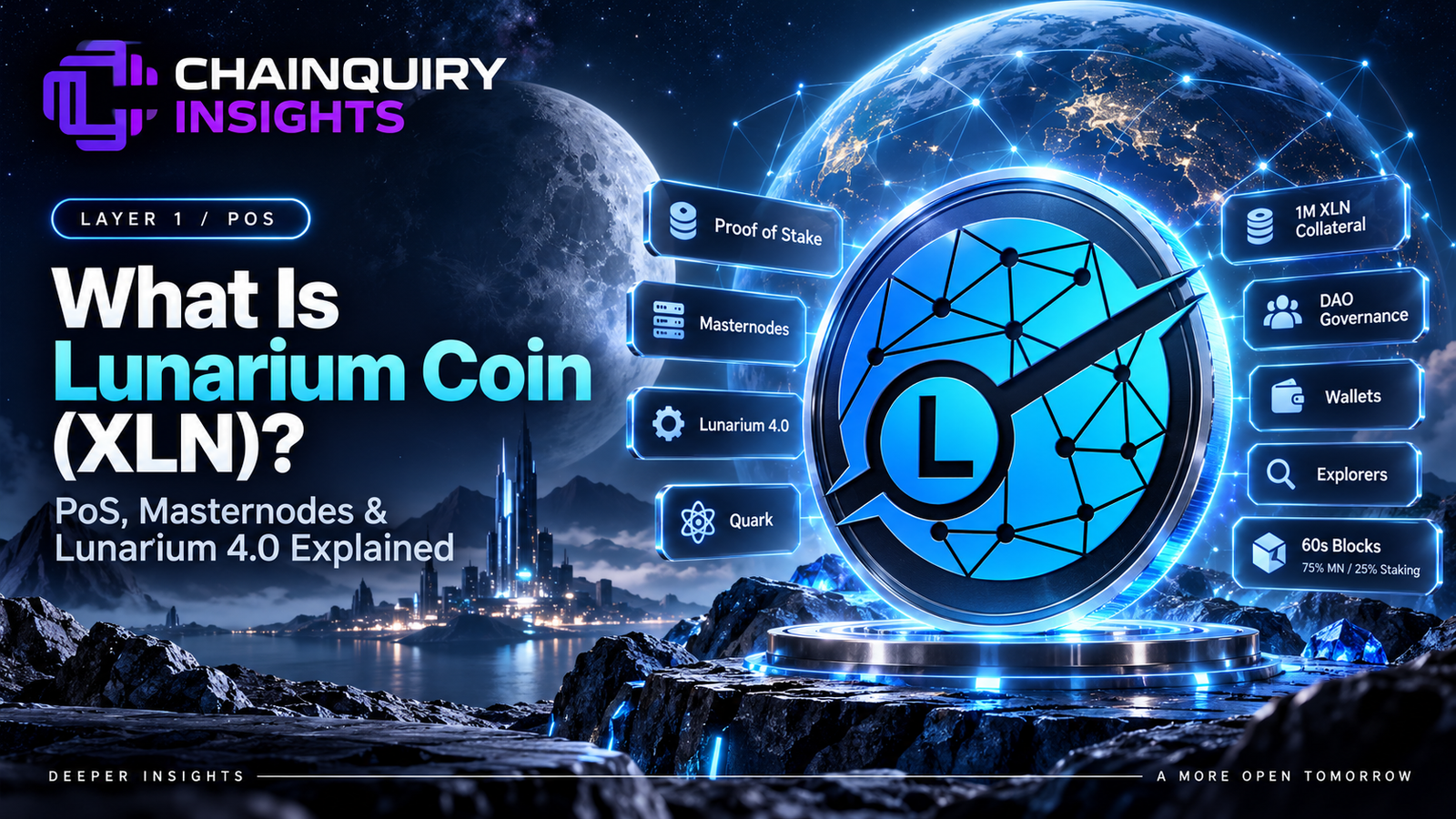
Established in 2018, Lunarium is an independent Layer 1 cryptocurrency built around Proof of Stake, masternodes, and community-oriented governance. Its current architecture, known as Lunarium 4.0, combines staking incentives with a collateral-backed masternode network.
The project also maintains desktop wallets, publicly accessible blockchain explorers, and an ecosystem initiative called XLNFT that aims to connect the native Lunarium network with BNB Smart Chain.
But how does Lunarium actually work? What is the purpose of XLN, how are its staking rewards distributed, and what should users understand before participating?
Let’s examine the technology, economics, and ecosystem behind Lunarium Coin.
What Is Lunarium Coin (XLN)?#
Lunarium Coin is a decentralized cryptocurrency operating on its own blockchain, rather than existing solely as a token issued on another network.
Its native coin, XLN, supports transfers, staking, masternode collateral, and participation in the network’s economic and governance systems.
The project dates back to 2018, placing it among the longer-running independent cryptocurrency initiatives.
Unlike blockchains that primarily compete through large smart-contract ecosystems, Lunarium emphasizes a relatively focused set of functions:
- Peer-to-peer transfers using its native cryptocurrency.
- Proof-of-Stake participation and rewards.
- Collateral-backed masternode operation.
- Community-oriented DAO governance.
- Desktop and mobile wallet accessibility.
- Public transaction verification through blockchain explorers.
Lunarium’s current architecture is referred to as Lunarium 4.0, with Quark hashing, Proof of Stake, and masternodes forming its principal technical identity.
For a structured overview of the project, including its network information and official resources, visit the Lunarium Coin profile on Chainquiry.
How Does the Lunarium Blockchain Work?#
Lunarium uses a combination of Proof-of-Stake consensus and masternode infrastructure.
These components perform related but distinct functions.
Proof of Stake allows eligible coin holders to participate in the process of maintaining consensus and receiving staking rewards. Instead of relying on continuous, competitive computational mining, staking uses cryptocurrency holdings and protocol rules to determine participation.
Masternodes are specialized network nodes operated by participants who commit a required amount of XLN as collateral.
According to the project’s documentation, they provide additional infrastructure and participate in governance.
Together, these mechanisms aim to support network operation while creating incentives for participants who maintain wallets, stake coins, or operate masternodes.
Lunarium’s published specifications describe a target block interval of approximately 60 seconds. Actual transaction confirmation experiences can vary depending on network conditions, software, and the level of finality required.
What Is the Quark Algorithm?#
One detail that can confuse newcomers is Lunarium’s use of Quark.
Quark is a cryptographic hashing algorithm, not the same thing as Lunarium’s current consensus mechanism.
A hashing algorithm processes data into fixed-length cryptographic outputs. Consensus rules, meanwhile, determine how the network agrees on valid blocks and maintains a shared ledger.
Lunarium identifies Quark as part of its blockchain technology while describing its current network as Proof of Stake plus masternodes.
Consequently, seeing Quark listed in a cryptocurrency directory should not automatically be interpreted as evidence that users can presently mine XLN through conventional Proof-of-Work mining.
Did Lunarium ever use Proof of Work?#
There is an important historical distinction in the public documentation.
The Lunarium GitHub repository describes a short Scrypt Proof-of-Work startup phase covering blocks 1 through 250, with Proof-of-Stake beginning from block 251.
However, Lunarium’s original 2018 announcement described the project as a PoS/Masternode cryptocurrency without Proof-of-Work mining.
These documents may reflect different versions or stages of the blockchain’s development, but they do not fully explain the transition between the specifications.
For readers researching its technical history, the safest approach is to distinguish the repository’s documented startup phase from the network’s currently advertised PoS/Masternode operation.
It would be misleading to describe Lunarium today as an ordinary Scrypt-mineable cryptocurrency.
What Is Lunarium 4.0?#
Lunarium 4.0 is the project’s current protocol generation and software ecosystem.
Its primary emphasis is maintaining an independent cryptocurrency network around staking, masternodes, wallet infrastructure, and decentralized governance.
Rather than introducing an entirely separate cryptocurrency, Lunarium 4.0 represents the development of the existing XLN ecosystem.
The project’s GitHub v4.0.0 release provides a useful look at the practical software available to network participants.
It includes core-node components, wallet packages, and releases for multiple operating systems.
The Windows ecosystem includes a traditional Qt wallet and a newer desktop interface built with Electron. The release documentation also describes blockchain bootstrap functionality intended to simplify initial synchronization.
This matters because cryptocurrency infrastructure is not only about consensus algorithms.
For an independent network to remain accessible, users need software they can install, maintain, and use to interact with the blockchain.
Lunarium’s continued wallet development is therefore a meaningful part of its technical story.
What Is a Lunarium Masternode?#
A masternode is a specialized cryptocurrency node operated by a participant who meets the network’s collateral and software requirements.
Within Lunarium, masternodes form an important part of the project’s infrastructure and reward system.
According to official documentation, masternodes support network stability, participate in governance, and receive a defined share of block rewards.
The collateral requirement is especially important.
How much XLN is required for a masternode?#
A Lunarium masternode currently requires 1,000,000 XLN in collateral, according to the official website and the current GitHub documentation.
This requirement has changed during the project’s history.
Older resources may mention 10,000, 250,000, or 300,000 XLN. Those figures should not be mistaken for the present requirement.
Before attempting to operate a masternode, users should confirm the required collateral, wallet version, node configuration, and applicable reward rules.
Collateral is a participation requirement, not a guarantee of profitability.
The economic outcome of operating a masternode depends on the value of XLN, network reward distribution, operational expenses, uptime, and other protocol conditions.
How Does Lunarium Staking Work?#
Staking is one of the primary ways users can participate in Lunarium without operating a dedicated masternode.
Under Proof of Stake, eligible XLN holdings can contribute to consensus participation and qualify for staking rewards according to the network’s rules.
The official wallet interface describes staking functionality that becomes available after the wallet is synchronized and eligible balances have received sufficient confirmations.
In practical terms, staking participation involves several considerations.
Wallet synchronization: A participating wallet needs an accurate view of the blockchain.
Eligible balance: Coins must meet the applicable maturity and protocol requirements.
Wallet availability: Depending on the staking implementation, an online wallet or continuously available node may be necessary.
Network conditions: Rewards are probabilistic or otherwise protocol-dependent, rather than guaranteed at fixed intervals to every holder.
Staking should not be confused with receiving interest from a bank account.
Rewards are issued according to blockchain rules, and their monetary value depends on the market value of XLN.
Users should also distinguish native wallet staking from any third-party service claiming to provide staking on their behalf.
Self-custody reduces reliance on custodians, but it also makes private-key protection and wallet backups the user’s responsibility.
Lunarium Tokenomics: Supply, Rewards and Distribution#
Tokenomics describes how a cryptocurrency is issued, distributed, and used.
For Lunarium, three elements are particularly relevant: XLN’s reported maximum supply, the division of block rewards, and the collateral required for masternodes.
Does Lunarium have a maximum supply?#
The Chainquiry research profile and CoinPaprika’s XLN data report a maximum supply of 1,000,000,000 XLN.
A 2024 Lunarium whitepaper also listed that figure.
However, the project’s original 2018 Bitcointalk announcement described its maximum supply as unlimited.
Because these historical specifications differ, the reported one-billion-coin limit should be distinguished from an independently verified present-day consensus-enforced cap.
A complete supply audit would require checking the current consensus implementation, existing issuance, and applicable protocol changes.
How are Lunarium block rewards distributed?#
The current GitHub documentation describes a reward allocation of:
- 75% to masternodes.
- 25% to Proof-of-Stake participants.
For example, the published schedule specifies a 10 XLN block reward beginning at height 621,702, split into 7.5 XLN for the masternode component and 2.5 XLN for the staking component.
Later scheduled stages reduce the total block reward.
At block 2,724,102, the documented total becomes 5 XLN, divided into 3.75 XLN for masternodes and 1.25 XLN for staking.
At block 4,826,502, it falls to 2 XLN, and at block 6,928,902, the schedule lists a total reward of 1 XLN.
These are scheduled values associated with specific block heights, not a claim that every stage is already active.
The broader model is designed around progressively declining issuance.
Lower future rewards can reduce the rate at which new coins enter circulation. However, declining issuance does not automatically increase demand, guarantee price appreciation, or eliminate investment risk.
What about the early coin distribution?#
The public GitHub README also documents a 51 million XLN allocation at block 1, described as a premine.
That is relevant historical information for readers evaluating the project’s distribution.
It does not, by itself, identify the final recipients or explain how those coins were subsequently used.
A complete assessment would require additional distribution records and blockchain analysis.
For smaller cryptocurrencies, transparency about early allocations, supply changes, and reward economics can be as important as technical performance.
How Does Lunarium DAO Governance Work?#
Governance is another important part of Lunarium’s design.
A Decentralized Autonomous Organization, or DAO, is a framework through which participants can influence decisions according to a project’s governance rules.
Lunarium describes a governance model in which masternode operators have voting rights.
The idea is to connect network participation with a role in deciding its direction.
Lunarium also maintains a dedicated DAO portal that provides registration, account access, and governance-related infrastructure.
In principle, community governance can allow eligible participants to weigh in on proposals and ecosystem priorities.
However, the existence of a DAO interface does not independently establish how decentralized decision-making is in practice.
Important questions include who can submit proposals, how voting weight is determined, whether results are enforced automatically, and how frequently governance is used.
For Lunarium, examining real proposals, voting records, and decision outcomes is a useful next step for anyone evaluating the governance model.
Lunarium Wallets and Network Tools#
A cryptocurrency’s accessibility depends heavily on the tools available to its users.
Lunarium provides several software options for interacting with XLN.
Desktop wallets#
The official project website and GitHub release describe desktop wallet support across Windows, macOS, and Linux.
Supported packages include core-node software, traditional Qt wallet functionality, and newer desktop wallet interfaces.
Depending on the package, users can manage balances, send and receive transactions, and access staking or masternode functions.
Android wallet#
The project’s wallet library also advertises an Android APK for mobile access.
Users should obtain wallet software only from verified official sources and check compatibility before installation.
Blockchain explorers#
A blockchain explorer provides a public interface for viewing transactions, blocks, and other network information.
Lunarium lists ExplorerXLN alongside additional explorer services.
These tools are useful for verifying transaction history independently of a wallet’s displayed balance.
They also provide a starting point for examining network activity, although explorer accuracy and availability depend on the service’s infrastructure.
Anyone installing an XLN wallet should securely back up recovery information, protect private keys, and verify software authenticity.
What Is XLNFT and How Is It Connected to Lunarium?#
An emerging part of the ecosystem is Lunarium Finance (XLNFT).
XLNFT should not be confused with the native XLN coin.
XLN operates on the independent Lunarium blockchain, whereas XLNFT is a BEP-20 token associated with BNB Smart Chain.
According to the official XLNFT information page, the token has:
- A fixed stated supply of 100,000,000 XLNFT.
- 18 decimal places.
- A BEP-20 contract on BNB Smart Chain.
- A proposed role connecting the native Lunarium ecosystem with broader Web3 liquidity.
The project’s stated concept involves allowing masternode participants to exchange eligible rewards for XLNFT, while XLNFT holders could acquire native XLN to participate in the Lunarium network.
This would create a connection between two distinct blockchain environments.
Importantly, the dedicated XLNFT page describes parts of the swap infrastructure as upcoming.
Therefore, the intended exchange or bridge mechanism should not be presented as fully operational without verifying actual transaction functionality and available liquidity.
The XLNFT contract information is linked by the project for users who want to examine the token on BscScan.
As with any cross-chain or token-swap system, users should independently verify contracts, supported networks, transaction paths, and custodial or smart-contract risks before transferring funds.
Where Can Users Find or Trade XLN?#
Lunarium’s official website lists several trading venues, including LunariumTrade, QuTrade, and Gatevia.
Because exchange support and liquidity can change, a venue appearing on a project website should not be treated as a guarantee that deposits, withdrawals, or active trading are available at a particular moment.
Before trading XLN, users should check the exact trading pair, order-book depth, network compatibility, withdrawal support, and any applicable exchange restrictions.
Smaller cryptocurrencies can have limited liquidity, meaning even relatively modest orders may experience significant price slippage.
Historical exchange listings are also not necessarily current.
For general market information, readers can consult CoinPaprika’s Lunarium page, while remembering that third-party circulating-supply and price data may be incomplete or delayed.
What Makes Lunarium Different?#
Lunarium is not attempting to occupy exactly the same position as every new blockchain.
Several characteristics define its current approach.
An established project history#
Lunarium’s origins trace back to 2018, rather than a recently created token launch.
Longevity alone does not prove security or adoption, but it provides a longer record of technical decisions and community activity for researchers to examine.
Participation through staking and masternodes#
The network connects native-coin ownership with several forms of participation.
Stakers can participate in reward distribution, while eligible masternode operators contribute infrastructure and receive a larger documented share of block rewards.
A governance-oriented identity#
Lunarium places DAO governance prominently within its project identity.
The practical value of that model depends on transparent proposals, meaningful participation, and consistent decision-making.
Continued wallet development#
The availability of desktop software, mobile options, node packages, and bootstrap functionality supports the project’s focus on maintaining an accessible independent blockchain.
A developing Web3 connection#
XLNFT represents an attempt to connect the Lunarium ecosystem with token infrastructure on BNB Smart Chain.
Its long-term relevance will depend on implementation, liquidity, security, and actual use.
Risks and Challenges to Understand#
Every cryptocurrency network comes with trade-offs, and Lunarium is no exception.
The first is liquidity and market accessibility.
Smaller digital assets can experience thin order books, volatile prices, and limited exchange support. Users should assess whether they can realistically enter or exit a position at acceptable prices.
The second is documentation consistency.
Lunarium’s historical announcement, later documentation, and current repository describe different supply and early-consensus specifications. These differences deserve a clear, version-specific technical explanation.
The third is masternode concentration.
A requirement of one million XLN creates a meaningful collateral threshold. Researchers should consider how ownership concentration and the distribution of active masternodes affect governance and network participation.
The fourth is software and operational security.
Running wallets or masternodes requires attention to updates, backups, node reliability, and safe management of cryptographic keys.
Finally, XLNFT integration is still an area to monitor.
Cross-chain connections introduce additional technical and economic dependencies. The intended benefits should be evaluated against deployed functionality rather than promotional descriptions alone.
None of these considerations is unique to Lunarium, but they are particularly relevant when researching smaller independent blockchain ecosystems.
Frequently Asked Questions About Lunarium Coin#
Is Lunarium Coin a Layer 1 blockchain?#
Yes. Lunarium operates its own blockchain with a native cryptocurrency, XLN. It is not simply an ERC-20 or BEP-20 token.
Is Lunarium Proof of Work or Proof of Stake?#
Lunarium currently describes its network as Proof of Stake with masternodes. Its GitHub documentation also records a limited Scrypt Proof-of-Work startup phase, which should not be confused with current staking-based operation.
What is Lunarium’s mining algorithm?#
Quark is the hashing algorithm associated with Lunarium’s current technical specifications. Its network consensus is described as PoS/Masternodes, rather than ongoing competitive Proof-of-Work mining.
How many XLN are needed for a masternode?#
The current documented requirement is 1,000,000 XLN. Older collateral figures belong to earlier specifications.
Can you stake Lunarium Coin?#
The official wallet ecosystem supports native Proof-of-Stake participation. Eligibility, wallet synchronization, coin maturity, and current protocol rules affect whether and when a user receives rewards.
What is the maximum supply of XLN?#
The commonly reported maximum is 1 billion XLN, although older project documentation described unlimited supply. Confirmation of the currently enforced cap requires examination of the current consensus rules.
Is XLNFT the same as XLN?#
No. XLN is the native coin of the Lunarium blockchain. XLNFT is a separate BEP-20 token associated with the project’s planned Web3 connectivity.
Where can I find official Lunarium information?#
Start with the official Lunarium website, its GitHub repository, and the Chainquiry XLN research profile.
Final Thoughts: Lunarium’s Place in the Crypto Ecosystem#
Lunarium Coin represents a different approach from the increasingly complex application-focused blockchains entering the market.
Its central design remains comparatively straightforward: an independent cryptocurrency, staking-based participation, masternode incentives, and a stated commitment to community governance.
Lunarium 4.0 continues that approach through updated wallet software and a network architecture centered on Proof of Stake and masternodes.
The XLNFT initiative introduces a separate direction, seeking to connect the native blockchain with the broader BNB Smart Chain environment.
What ultimately matters, however, is execution.
The project’s long-term development depends on reliable infrastructure, transparent tokenomics, functioning governance, accessible markets, and sustained community participation.
For researchers, Lunarium is an example of how a smaller, long-running Layer 1 cryptocurrency can continue evolving without abandoning its original emphasis on native-coin participation and masternode infrastructure.
Readers interested in following that evolution can explore the Lunarium Coin (XLN) directory listing on Chainquiry for its current profile, verified links, and research references.
Editorial disclosure: This feature was prepared as part of a paid Chainquiry Premium campaign. The technical discussion is based on publicly available documentation, and unresolved discrepancies are identified rather than treated as confirmed facts. This article is for informational purposes only and does not constitute financial advice. Always conduct your own research before interacting with cryptocurrency networks or assets.