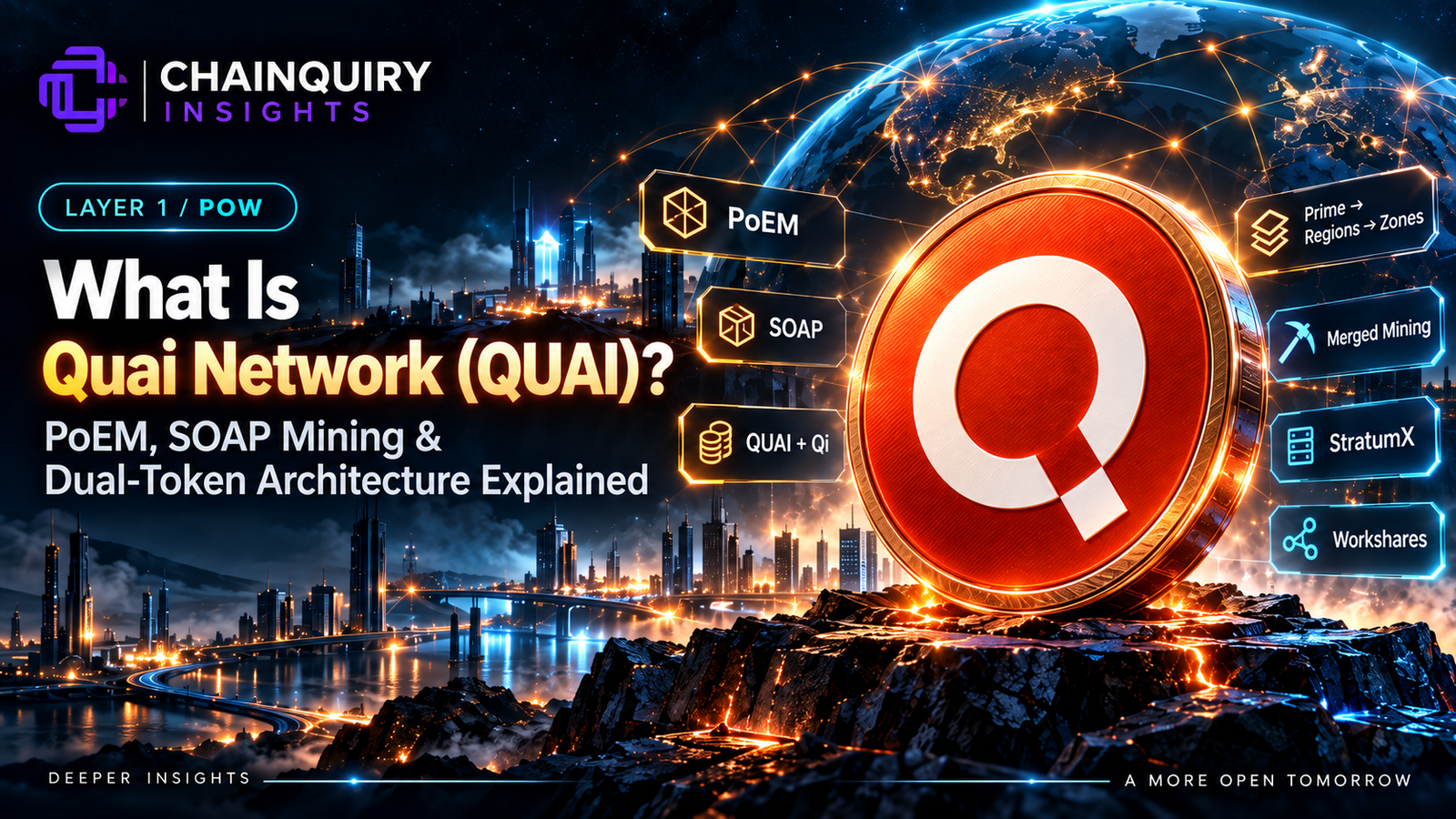
Quai Network is attempting something unusually ambitious for a modern Layer 1 blockchain: scaling Proof-of-Work without abandoning the properties that made Proof-of-Work attractive in the first place.
Rather than replacing miners with validators or moving most activity onto separate Layer-2 networks, Quai uses a hierarchy of interconnected blockchains, merged mining, a consensus mechanism called Proof-of-Entropy-Minima (PoEM), dual account and UTXO ledgers, and a two-token monetary system built around QUAI and Qi.
The network has continued to evolve since its mainnet launch in February 2025. Project SOAP expanded mining beyond GPU-based KawPoW to SHA-256 and Scrypt hardware, StratumX introduced decentralized solo-mining infrastructure, and the March 2026 Singularity fork dramatically restructured QUAI’s future supply.
So what exactly is Quai Network, and how do all of these pieces fit together?
What Is Quai Network?#
Quai Network is an EVM-compatible Layer 1 blockchain designed around scalable Proof-of-Work.
Its architecture differs from conventional single-chain networks. Instead of expecting one blockchain to process every transaction, Quai distributes execution across multiple interconnected chains while using shared Proof-of-Work security to keep them coordinated.
At the highest level sits the Prime chain. Below Prime are Region chains, and beneath those are Zone chains where user transactions and smart-contract execution occur.
This creates a hierarchy:
Prime → Regions → Zones
Rather than forcing every node to process every transaction globally, different zones can process activity in parallel. Quai’s design is intended to allow additional execution capacity to be introduced as network demand grows.
The important distinction is that these chains are not independent networks competing for separate pools of security. They are connected through merged mining and Quai’s hierarchical consensus architecture.
For a concise directory overview, see the Chainquiry project profile:
Why Is Quai Trying to Scale Proof-of-Work?#
Bitcoin demonstrated that Proof-of-Work can coordinate a decentralized monetary network without requiring a central authority.
But traditional Proof-of-Work blockchains also face a fundamental scaling problem.
If every transaction must ultimately be processed by the same blockchain, increasing demand can result in congestion, higher fees or pressure to increase hardware requirements.
Many newer blockchain ecosystems address this through Proof-of-Stake, Layer-2 execution environments, sidechains or other scaling systems.
Quai takes a different approach.
Its thesis is that Proof-of-Work itself can be horizontally scaled by coordinating multiple execution chains that share security.
Instead of making one chain increasingly powerful, Quai can theoretically add more chains.
The result is an architecture designed around parallelism rather than simply increasing the capacity of a single global ledger.
Understanding Quai’s Hierarchical Blockchain Architecture#
The easiest way to understand Quai is to think of the network as a hierarchy rather than one blockchain.
Prime Chain#
Prime sits at the top of the hierarchy.
It coordinates the broader network and links the underlying regions together.
Prime is not intended to handle every ordinary transaction directly. Its role is primarily coordination and global security.
Region Chains#
Region chains sit underneath Prime.
They coordinate groups of Zone chains and provide another layer of organization between global consensus and transaction execution.
Quai has used names including Cyprus, Paxos and Hydra for regions in its network architecture.
Zone Chains#
Zones are where most user-facing activity happens.
Transactions, smart contracts and decentralized applications operate within these execution environments.
Because separate zones can process transactions simultaneously, adding zones can increase aggregate network capacity.
This is the core of Quai’s horizontal scaling model.
Instead of making every node process an ever-growing amount of global activity, execution can be distributed across multiple zones.
What Is Proof-of-Entropy-Minima?#
One of the most technically distinctive components of Quai Network is Proof-of-Entropy-Minima, usually shortened to PoEM.
PoEM is Quai’s Proof-of-Work consensus mechanism and fork-choice system.
Traditional Nakamoto-style Proof-of-Work determines whether a block is valid based on whether its hash satisfies a difficulty threshold. When two valid competing blocks appear at similar times, different nodes may temporarily disagree about which chain is canonical until additional blocks resolve the fork.
PoEM attempts to improve this process by considering the intrinsic quality of the work represented by each block.
Instead of treating every hash that passes the required threshold as effectively equivalent, PoEM measures the amount of entropy removed from the hash space.
In simpler terms, a block that produces an unusually difficult hash can carry more intrinsic weight than another block that merely crossed the minimum threshold.
This gives nodes a deterministic way to compare competing blocks.
Quai argues that the result is faster fork resolution and reduced ambiguity between nodes.
That property becomes especially important in a system composed of many interconnected chains. Coordinating multiple blockchains becomes substantially more complicated if different parts of the network frequently disagree about their canonical histories.
PoEM is therefore not simply an alternative mining algorithm. It is one of the mechanisms that makes Quai’s wider multi-chain design possible.
Merged Mining Across Quai#
Quai’s chains also use merged mining.
Merged mining allows the same Proof-of-Work to contribute security to multiple chains.
A miner may produce a hash that satisfies the difficulty requirement of a Zone chain while an especially strong hash might simultaneously meet the requirements of its Region or Prime chain.
Quai refers to blocks that are valid across multiple levels of the hierarchy as coincident blocks.
These coincident blocks help connect the different parts of the network and provide a mechanism for transferring information through the hierarchy.
The objective is to avoid fragmenting mining security as new execution capacity is added.
This is an important part of Quai’s scaling thesis: adding more chains should not necessarily mean creating separate networks with independent security budgets.
What Are Workshares?#
Mining normally produces large quantities of computational work that never becomes a block.
A miner may calculate an enormous number of hashes that come close to the network difficulty target but do not satisfy it.
Quai uses a concept known as workshares to make some of this otherwise discarded work useful.
Workshares represent valid mining work that does not qualify as a full block but meets a lower difficulty threshold.
They can be incorporated into Quai’s reward and consensus mechanisms.
The project has continued developing this concept as part of its research into proportional miner rewards and Proof-of-Work efficiency.
Workshares are also important to another major component of modern Quai Network: Project SOAP.
What Is Project SOAP?#
SOAP stands for Subsidized Open-market Acquisition Protocol.
It became one of the largest changes to Quai’s mining economics when it launched on mainnet in December 2025.
Traditional merged mining allows a miner to use work performed for one blockchain to simultaneously participate in another blockchain.
SOAP modifies the economic relationship.
Instead of simply paying auxiliary-chain rewards directly to external miners, SOAP is designed to use value generated by external Proof-of-Work activity to purchase QUAI on the open market.
Those purchased tokens can then be burned or used according to the protocol’s incentive mechanisms.
The idea is to transform external mining subsidies into an economic input for Quai.
SOAP also dramatically expanded the range of mining hardware capable of participating in the network.
Quai originally relied primarily on GPU-oriented mining. With SOAP and subsequent network upgrades, the network supports:
KawPoW
SHA-256
Scrypt
This means hardware associated with several major Proof-of-Work ecosystems can participate in Quai’s mining economy.
SHA-256 is famously associated with Bitcoin and Bitcoin Cash, while Scrypt hardware is widely used for Litecoin and Dogecoin.
KawPoW maintains a route for GPU miners.
Instead of depending on one hardware class, Quai is trying to build a multi-algorithm Proof-of-Work environment.
SOAP and QUAI Buybacks#
SOAP is also closely connected with Quai’s monetary policy.
When supported external mining activity produces parent-chain rewards, the protocol can convert that value into QUAI purchases.
Purchased QUAI can then be removed from circulation through burns or directed toward longer-term protocol incentives.
This is intended to offset some of the new issuance created through Quai mining.
However, the ultimate economic impact depends on real mining participation, external mining revenue, QUAI liquidity, protocol parameters and broader network usage.
SOAP therefore should not be interpreted as guaranteeing that QUAI will become deflationary.
Instead, it introduces an unusual mechanism through which external Proof-of-Work activity can influence QUAI’s net issuance.
What Is StratumX?#
Another major mining-related addition arrived in January 2026 with StratumX.
StratumX is decentralized stratum infrastructure designed to let miners connect directly to Quai-compatible nodes rather than depending entirely on conventional centralized mining pools.
It supports KawPoW, SHA-256 and Scrypt miners.
The system integrates stratum functionality into go-quai nodes and allows independent node operators to expose mining endpoints.
Miners can then submit workshares and participate without necessarily creating a separate pool infrastructure stack.
Quai positions StratumX as non-custodial, non-KYC and zero-fee solo-mining infrastructure.
Together, SOAP, workshares and StratumX illustrate how significant mining remains to Quai’s design.
Mining is not merely the mechanism that produces blocks; it is deeply integrated into the network’s monetary and scaling architecture.
QUAI and Qi: Why Does Quai Have Two Tokens?#
Another feature that separates Quai from many Layer 1 networks is its dual-token system.
The network uses two native assets with different monetary roles:
QUAI
Qi
They operate on different ledger models and are designed for different purposes.
What Is QUAI?#
QUAI is the account-based asset within Quai Network.
It is compatible with the network’s EVM environment and can be used with smart contracts, decentralized applications and DeFi.
From a monetary perspective, Quai positions QUAI as the scarcer asset within the system.
Its issuance is connected to Proof-of-Work mining, while protocol changes including SOAP and the Singularity fork have altered its longer-term supply dynamics.
QUAI is therefore both a network asset and part of Quai’s broader monetary experiment.
What Is Qi?#
Qi takes a different approach.
Rather than using the same account model as QUAI, Qi operates on a UTXO-style ledger.
UTXO systems are most closely associated with Bitcoin and represent value through spendable transaction outputs instead of continuously updated account balances.
Qi is intended to function more like transactional digital cash.
Its monetary design is linked to mining difficulty and therefore indirectly to the energy expenditure required to secure the network.
Quai describes this concept as energy-denominated money.
Instead of maintaining a fixed peg to the US dollar through reserves or collateral, Qi’s design attempts to connect its monetary value to the economics of energy and Proof-of-Work.
That makes Qi fundamentally different from conventional stablecoins.
It is important not to confuse “energy-denominated” with “USD-pegged.” Qi is not simply another version of USDT or USDC.
One Network, Two Ledgers#
Having both QUAI and Qi also means Quai effectively operates two monetary ledgers.
QUAI uses an account-based system suited to EVM smart contracts.
Qi uses UTXOs suited to cash-like transactions.
Users can interact with both within the same broader network architecture.
This creates an unusual division of responsibilities: one asset can serve programmable applications and capital markets while the other can focus more heavily on payments and transactional use.
Whether this dual-token model gains meaningful adoption will depend on ecosystem activity, liquidity, merchant usage and user experience, but technically it is one of Quai’s clearest differentiators.
The Singularity Fork and QUAI Supply#
Quai’s tokenomics changed substantially on March 19, 2026.
At Prime block 1,530,500, the Singularity fork activated.
One of its most significant changes was the removal of approximately 1.67 billion QUAI that had previously been scheduled for future genesis-related unlocks.
According to Quai, the change resulted from investors, Dominant Strategies and the Quai Foundation agreeing to forgo those future vested allocations.
These tokens had not yet entered circulating supply.
Instead of burning already circulating coins, the fork prevented the affected future allocations from ever being released.
Quai stated that this eliminated approximately 81% of the remaining future genesis unlocks.
Following the change, the project began describing QUAI as having a soft supply cap of approximately 1.4 billion QUAI.
The word “soft” matters.
QUAI does not operate with the same simple fixed maximum supply model as Bitcoin.
Its supply equation also includes continuing mining emissions and SOAP-related burns.
As a result, future supply depends on protocol activity rather than one immutable maximum-supply number.
EVM Compatibility#
Quai Network also supports Ethereum-style smart contracts.
This makes its architecture more approachable for developers already familiar with Solidity and EVM development.
Rather than asking builders to learn an entirely new application environment, Quai provides tooling intended to resemble familiar Ethereum development workflows.
Its JavaScript tooling includes quais, a maintained adaptation of Ethers designed to understand Quai’s multi-chain topology and sharded addresses.
Developers can build decentralized exchanges, financial applications, token systems, NFT platforms and other smart-contract applications while the underlying network handles routing across its architecture.
EVM compatibility is strategically important because blockchain infrastructure becomes substantially less useful without applications.
Quai’s challenge is therefore not just achieving technical scalability but attracting enough developers, liquidity and users to make that capacity relevant.
The Quai Ecosystem in 2026#
Quai has continued building out its application layer since mainnet.
Quainance launched as a DeFi hub for the network in July 2026.
The ecosystem also gained USDT connectivity through a Symbiosis integration, giving users a route for bringing stablecoin liquidity onto Quai and connecting with external EVM ecosystems.
Wallet options include the Pelagus browser wallet and Blip mobile wallet, while the ecosystem also includes mining tools, explorers, decentralized applications and developer infrastructure.
QUAI also became available on Kraken in April 2026, expanding access beyond the exchanges that supported it earlier.
These developments are important because infrastructure alone does not determine whether a blockchain succeeds.
Liquidity, applications, wallets, exchanges and developer activity ultimately determine how much real economic activity reaches the network.
How Fast Is Quai Network?#
Quai markets scalability as one of its core advantages.
The network’s website currently describes an architecture capable of scaling to very high aggregate transaction throughput as additional execution capacity is introduced.
These figures should be interpreted carefully.
Maximum architectural or test capacity is not the same thing as sustained real-world mainnet throughput under everyday economic usage.
The more important feature of Quai’s design is the mechanism behind the claim: execution capacity can be expanded horizontally by adding additional Zone chains rather than forcing a single blockchain to process everything.
The current roadmap describes future zone expansion as demand-triggered.
That approach is sensible from an operational perspective. There is little value in maintaining large amounts of unused blockchain capacity before transaction demand actually requires it.
For researchers, real-world throughput, node requirements, cross-zone activity and fee behavior will therefore be worth monitoring as adoption grows.
What Is Next for Quai Network?#
Quai’s 2026 roadmap remains unusually broad.
Several areas are actively being developed or researched.
One of the most significant is native Bitcoin Proof-of-Work integration into SOAP.
The objective is to allow compatible Bitcoin mining work to contribute to Quai without requiring Bitcoin miners to abandon their existing mining activity.
Quai is also working on NiPoPoWs, or Non-Interactive Proofs of Proof-of-Work, which can enable compact verification of blockchain history.
Other roadmap areas include deeper DeFi liquidity, qBTC concepts, improved snapshot syncing, payment infrastructure, privacy research and additional SOAP-compatible Proof-of-Work ecosystems.
The project is also exploring machine-native payments and ways that AI or compute workloads could interact with its energy-based monetary system.
Not every research item on a roadmap becomes a production feature.
Quai explicitly marks several areas as exploratory, proposed or under active development, and they should be treated accordingly.
What Makes Quai Network Different?#
Many Layer 1 networks advertise speed, low fees and smart-contract support.
Those features alone do not make Quai unusual.
Its more interesting differentiators are architectural.
Quai retains Proof-of-Work while attempting horizontal blockchain scaling.
PoEM changes how competing Proof-of-Work blocks are evaluated.
Merged mining coordinates a hierarchy of chains.
Workshares attempt to make more mining work economically useful.
SOAP connects external mining economics with QUAI buybacks and burns.
StratumX provides decentralized mining infrastructure.
And the QUAI/Qi model separates programmable value from an energy-linked transactional asset.
Individually, several of these concepts have precedents elsewhere in cryptocurrency.
What makes Quai distinctive is the attempt to combine them into one integrated monetary and execution network.
Risks and Questions to Watch#
Quai’s architecture is technically ambitious, and that creates both opportunities and uncertainties.
The first question is adoption.
A blockchain can theoretically support enormous throughput while still processing relatively little economically meaningful activity. Developer growth, liquidity, applications and users matter more than maximum capacity alone.
The second is complexity.
A hierarchy of chains, two native monetary assets, cross-chain coordination, multiple mining algorithms and SOAP create a substantially more complex system than a conventional single-chain blockchain.
Complexity can make infrastructure harder to operate, audit and understand.
The third question concerns monetary economics.
SOAP introduces an unusual relationship between mining subsidies, market purchases, burns and new QUAI issuance. Its long-term effect will depend on participation and market conditions.
Qi also represents a monetary experiment rather than a conventional stablecoin. Whether users choose an energy-linked transactional asset over dollar-denominated alternatives remains an open question.
Finally, many future features remain under development.
Native Bitcoin proofs, qBTC, further privacy systems, additional SOAP integrations and other roadmap items should not be treated as completed functionality until deployed and independently observable on mainnet.
Is Quai Network a Proof-of-Work Blockchain?#
Yes.
Quai Network is fundamentally a Proof-of-Work network, although its implementation differs substantially from Bitcoin-style single-chain PoW.
PoEM is its consensus and fork-choice mechanism, while merged mining, workshares and SOAP extend how mining activity interacts with the wider system.
The network currently supports KawPoW, SHA-256 and Scrypt participation.
This makes Quai particularly relevant to miners and researchers interested in whether Proof-of-Work architecture can evolve beyond traditional single-chain designs.
Final Thoughts#
Quai Network is one of the more technically unconventional attempts to rethink Proof-of-Work.
Instead of moving away from mining to solve blockchain scalability, Quai is trying to redesign the structure around it.
PoEM provides deterministic block comparison. Hierarchical chains introduce parallel execution. Merged mining allows those chains to share security. Workshares capture mining effort that would otherwise be discarded. SOAP connects external mining economies with QUAI’s monetary system. QUAI and Qi divide programmable value and transactional money across account and UTXO ledgers.
The result is far more than another EVM-compatible Layer 1.
It is an experiment in whether Proof-of-Work can become scalable, programmable and economically flexible enough to support applications and payments without abandoning an open mining-based security model.
Mainnet has only been live since February 2025, so many of Quai’s biggest claims will ultimately need to be judged through real usage rather than architecture alone.
But between the Singularity supply restructuring, multi-algorithm SOAP mining, StratumX, growing DeFi infrastructure and ongoing protocol research, Quai Network has become a project worth watching for anyone interested in the future direction of Proof-of-Work blockchains.
Research Quai Network on Chainquiry:
https://chainquiry.com/projects/quai-network/
This article is for informational and research purposes only and does not constitute financial advice. Cryptocurrency networks and digital assets involve significant technical, market and regulatory risks. Always verify information independently and conduct your own research.