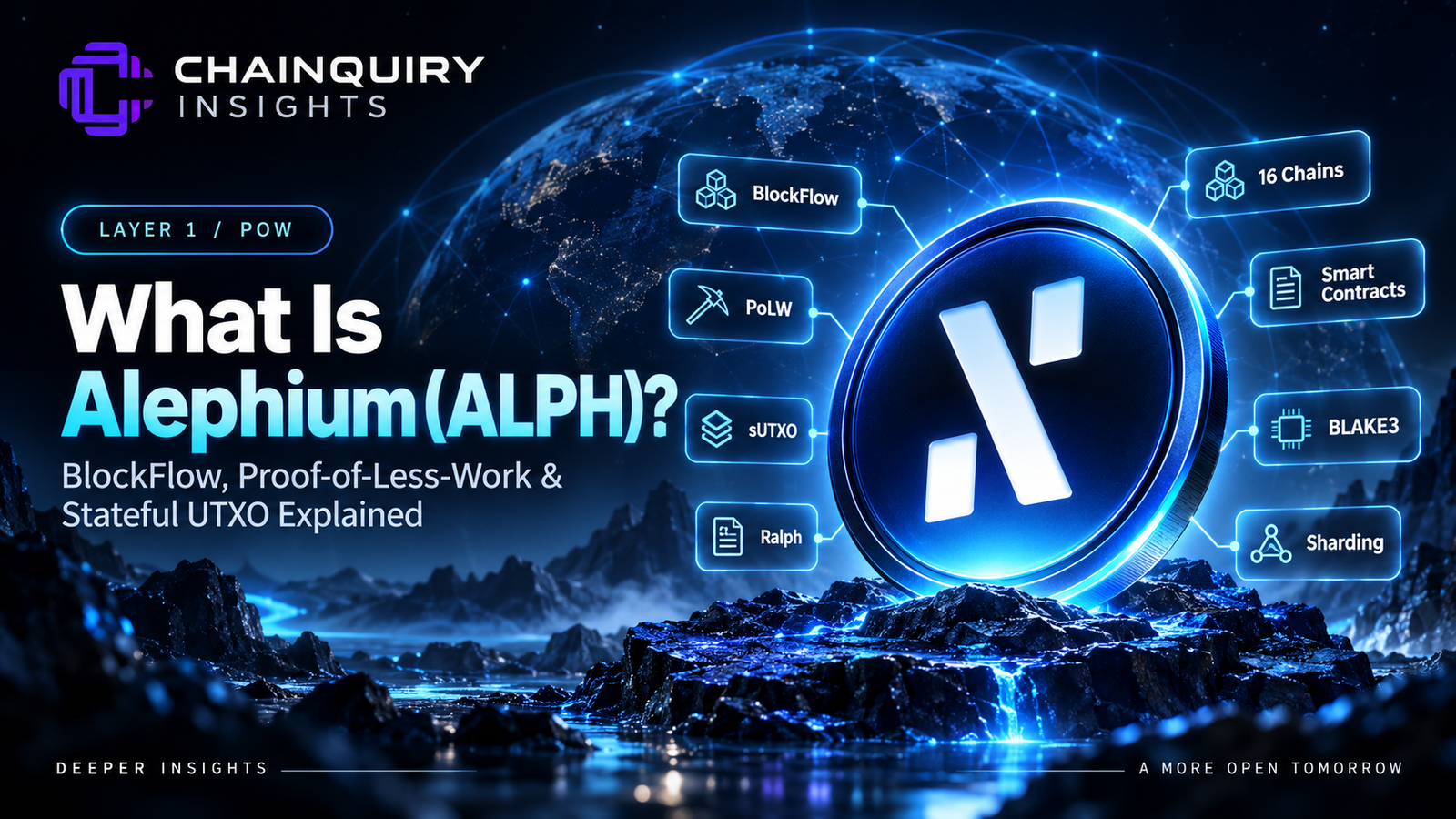
Alephium is a programmable Layer 1 blockchain that takes several ideas associated with Bitcoin — Proof-of-Work mining, UTXO-based asset ownership and permissionless validation — and combines them with sharding and a smart-contract environment designed for decentralized applications.
Its native cryptocurrency is ALPH.
The network is unusual because it does not simply copy Bitcoin’s architecture or reproduce the account-based model used by Ethereum. Alephium instead uses its own BlockFlow sharding algorithm, a stateful UTXO accounting model, the Alphred virtual machine and a purpose-built smart-contract language called Ralph.
Alephium also introduces Proof-of-Less-Work, or PoLW, an extension of Proof of Work intended to reduce the amount of physical energy required as mining activity grows.
The mainnet has been operating since November 8, 2021, and the protocol has continued to evolve. The Danube network upgrade in July 2025 reduced block times, improved sharding usability and developer tooling, and substantially changed the long-term ALPH emission model.
For the structured project information, official links and network details, see the Alephium (ALPH) profile on Chainquiry.
Alephium at a Glance#
Alephium is an independent Layer 1 rather than a token issued on Ethereum or another external blockchain.
The network uses Proof of Work, has its own native ALPH asset and supports programmable smart contracts.
Its current architecture includes four address groups and 16 transaction chains operating in parallel through BlockFlow. Following the Danube upgrade, each chain targets an eight-second block time, producing an average network-wide rate of approximately two blocks per second.
Alephium’s official documentation describes protocol throughput above 20,000 transactions per second under its current architecture. This should be understood as a network-capacity figure rather than a measurement of actual everyday transaction demand.
The blockchain also supports native tokens, decentralized applications, mining, wallets, cross-chain infrastructure and an expanding DeFi ecosystem.
Who Founded Alephium?#
Alephium was founded by Cheng Wang.
Wang has described studying number theory and later conducting research in distributed algorithms and Byzantine fault tolerance. His work on consensus systems eventually led him into cryptocurrency and the development of Alephium.
The project began publicly documenting its blockchain architecture before mainnet and developed around the problem of making a UTXO-based Proof-of-Work blockchain more scalable and programmable.
Alephium’s mainnet officially launched on November 8, 2021.
There is one historical detail that can cause confusion when examining the blockchain directly: Alephium’s genesis block carries the timestamp of January 3, 2009, matching Bitcoin’s genesis date as a deliberate tribute.
That does not mean Alephium launched in 2009. Its actual mainnet launch occurred in 2021.
How Does Alephium Work?#
Alephium combines several pieces of technology that are normally associated with different blockchain designs.
Proof of Work provides the basis for network consensus.
UTXOs manage assets.
Smart contracts maintain programmable state.
BlockFlow divides transaction processing across multiple chains.
Ralph provides the language developers use to write contracts, while the Alphred virtual machine executes them.
The result is a blockchain that attempts to preserve the ownership and verification properties of UTXO systems while supporting the kinds of stateful applications normally associated with smart-contract platforms.
To understand why Alephium is different, it helps to examine each of these parts separately.
What Is BlockFlow?#
BlockFlow is Alephium’s native sharding algorithm.
Sharding is a way of dividing blockchain work so that every part of the network does not need to process transactions sequentially through one single chain.
Alephium currently divides addresses into four groups.
Transactions between those groups are distributed across 16 chains because each possible source-and-destination combination receives its own transaction chain.
With four groups, the structure can be represented as:
4 × 4 = 16 chains.
A transaction moving from an address in Group 0 to another Group 0 address belongs to one chain, while a transaction from Group 0 to Group 2 belongs to another.
Blocks can reference information from multiple chains, allowing BlockFlow to maintain a consistent view of the wider network while processing activity in parallel.
The important point is that these chains are not presented to users as separate Layer 1 networks.
They are components of Alephium itself.
Does Alephium Have 16 Separate Blockchains?#
Technically, Alephium’s current BlockFlow configuration contains 16 transaction chains, but users are not expected to manage them as though they were 16 independent cryptocurrencies.
They share the Alephium protocol, native asset and wider network state.
Danube also introduced what Alephium calls groupless addresses, helping wallets hide more of the underlying sharding structure from ordinary users.
That matters because one of the historical problems with sharded blockchain designs has been usability.
A scaling architecture may look impressive on paper but become considerably less attractive if users constantly have to understand which shard holds their assets or manually move between different execution environments.
Alephium’s approach is intended to keep the parallel architecture largely beneath the user experience.
How Scalable Is BlockFlow?#
Alephium currently operates four groups and 16 chains.
Its architecture can support a larger number of groups, although increasing the shard count requires a network upgrade rather than happening automatically.
Alephium documentation describes a theoretical configuration of 32 groups, which would create 1,024 transaction chains.
The current network does not run 1,024 chains.
That figure represents the scaling design rather than today’s mainnet configuration.
Following Danube, Alephium reports protocol capacity above 20,000 transactions per second. As with throughput claims made by any blockchain project, capacity benchmarks should not be confused with real transaction usage.
For comparison, other Proof-of-Work Layer 1s have taken very different approaches to parallelism. Kaspa, for example, uses a blockDAG architecture rather than Alephium’s BlockFlow sharding model.
What Is Stateful UTXO?#
Alephium calls its accounting architecture stateful UTXO, often shortened to sUTXO.
Traditional UTXO systems such as Bitcoin represent spendable assets as discrete transaction outputs.
Account-based smart-contract platforms operate differently. Ethereum, for example, maintains accounts and a continuously changing global state.
Alephium combines elements of both designs.
Assets are controlled through UTXOs.
Smart-contract state is maintained separately using a stateful model.
This separation is important because it means a token does not need to become an arbitrary balance maintained inside a smart contract simply because it is used by a decentralized application.
Instead, assets retain UTXO-style ownership while contracts can still maintain mutable state.
Readers unfamiliar with the contrasting account model can compare this with how Ethereum and the EVM work.
Why Does Alephium Use Stateful UTXO?#
Alephium’s design is partly about separating who owns an asset from what a smart contract is doing.
A simple asset transfer can occur through UTXOs without invoking a smart contract.
More complicated transactions can execute contract logic while still handling the underlying assets through the UTXO model.
This changes several aspects of smart-contract programming.
One of the most significant is token approval.
On EVM-based networks, users frequently approve a smart contract to spend tokens on their behalf. Depending on the application and approval amount, that permission can sometimes remain available after the original transaction.
Alephium takes a different approach.
Assets used in a contract interaction are explicitly supplied and authorized for that transaction.
That model forms the basis of Alephium’s Asset Permission System.
What Is the Asset Permission System?#
The Asset Permission System, or APS, is designed to make the movement of assets explicit inside Alephium smart contracts.
Rather than granting a contract an open-ended ability to spend tokens from a wallet, Ralph allows the transaction to specify the assets and quantities that a function is permitted to use.
A function receiving one ALPH and one particular token, for example, cannot simply access unrelated assets from the user’s wallet.
This allows authorization to be scoped to the transaction being executed.
Alephium describes this as a way of eliminating the unlimited token-approval pattern found in many EVM applications.
That does not mean every application built on Alephium is automatically safe.
Contract logic can still contain bugs, applications can still be malicious, and users remain responsible for protecting their wallets and keys.
APS instead changes one particular class of asset-permission risk at the protocol and programming-model level.
What Is Ralph?#
Ralph is Alephium’s smart-contract programming language.
It was created specifically for the Alephium blockchain rather than adopting Solidity as the network’s native contract language.
The language is designed around Alephium’s stateful UTXO model and emphasizes explicit behavior.
Variables are immutable by default, asset access needs to be declared, and contract functions can specify whether they need access to user-approved assets, assets belonging to the contract or mutable contract fields.
These restrictions are intended to make contract behavior easier to reason about.
Ralph also works with transaction scripts, or TxScripts, which can coordinate multiple smart-contract calls inside the same transaction without requiring developers to deploy a separate aggregation contract for every workflow.
What Is the Alphred Virtual Machine?#
Alphred is Alephium’s smart-contract virtual machine.
It executes Ralph contracts and provides the environment in which Alephium applications operate.
Its design is closely connected to stateful UTXO and the Asset Permission System.
Alephium’s documentation describes several safeguards implemented at the language or VM level, including protections against common reentrancy patterns, uncontrolled token approvals and unintended external calls.
This is a different philosophy from simply providing a completely general execution environment and expecting application developers to implement every security pattern themselves.
There is still no such thing as a smart-contract platform on which applications cannot contain vulnerabilities, but Alephium attempts to make several risky patterns harder to express in the first place.
What Is Proof-of-Less-Work?#
Alephium uses a consensus design called Proof-of-Less-Work, or PoLW.
Despite the name, Alephium remains a Proof-of-Work blockchain.
PoLW is not Proof of Stake.
Miners still perform computational work, mining hardware still matters and blocks still depend on Proof-of-Work consensus.
The difference appears in how the protocol is designed to handle the economic cost of mining as network hashrate becomes sufficiently large.
Traditional Proof of Work places the overwhelming majority of mining cost outside the blockchain.
Miners buy hardware and electricity.
Proof-of-Less-Work is designed to shift part of that cost inside the network by requiring miners to burn ALPH once the relevant hashrate conditions are reached.
Instead of requiring all of the security expenditure to take the form of additional electricity and hardware, part can take the form of permanently destroyed coins.
Does Proof-of-Less-Work Use Less Energy?#
Alephium designed PoLW specifically to reduce the physical-energy component of Proof of Work while retaining an external computational cost.
The project’s current documentation states that the model can reduce energy use by more than 87% compared with an equivalent conventional Proof-of-Work setup once the full mechanism applies.
That percentage is Alephium’s protocol-model claim rather than a measurement showing that the current Alephium network consumes exactly 87% less electricity than another specific blockchain today.
The distinction matters.
PoLW does not mean mining requires no electricity.
It means Alephium has designed a mechanism in which some of the economic security cost can eventually come from ALPH burning rather than increasingly large amounts of physical computation.
What Mining Algorithm Does Alephium Use?#
Alephium is a mineable blockchain.
Its mining implementation uses BLAKE3 for block hashing, and miners can participate through solo mining or mining pools.
Because BlockFlow currently consists of 16 chains, mining infrastructure distributes work across those chains.
The target block time after Danube is eight seconds per chain.
Across all 16 chains, this results in an average of approximately 172,800 blocks being produced per day.
Mining rewards are not immediately spendable. Newly mined ALPH is subject to a lock period of approximately 500 minutes.
The purpose of that delay is to make certain blockchain-reorganization attacks more difficult.
Mining conditions and block rewards can change with the protocol, so current miners should use Alephium’s live documentation rather than relying on historical reward figures.
What Is ALPH Used For?#
ALPH is the native asset of the Alephium network.
It is used to pay transaction fees, transfer value, interact with smart contracts and participate in the network’s economic system.
ALPH is also issued as mining rewards.
Under the Proof-of-Less-Work design, ALPH can additionally serve as an internal mining cost through coin burning when the relevant PoLW conditions apply.
The asset is therefore connected directly to both network usage and Proof-of-Work economics rather than existing only as an application token layered on top of another blockchain.
Does ALPH Have a Maximum Supply?#
No — not anymore.
This is one of the most important pieces of outdated Alephium information still found online.
Alephium originally launched with a 1 billion ALPH maximum-supply model.
The genesis allocation consisted of 140 million ALPH, including allocations for private sales, ecosystem development and the treasury, while the remaining original supply schedule was intended primarily for mining.
That changed with the Danube upgrade in July 2025.
Danube removed the hard cap and introduced a long-term tail-emission model.
Alephium’s current documentation therefore lists mining emissions as unlimited and ALPH as having no fixed maximum supply.
Crucially, this did not suddenly release hundreds of millions of additional ALPH.
Alephium says the original emission curve remains in place for roughly the first eight decades. Tail emissions apply after that original schedule, providing a continuing miner incentive instead of allowing issuance eventually to fall to zero.
For this reason, websites still describing ALPH as permanently capped at 1 billion coins are using the project’s previous tokenomics model.
Does Alephium Burn ALPH?#
Yes.
Current Alephium documentation states that transaction fees are burned.
Proof-of-Less-Work introduces another potential burn mechanism because miners can be required to destroy ALPH as part of mining economics when the PoLW component becomes applicable.
Burning creates a supply-reducing force, while mining rewards create new ALPH.
The long-term supply therefore depends on the interaction between issuance and burning rather than on a fixed maximum number.
An unlimited maximum supply also does not mean an unlimited amount of ALPH can suddenly enter circulation.
Emission is determined by protocol rules over time.
What Was the Danube Upgrade?#
Danube was Alephium’s third major network upgrade, following Leman and Rhone.
It activated on mainnet on July 15, 2025.
One of the most visible changes was a reduction in target block time from 16 seconds to eight seconds.
Because Alephium currently runs 16 parallel transaction chains, the change increased average network-wide block production to approximately two blocks per second.
Danube also improved node synchronization, BlockFlow performance, address handling and Ralph development.
The upgrade introduced groupless addresses intended to make the underlying sharding architecture less visible to users and added developer improvements for contract calls, asset handling and wallet onboarding.
Its tokenomics change was equally significant: the original fixed ALPH supply ceiling was replaced by tail emissions.
How Fast Is Alephium?#
Following Danube, each Alephium chain targets an eight-second block interval.
Across the current 16-chain network, the protocol averages approximately two blocks per second.
Alephium’s official materials state that BlockFlow can process more than 20,000 transactions per second in its current configuration.
That should not be interpreted as evidence that Alephium regularly processes 20,000 real user transactions every second.
Blockchain throughput figures normally describe technical capacity under particular conditions.
Actual network usage is a separate metric.
This distinction is useful when comparing any Layer 1, because advertised TPS numbers often measure different workloads and testing assumptions.
Can Developers Build dApps on Alephium?#
Yes.
Alephium is designed as a general-purpose smart-contract Layer 1 rather than only a payment network.
Developers build applications using Ralph, the Alephium TypeScript SDK and the Alphred virtual machine.
The ecosystem can support applications such as decentralized exchanges, tokens, NFT systems, liquidity protocols and other programmable financial or Web3 services.
Alephium also maintains public developer documentation and open-source repositories for its node software, wallets, SDKs and supporting infrastructure.
The reference node implementation is available through the project’s verified GitHub organization.
What Is Powfi?#
As of September 2026, Powfi is live on Alephium mainnet as part of the network’s developing DeFi infrastructure.
Its current functionality includes token swaps, concentrated-liquidity and constant-product liquidity pools, and xALPH.
xALPH represents ALPH deposited through Powfi’s staking system and can be used within supported liquidity markets.
It is important not to confuse this with Alephium’s consensus mechanism.
Alephium itself remains a Proof-of-Work network.
Staking ALPH through an application such as Powfi does not turn Alephium into Proof of Stake and does not make xALPH validators responsible for producing Alephium blocks.
This distinction is similar to the difference between a blockchain’s base consensus and financial applications built on top of that blockchain.
Does Alephium Support Cross-Chain Assets?#
Alephium has bridge infrastructure connecting the network with other blockchain ecosystems.
The Alephium Bridge can move supported assets between Alephium and networks including Ethereum and BNB Smart Chain.
Bridged assets introduce additional assumptions beyond simply holding a native Layer 1 asset.
Users should understand the specific bridge contracts, custody or validation model and token representation involved before treating a bridged asset as identical to its native counterpart.
The existence of a bridge also does not make Alephium an Ethereum Layer 2 or sidechain.
Alephium remains an independent Layer 1 with its own consensus, miners and native ALPH asset.
Is Alephium EVM-Compatible?#
Alephium is not simply another EVM chain.
It has its own virtual machine, smart-contract language and stateful UTXO programming model.
That means Solidity contracts cannot automatically be treated as native Ralph contracts without adaptation.
The trade-off is that Alephium can design its execution environment around concepts such as UTXO asset ownership and explicit asset permissions rather than maintaining compatibility with Ethereum’s existing execution model.
Developers coming from Ethereum therefore encounter different tooling and programming concepts.
That can provide new security properties, but it also creates a learning curve and means Alephium does not automatically inherit the enormous library of EVM applications and developer tools.
Is Alephium Open Source?#
Yes.
Alephium’s reference node and numerous ecosystem components are publicly available through the project’s verified GitHub organization.
Repositories include the core Alephium implementation, frontend applications, explorer infrastructure, TypeScript SDK, browser-extension wallet and documentation.
Open-source code allows independent developers to inspect the implementation, operate nodes, build tools and submit changes.
It should not, however, be confused with proof that every smart contract or application deployed on Alephium has been audited or is safe.
Individual applications need to be evaluated separately.
What Are the Main Risks and Limitations of Alephium?#
Alephium makes several architectural trade-offs that prospective users and developers should understand.
Its smart-contract environment is significantly smaller than Ethereum’s, which means fewer applications, integrations and developer resources are available compared with the largest established ecosystems.
Ralph and stateful UTXO also require developers familiar with EVM development to learn a different programming model.
Proof-of-Work networks can face mining centralization if a small number of pools or hardware operators control a large proportion of hashrate.
Sharding introduces additional protocol complexity even when wallets successfully hide much of that complexity from users.
Bridges and decentralized applications introduce their own smart-contract and operational risks that are separate from the security of the Alephium base protocol.
Finally, performance figures such as 20,000+ TPS describe technical capacity rather than guaranteed real-world adoption.
A technically capable blockchain still needs users, developers, applications, liquidity and sustained network participation.
Alephium vs Bitcoin#
Alephium borrows heavily from the UTXO and Proof-of-Work principles associated with Bitcoin, but the two systems are designed for different purposes.
Bitcoin intentionally maintains a comparatively narrow base-layer programming model and focuses heavily on monetary settlement and network robustness.
Alephium adds native sharding, stateful smart contracts, programmable tokens and a custom virtual machine.
Proof-of-Less-Work also changes long-term mining economics by combining external computational cost with an internal ALPH-burning mechanism.
The connection between the projects is therefore architectural rather than an attempt to make Alephium another version of Bitcoin.
Alephium vs Ethereum#
Both Alephium and Ethereum support programmable applications, tokens and smart contracts, but the underlying designs differ considerably.
Ethereum uses an account-based execution environment and Proof-of-Stake consensus.
Alephium uses Proof of Work, stateful UTXO and BlockFlow sharding.
Ethereum’s dominant smart-contract language is Solidity and execution occurs through the EVM.
Alephium uses Ralph and Alphred.
Ethereum also has a much larger established application, liquidity and developer ecosystem.
Alephium’s differentiator is therefore not simply that it supports smart contracts. It is the attempt to combine programmable applications with a UTXO-oriented asset model, sharded Proof of Work and security restrictions built directly into its programming environment.
How Can Alephium Be Researched Independently?#
Alephium provides considerably more technical material than can be covered in a single explainer.
Its full-node implementation is open source.
Block and transaction activity can be checked through the public explorer.
The documentation explains BlockFlow, mining, Ralph, stateful UTXO, the Asset Permission System and network upgrades in detail.
Users researching ALPH tokenomics should pay particular attention to the date of any source they find.
Material published before Danube may still describe a fixed 1 billion ALPH maximum supply, whereas the current protocol uses an unlimited tail-emission model.
Likewise, older technical material may refer to 16-second blocks or earlier throughput figures that were superseded by the 2025 network upgrade.
Checking current primary documentation is therefore particularly important with Alephium.
Final Perspective#
Alephium is a Proof-of-Work Layer 1 built around the idea that scalability and programmable smart contracts do not necessarily require abandoning UTXOs or mining.
BlockFlow allows the network to process transactions across multiple parallel chains.
Stateful UTXO separates asset ownership from contract state.
Ralph and the Alphred VM provide a smart-contract environment with explicit controls around asset movement.
Proof-of-Less-Work attempts to preserve external Proof-of-Work security while shifting part of the long-term mining cost away from electricity and toward ALPH burning.
And Danube significantly modernized the network with eight-second blocks, improved sharding usability, developer changes and a new tail-emission model.
That combination makes Alephium technically different from both conventional Bitcoin-derived payment chains and the large family of EVM-compatible Layer 1s.
Whether those architectural choices translate into sustained adoption will depend on more than protocol design. Developer activity, applications, liquidity, mining participation and real network usage matter as well.
For readers who want the structured network details and official project links alongside this explainer, Chainquiry maintains a dedicated Alephium (ALPH) project profile.
You can also explore more independent blockchain and cryptocurrency research through Chainquiry Insights.
Frequently Asked Questions
What is Alephium?#
Alephium is an independent Layer 1 blockchain using Proof of Work, BlockFlow sharding and a stateful UTXO model. It supports programmable smart contracts through its Ralph language and Alphred virtual machine.
What is the Alephium ticker?#
Alephium’s native cryptocurrency uses the ticker ALPH.
When did Alephium launch?#
Alephium mainnet launched on November 8, 2021.
Who founded Alephium?#
Alephium was founded by Cheng Wang, whose background included research in mathematics, distributed algorithms and blockchain consensus.
What consensus mechanism does Alephium use?#
Alephium uses Proof-of-Less-Work, a Proof-of-Work-based consensus design. It does not use Proof of Stake for base-layer consensus.
What mining algorithm does Alephium use?#
Alephium’s mining implementation uses BLAKE3 hashing. The network supports both solo and pool mining.
What is BlockFlow?#
BlockFlow is Alephium’s native sharding algorithm. The current mainnet divides addresses into four groups and processes transactions through 16 parallel chains while maintaining one Alephium network.
What is stateful UTXO?#
Stateful UTXO is Alephium’s accounting model. Assets are managed through UTXOs while smart-contract state is maintained separately, allowing Alephium to combine UTXO-style asset ownership with programmable stateful contracts.
What is Ralph?#
Ralph is Alephium’s purpose-built smart-contract programming language. It is designed around explicit permissions, stateful UTXO and the Alphred virtual machine.
Does Alephium have a maximum supply?#
No. Alephium originally had a 1 billion ALPH hard cap, but the Danube upgrade removed the fixed cap and introduced long-term tail emissions. Current Alephium documentation therefore lists mining emissions as unlimited.
Is ALPH still mineable?#
Yes. ALPH is the native Proof-of-Work cryptocurrency of Alephium and is issued to miners according to the protocol’s emission rules.
Does Alephium have staking?#
Alephium’s base consensus does not use staking. It remains Proof of Work. Applications within the ecosystem can offer staking-related products, such as xALPH through Powfi, but these are application-level mechanisms rather than Alephium’s consensus.
How fast is Alephium?#
Following the Danube upgrade, Alephium targets eight-second blocks on each of its 16 current chains and averages approximately two blocks per second across the network. Official documentation describes protocol throughput above 20,000 TPS, which is a capacity figure rather than a measurement of actual transaction usage.
Is Alephium EVM-compatible?#
No. Alephium uses its own Alphred virtual machine and Ralph smart-contract language rather than the Ethereum Virtual Machine.
Is Alephium open source?#
Yes. Alephium’s core node, SDKs, wallets, explorer components and other infrastructure are publicly available through its verified GitHub organization.

Chainquiry provides independent cryptocurrency research. Coverage is not an investment recommendation. Verify important details through current primary sources.