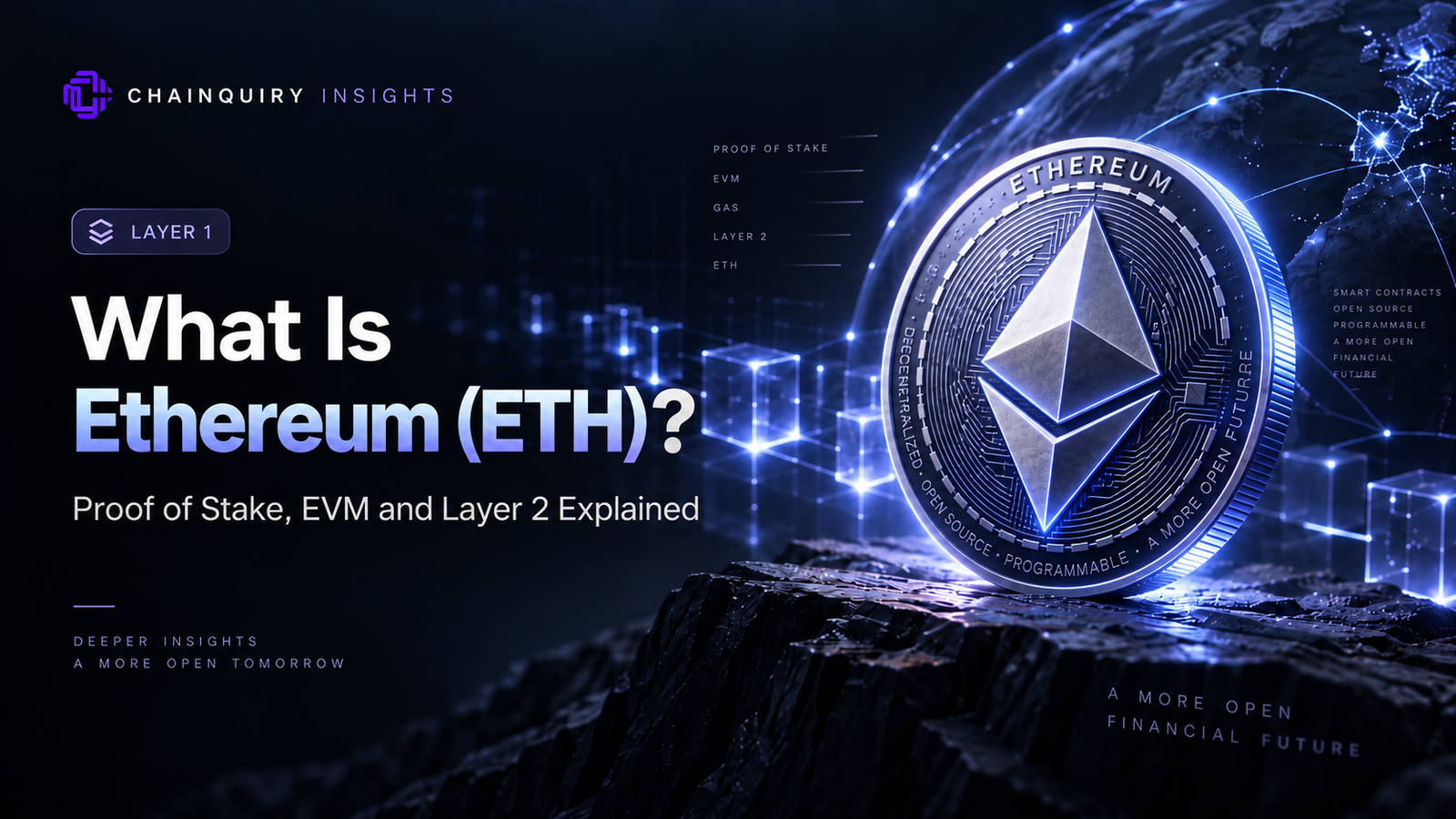
Ethereum is an open-source Layer 1 blockchain designed to run programmable applications and transfer digital assets without relying on a single central operator.
Its native cryptocurrency is ether, commonly identified by the ticker ETH.
Ethereum introduced a general-purpose blockchain environment in which developers can deploy programs known as smart contracts. Those programs can power applications ranging from decentralized exchanges and lending markets to stablecoins, games, identity systems, prediction markets and digital collectibles.
The network launched on July 30, 2015.
Ethereum today is substantially different from the network that originally launched. Mining has been replaced by Proof of Stake, transaction fees use a burn mechanism, Layer 2 rollups handle increasing amounts of execution, and protocol upgrades continue to expand data capacity, validator functionality and account capabilities.
Understanding Ethereum therefore requires looking at both the base blockchain and the wider ecosystem built around it.
Ethereum vs ETH#
Ethereum is the blockchain network and computing platform.
ETH is its native asset.
ETH is used for several purposes:
paying transaction fees
staking to secure the network
transferring value
providing collateral
interacting with decentralized applications
settling activity across parts of the Ethereum ecosystem
The two names are often used interchangeably in casual conversation, but they describe different things.
Ethereum is the network.
Ether, or ETH, is the network’s native currency.
When Did Ethereum Launch?#
The idea for Ethereum was proposed by Vitalik Buterin in 2013.
A wider founding group later helped develop and launch the project, including contributors such as Gavin Wood, Joseph Lubin, Jeffrey Wilcke and others.
Ethereum’s public crowdfunding campaign took place in 2014.
The main network launched on July 30, 2015, with the Frontier release and creation of the genesis block.
Ethereum initially used Proof of Work mining.
That consensus system remained in place until September 2022, when Ethereum completed The Merge and transitioned to Proof of Stake.
What Makes Ethereum Programmable?#
Bitcoin demonstrated that a decentralized blockchain could transfer and account for a native digital asset.
Ethereum expanded the model by introducing a general-purpose execution environment.
Developers can deploy programs to Ethereum and have network nodes execute those programs according to shared protocol rules.
This makes Ethereum more than a payment ledger.
The blockchain maintains a continuously updated state containing account balances, smart-contract code, contract storage and other network information.
Each valid transaction can modify that state.
What Is the Ethereum Virtual Machine?#
The Ethereum Virtual Machine, or EVM, is the execution environment responsible for running smart-contract code.
Every Ethereum node arrives at the same result when processing the same valid transactions because EVM execution follows deterministic protocol rules.
Developers typically write contracts using languages such as Solidity and compile them into EVM bytecode.
The EVM then executes that bytecode.
Operations performed by the EVM consume computational resources measured in units called gas.
This combination of shared execution, persistent state and economic resource pricing is central to Ethereum’s application model.
What Is a Smart Contract?#
A smart contract is a program deployed to an Ethereum address.
It can contain both code and stored data.
Users and other contracts interact with it by sending transactions or messages that call functions defined by the contract.
A smart contract can perform actions such as:
transferring tokens
checking ownership
managing collateral
executing trades
issuing assets
recording votes
distributing funds
interacting with other contracts
The term “smart contract” does not necessarily mean a legal contract between two people.
Technically, it is code executed through Ethereum according to predefined rules.
Ethereum Account Types#
Ethereum traditionally distinguishes between two main account types.
Externally owned accounts, or EOAs, are controlled through cryptographic keys.
Contract accounts are controlled by their deployed code.
An EOA can initiate a transaction.
A contract account normally acts in response to a transaction or call.
Both can hold ETH and interact with other accounts.
Ethereum’s account model is also evolving.
The Pectra upgrade introduced EIP-7702, which allows an EOA to delegate execution to deployed smart-contract code while retaining its existing address.
This can enable wallet features such as transaction batching, sponsored fees and more flexible account behavior while allowing users to continue using an existing address.
What Consensus Mechanism Does Ethereum Use?#
Ethereum uses Proof of Stake.
It no longer uses Proof of Work mining.
The transition occurred during The Merge on September 15, 2022.
Under Proof of Stake, validators lock ETH as economic collateral and participate in proposing and attesting to blocks.
Dishonest validator behavior can result in penalties or slashing.
This creates a financial cost for certain forms of protocol violation.
How Ethereum Validators Work#
Ethereum divides time into 12-second slots.
Each slot is an opportunity for a validator to propose a block.
Other validators attest to blocks and help the network agree on its canonical history.
Thirty-two slots form an epoch, lasting approximately 6.4 minutes.
Validators receive rewards for correctly performing protocol duties and can lose ETH for failing to participate or behaving improperly.
Simple downtime generally results in relatively small inactivity penalties rather than slashing.
Slashing is reserved for specific provably conflicting actions, such as signing contradictory blocks or attestations.
How Much ETH Is Required to Run a Validator?#
The minimum balance for an individual Ethereum validator remains 32 ETH.
Historically, the maximum effective balance on which a validator could earn rewards was also 32 ETH.
That changed with Pectra in May 2025.
Pectra introduced compounding validators using 0x02 withdrawal credentials.
These validators can have an effective balance between 32 ETH and 2,048 ETH, allowing rewards to compound without requiring operators to maintain a separate validator for every 32 ETH.
Traditional 0x01 validators remain capped at a 32 ETH effective balance and automatically receive excess rewards through withdrawal sweeps.
Running a validator also requires suitable hardware, internet connectivity and execution and consensus software.
Staking Without Running a Validator#
Someone does not necessarily need 32 ETH or their own validator infrastructure to gain exposure to Ethereum staking.
Third-party services and pooled staking systems can aggregate smaller deposits.
Liquid staking protocols may also issue tokens representing staked positions.
These approaches introduce additional risks that native solo staking does not have, including:
smart-contract risk
operator risk
governance risk
liquidity risk
token depeg risk
Users should distinguish Ethereum’s underlying staking protocol from applications built on top of it.
Does Ethereum Still Have Miners?#
No.
Proof-of-Work mining stopped securing Ethereum Mainnet when The Merge activated in September 2022.
Graphics cards and ASIC miners no longer produce Ethereum blocks or receive Ethereum mining rewards.
Block production is now performed by Proof-of-Stake validators.
Historical references to Ethereum mining describe the network before The Merge.
How Are Ethereum Transactions Confirmed?#
A user signs a transaction with the private key controlling their account and broadcasts it to the network.
Validators can include valid transactions in proposed blocks.
A new slot occurs every 12 seconds, although not every slot is guaranteed to contain a block.
Once included, additional blocks and validator attestations progressively increase confidence that a transaction will remain part of Ethereum’s canonical history.
Protocol finality occurs after validator consensus finalizes checkpoints rather than immediately at the instant a transaction first appears in a block.
Applications can choose different confirmation requirements depending on the amount of risk involved.
What Is Gas?#
Gas measures computational work on Ethereum.
Every operation has a gas cost.
A basic ETH transfer requires relatively little computation.
Executing a complex smart contract may require substantially more.
Users pay transaction fees in ETH based on the amount of gas consumed and the price paid for each unit of gas.
Gas prevents unlimited computation and makes it economically costly to flood the network with resource-intensive operations.
A transaction that runs out of gas or reverts can still consume a fee because network resources were used attempting to execute it.
How Ethereum Fees Work#
Ethereum’s fee system changed significantly with EIP-1559, activated through the London upgrade in 2021.
Transactions generally contain two important fee components.
The base fee is determined by the protocol according to network demand.
That base fee is burned, permanently removing the corresponding ETH from circulation.
Users can also include a priority fee, commonly called a tip, to incentivize block inclusion.
The resulting transaction cost changes continuously with network demand and the complexity of the operation.
There is therefore no fixed Ethereum transaction fee.
Does Ethereum Burn ETH?#
Yes.
EIP-1559 introduced a mechanism that permanently destroys the base-fee portion of Ethereum transaction fees.
This creates a supply-reducing force.
At the same time, the Proof-of-Stake protocol issues new ETH as validator rewards.
Ethereum’s net supply change is therefore determined by the interaction between:
new ETH issuance
and
ETH burned through transaction activity
During periods when issuance exceeds burning, total ETH supply grows.
When burning exceeds issuance, supply declines.
Ethereum should therefore not be described as permanently inflationary or permanently deflationary.
Its supply growth rate is dynamic.
Does ETH Have a Maximum Supply?#
No.
Ethereum does not have a fixed maximum supply comparable with Bitcoin’s 21 million BTC cap.
The protocol instead manages supply through issuance and burning.
Proof-of-Stake validator rewards create ETH.
EIP-1559 removes ETH.
Because both processes change with network conditions and staking participation, the total supply changes over time.
Ethereum’s total ETH supply is therefore a time-sensitive value rather than a permanent protocol limit.
Is ETH an ERC-20 Token?#
No.
ETH is Ethereum’s native asset.
ERC-20 is a smart-contract token standard used by assets deployed on Ethereum.
Examples of ERC-20 tokens can include stablecoins, governance tokens and application tokens.
Native ETH itself does not use an ERC-20 contract.
Wrapped Ether, or WETH, is an ERC-20-compatible representation of ETH frequently used by decentralized applications that expect ERC-20 functionality.
WETH should not be confused with native ETH even though users can commonly convert between the two at a one-to-one protocol-defined relationship.
What Are Ethereum Token Standards?#
Ethereum smart contracts allow developers to create assets using standardized interfaces.
ERC-20 is widely used for fungible tokens.
ERC-721 introduced a standard commonly associated with non-fungible tokens.
ERC-1155 supports contracts capable of managing multiple token types.
These standards help wallets, exchanges and applications interact with tokens in consistent ways.
The existence of a token standard does not imply that Ethereum itself endorses a token or guarantees its value or security.
Anyone can potentially deploy a smart contract.
Ethereum and Decentralized Finance#
Ethereum became a major foundation for decentralized finance, commonly called DeFi.
Smart contracts can be used to build financial applications for activities such as:
trading
lending
borrowing
stablecoins
derivatives
collateral management
asset issuance
liquidity provision
These applications can interact with each other because many Ethereum protocols use compatible token and contract standards.
This composability is one of Ethereum’s defining characteristics.
It also creates dependencies.
A vulnerability in one protocol can affect other applications that rely on it.
Ethereum and Stablecoins#
A substantial amount of stablecoin infrastructure operates on Ethereum and Ethereum-compatible networks.
Stablecoins are tokens designed to reference another asset, commonly a fiat currency such as the U.S. dollar.
Ethereum provides the smart-contract environment through which those tokens can be issued and transferred.
The issuer, reserve model and administrative controls of a stablecoin remain separate from Ethereum itself.
Using an Ethereum token does not make that token decentralized.
Ethereum and NFTs#
Ethereum also helped popularize non-fungible tokens.
NFTs can represent distinct blockchain records associated with artwork, game items, memberships, credentials, domain names and other forms of digital ownership or access.
The blockchain records the token and its ownership state.
Images or other associated content may be stored separately depending on the project.
Owning an NFT also does not automatically transfer copyright or other legal rights unless separate terms specify that relationship.
Why Does Ethereum Need Layer 2 Networks?#
Ethereum Mainnet prioritizes properties such as decentralized verification and security.
That limits how much computation and data can be processed directly on Layer 1 without increasing the hardware requirements for network participants.
High demand can therefore make Layer 1 transactions expensive.
Ethereum’s current scaling strategy relies heavily on Layer 2 systems, especially rollups.
Rollups execute many transactions outside Ethereum Mainnet and then use Ethereum for settlement, verification or data availability.
This allows more user activity to be processed while reducing the amount of Layer 1 work required per individual transaction.
What Are Rollups?#
Rollups bundle large numbers of transactions and submit information about them to Ethereum.
Two major categories are optimistic rollups and zero-knowledge rollups.
Optimistic rollups generally assume submitted state changes are valid unless challenged according to the rollup’s dispute mechanism.
Zero-knowledge rollups submit cryptographic proofs that demonstrate the validity of their state transitions.
The precise security model differs between systems.
Users should not assume every network marketed as an Ethereum scaling chain has identical trust assumptions.
What Are Blobs?#
The Dencun upgrade activated in March 2024 and introduced EIP-4844, commonly known as Proto-Danksharding.
EIP-4844 added a temporary data format called blobs.
Rollups can use blobs to publish data more cheaply than storing the same information permanently through conventional transaction calldata.
Blob data is available long enough for the network and rollup systems to verify it and is later pruned.
This made data availability for Layer 2 rollups significantly more efficient.
What Did Fusaka Change?#
Ethereum’s Fusaka upgrade activated on December 3, 2025.
Its headline scaling feature was PeerDAS, or Peer Data Availability Sampling.
Before PeerDAS, nodes dealing with blob data had greater requirements to obtain complete data.
PeerDAS distributes blob-data responsibilities so nodes can sample portions of the available data while the protocol maintains confidence that the complete data is recoverable.
This substantially increases the amount of blob data Ethereum can support without requiring every validator to download every piece in full.
For users, the significance is mainly indirect.
More data capacity gives Layer 2 rollups additional room to scale.
What Did Pectra Change?#
Pectra activated on Ethereum Mainnet on May 7, 2025.
It combined changes to Ethereum’s execution and consensus layers.
Important additions included:
EIP-7702 for more capable externally owned accounts
EIP-7251 increasing the optional validator maximum effective balance to 2,048 ETH
changes improving validator deposits, exits and withdrawal behavior
additional blob capacity
Together, these changes improved wallet design possibilities, validator operations and Layer 2 data availability.
Pectra did not replace Ethereum’s Proof-of-Stake consensus.
It extended the network’s existing architecture.
What Is the Difference Between Ethereum Layer 1 and Layer 2?#
Ethereum Mainnet is Layer 1.
Its validators maintain consensus and execute the core Ethereum protocol.
Layer 2 systems process activity separately and connect back to Ethereum in different ways.
A rollup transaction is therefore not literally being executed inside Ethereum Mainnet’s EVM at the same moment as an ordinary Layer 1 transaction.
The rollup has its own execution environment, operators and protocol rules.
It then uses Ethereum for functions such as settlement, proofs or data availability.
Users should understand the specific Layer 2 they are using rather than treating every Ethereum-connected network as identical to Mainnet.
Are Sidechains the Same as Ethereum Layer 2?#
Not necessarily.
A network can be compatible with Ethereum’s EVM without inheriting Ethereum’s consensus security.
Sidechains can operate their own validator or consensus systems while supporting Ethereum-compatible applications.
Rollups are designed to derive important security properties from Ethereum.
This distinction affects bridge assumptions, transaction finality, data availability and what could happen if a network’s operators fail.
EVM compatibility alone does not make a blockchain an Ethereum Layer 2.
Who Controls Ethereum?#
Ethereum does not have a CEO or single organization with unilateral control over the blockchain.
The Ethereum Foundation supports research, development, grants and ecosystem coordination, but it is not the owner of the network.
Protocol changes are proposed publicly through processes that include Ethereum Improvement Proposals, research discussions, client development and coordination among network participants.
Ultimately, software changes only become part of Ethereum when compatible clients and ecosystem participants adopt them sufficiently for the network to activate the upgrade.
Influence is not distributed perfectly evenly.
Researchers, client teams, application developers, node operators, validators, infrastructure providers and large ecosystem organizations can have different levels of practical influence.
That is different from one company possessing an administrative key capable of rewriting Ethereum’s protocol state.
What Are Ethereum Clients?#
Ethereum is a protocol rather than one piece of software.
Independent software implementations called clients allow nodes to participate in the network.
Modern Ethereum nodes generally operate both:
an execution client
and
a consensus client
Execution clients process transactions and maintain Ethereum’s execution state.
Consensus clients participate in Proof-of-Stake consensus.
Multiple independent client implementations reduce reliance on one software codebase.
Client diversity matters because a severe bug affecting one dominant implementation can create broader network risk.
Can Ethereum Transactions Be Reversed?#
Ethereum transactions are generally irreversible once finalized through the protocol.
There is no universal Ethereum customer-support department capable of undoing a mistaken transfer.
Smart contracts may themselves contain administrative, upgrade or recovery mechanisms, depending on their design.
Centralized exchanges may also control transactions within their own internal systems.
Those application-level controls should not be confused with Ethereum base-layer transaction reversibility.
Users should verify addresses, networks and contract interactions before signing transactions.
Is Ethereum Private?#
No.
Ethereum Mainnet is a public blockchain.
Transactions, account addresses, contract interactions and balances can generally be inspected through blockchain explorers.
Addresses are pseudonymous rather than automatically tied to real-world names at the protocol level.
However, transaction patterns and information obtained from exchanges or other services can sometimes link blockchain activity to identifiable individuals or organizations.
Users should not assume that using Ethereum provides financial anonymity.
What Are the Main Risks of Using Ethereum?#
Ethereum’s base protocol is only one part of the risk users encounter.
Smart contracts can contain vulnerabilities.
Wallet keys can be lost or stolen.
Fraudulent tokens and applications can imitate legitimate projects.
Layer 2 networks can introduce sequencer, proof-system, bridge or governance assumptions.
Cross-chain bridges can create additional security dependencies.
Stakers can face downtime penalties or, for certain protocol violations, slashing.
Transaction fees can also rise when Layer 1 demand increases.
Ethereum being decentralized does not make every application built on Ethereum decentralized or safe.
Ethereum’s Upgrade Model#
Ethereum is not a finished protocol.
It changes through planned network upgrades.
Major upgrades over recent years include:
The Merge in 2022, which completed the move to Proof of Stake
Shapella in 2023, which enabled staking withdrawals
Dencun in 2024, which introduced blobs through EIP-4844
Pectra in 2025, which expanded validator and account capabilities
Fusaka in 2025, which introduced PeerDAS and expanded scaling capacity
Further protocol development continues across execution, consensus, user experience, security and scaling.
Future roadmap features remain subject to research, testing and community coordination until activated on Mainnet.
Why Ethereum Matters to the Wider Crypto Ecosystem#
Ethereum helped establish the programmable blockchain model now used across much of the cryptocurrency industry.
Concepts popularized through its ecosystem include:
general-purpose smart contracts
fungible token standards
NFT standards
decentralized exchanges
permissionless lending
on-chain stablecoins
DAOs
rollup-based scaling
Ethereum’s technology has also influenced numerous other blockchains and EVM-compatible networks.
That historical influence does not mean Ethereum is the only platform capable of these functions.
Other Layer 1 and Layer 2 systems make different trade-offs around throughput, hardware requirements, execution design, governance and interoperability.
How to Research Ethereum Independently#
Ethereum’s technical documentation is publicly available.
Useful primary resources include ethereum.org, the Ethereum Foundation blog, the EIP repository, public client repositories and network explorers.
When reading older Ethereum material, check the publication date.
Descriptions involving GPU mining, proof-of-work rewards, locked staking withdrawals or a 32 ETH maximum effective balance may describe earlier versions of the protocol.
Ethereum has undergone several major upgrades, so current documentation is important when verifying technical details.
For structured network information and official resources, see the Ethereum (ETH) profile on Chainquiry.
Final Perspective#
Ethereum is best understood as a programmable Proof-of-Stake blockchain rather than simply a cryptocurrency.
ETH is the native asset that pays for execution and provides economic collateral for validators.
The EVM gives developers a common environment for running smart contracts, while Ethereum’s public state allows applications and assets to interact with one another.
Since The Merge, validators rather than miners secure the network.
EIP-1559 combines ETH issuance with fee burning, producing a dynamic supply rather than a fixed maximum.
At the same time, Ethereum increasingly relies on Layer 2 rollups for scaling.
Dencun introduced blobs for cheaper rollup data, Pectra expanded account and validator capabilities, and Fusaka introduced PeerDAS to increase data availability capacity.
That architecture creates a system consisting not only of Ethereum Mainnet but also of smart contracts, wallets, validators, rollups and applications built around it.
Each layer has its own capabilities and risks.
Understanding those distinctions provides a more accurate picture of modern Ethereum than treating ETH solely as the world’s second-largest cryptocurrency.