
Layer 1 PoW / PoS
Aetheris AETH
Open-source Layer 1 blockchain combining Scrypt Proof of Work and Proof of Stake, with self-custody wallet software and public network…
9 official links Reviewed Sep 2026
StatusLive
LaunchedDec 2025
NetworkAetheris
Open-source Layer 1 blockchain powering smart contracts, decentralized applications and digital assets through Proof-of-Stake consensus.
Overview
Ethereum (ETH) is an open-source Layer 1 blockchain and programmable platform designed for smart contracts and decentralized applications. The concept was proposed by Vitalik Buterin in 2013, and Ethereum mainnet officially launched on 30 July 2015.
ETH, or ether, is the native asset of the Ethereum network. It is used to pay transaction fees known as gas, secure the network through staking and interact with applications and smart contracts across the Ethereum ecosystem.
Ethereum uses Proof-of-Stake consensus. Validators stake ETH to participate in block validation and network security, replacing the Proof-of-Work mining system used by Ethereum before The Merge in September 2022.
The Ethereum Virtual Machine (EVM) provides a general-purpose execution environment for smart contracts. Ethereum supports a large ecosystem spanning decentralized finance, stablecoins, NFTs, gaming, decentralized organizations and other blockchain-based applications. A growing ecosystem of Layer 2 networks also extends Ethereum by processing transactions outside the main execution layer while settling back to Ethereum.
ETH does not have a fixed maximum supply. New ETH is issued as validator rewards while a portion of transaction fees is permanently burned under EIP-1559. As a result, total ETH supply is dynamic and can increase or decrease depending on network issuance and activity.
Ethereum is decentralized and does not have a CEO or single controlling organization. Protocol development is coordinated openly across developers, researchers, client teams and the wider Ethereum community, with organizations such as the Ethereum Foundation supporting ecosystem development.
Technology
Tokenomics
Chainquiry Insights
Explore how Ethereum works, from Proof of Stake and the EVM to smart contracts, gas, ETH supply, Layer 2 rollups, blobs and modern network upgrades.
Read the article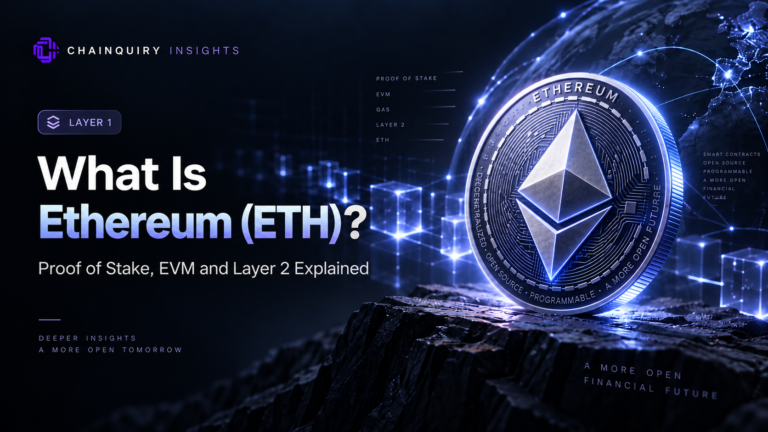
Reference material
EXPLORE MORE
Open-source Layer 1 blockchain combining Scrypt Proof of Work and Proof of Stake, with self-custody wallet software and public network…

Sharded Proof-of-Work Layer 1 with BlockFlow scaling, Ralph smart contracts, Blake3 mining and the native ALPH coin.

Permissionless Layer 1 blockchain using Pure Proof-of-Stake consensus for fast, low-cost transactions and smart contract execution.
PROJECT PULSE
The Chainquiry profile review date was updated to 2026-09-22.
Chainquiry project profile ↗The listed discord invite destination has changed.
Discord invite ↗A new block explorer has been added to the project profile.
Block explorer ↗Network changed from “not set” to “Ethereum”.
Chainquiry project profile ↗The listed github repository destination has changed.
GitHub repository ↗Get important project changes by email. No account is required for a single-project watch.
Want a full watchlist and notification history? Create a free account.