Quantum computing represents one of the most significant long-term challenges to the cryptographic systems that secure digital assets. While most established cryptocurrencies rely on signature algorithms that could eventually become vulnerable to sufficiently powerful quantum computers, a growing number of blockchain projects are exploring alternatives.
Soqucoin (SOQ) takes a particularly direct approach: instead of planning to introduce post-quantum signatures through a future network upgrade, it builds them into the blockchain’s transaction architecture from the beginning.
On October 13, 2026, Soqucoin reached its scheduled mainnet launch, marking its transition from development and stagenet testing to a publicly observable production blockchain. Its official explorer now reports live blocks, native SOQ issuance and an operating mainnet node.
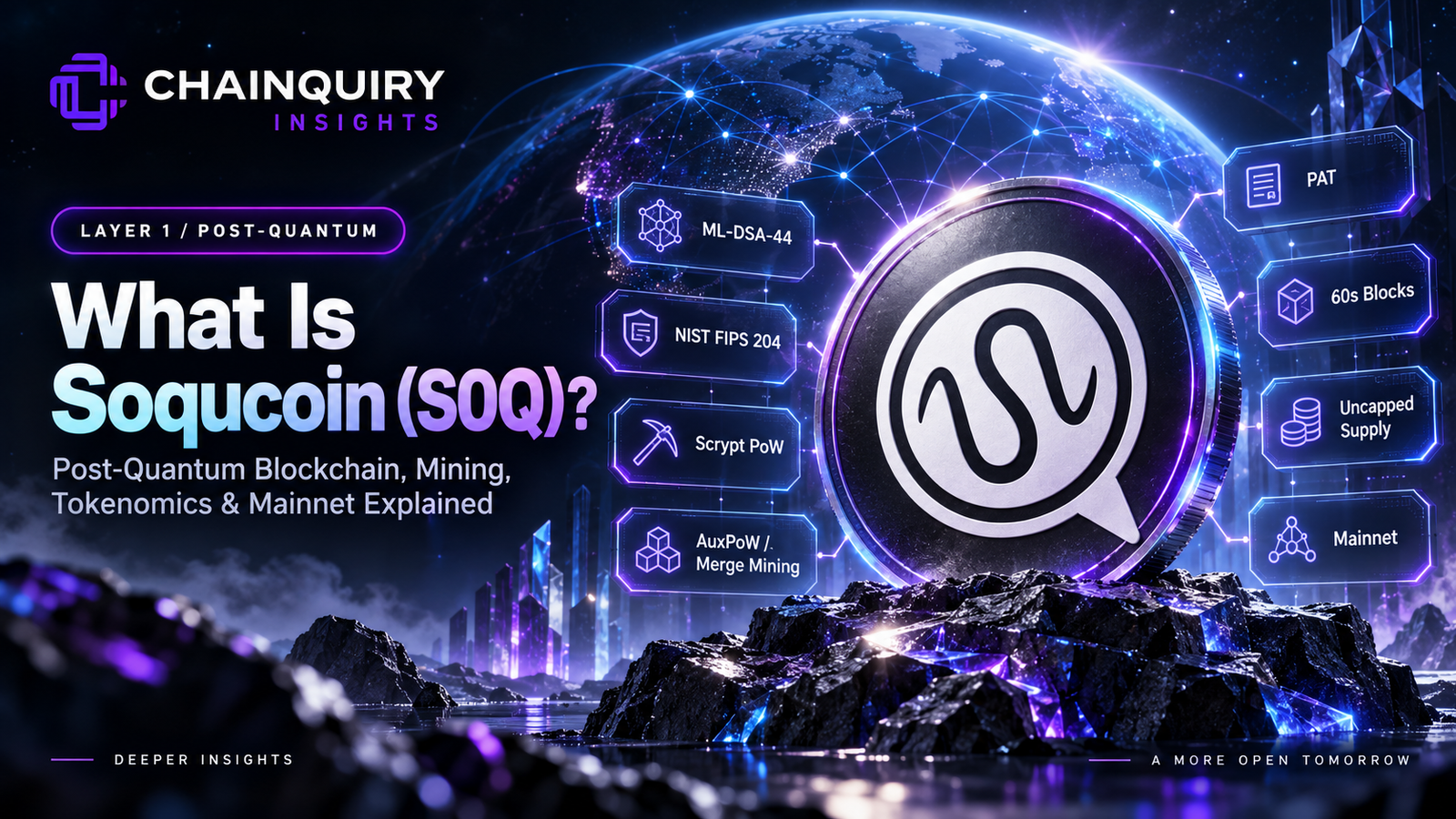
The network combines NIST-standardized ML-DSA-44 digital signatures, Scrypt Proof of Work, Auxiliary Proof of Work (AuxPoW) merge mining, and a native cryptocurrency called SOQ. It also introduces mechanisms for signature attestation and limits on deep blockchain reorganizations.
But what does post-quantum security actually mean for cryptocurrency users? How does Soqucoin compare with Bitcoin and Dogecoin? Can existing Scrypt miners participate, and what should readers understand about its tokenomics, initial distribution and security assessments?
This Chainquiry research guide examines Soqucoin’s architecture, mining model, emission schedule, ecosystem, independent security reviews and October 2026 mainnet status using publicly available technical documentation and primary sources.
For network specifications and official links, explore the Soqucoin (SOQ) project profile on Chainquiry.
What Is Soqucoin (SOQ)?#
Soqucoin is an open-source Layer 1 cryptocurrency designed around post-quantum transaction authentication.
Like Bitcoin and Dogecoin, Soqucoin uses Proof of Work to validate blocks, maintain a shared transaction history and distribute newly issued coins to miners.
Its main difference is the cryptography used to authorize transactions.
Many established cryptocurrency systems rely on elliptic-curve digital signatures, including ECDSA and Schnorr signatures. Soqucoin instead uses ML-DSA-44, a lattice-based digital signature algorithm standardized by the US National Institute of Standards and Technology (NIST).
SOQ is the native asset of the Soqucoin blockchain. It is used for transactions, network fees and mining rewards.
Importantly, Soqucoin is not an ERC-20 token or a cryptocurrency operating on another blockchain. It maintains its own network, consensus rules, genesis block, address format and monetary policy.
The project’s software architecture is derived from Dogecoin Core, but its implementation introduces substantial changes to transaction signing and other consensus-related mechanisms.
Its central design principle is that post-quantum authentication should be a foundational property of the network rather than something introduced after quantum-related threats become urgent.
Soqucoin at a Glance#
| Feature | Details |
|---|---|
| Project | Soqucoin |
| Ticker | SOQ |
| Blockchain | Independent Layer 1 |
| Consensus | Proof of Work |
| Mining algorithm | Scrypt |
| Merge mining | AuxPoW with compatible LTC/DOGE infrastructure |
| Signature algorithm | ML-DSA-44 (Dilithium) |
| Cryptographic standard | NIST FIPS 204 |
| Target block time | 60 seconds |
| Initial block subsidy | 100,000 SOQ |
| Maximum supply | Unlimited |
| Long-term block subsidy | 2,500 SOQ |
| Mainnet launch | October 13, 2026 |
| Network status | Mainnet live as of October 15, 2026 |
| Source code | Open source, MIT license |
These specifications describe the published protocol design. Actual network statistics and infrastructure availability may change.
Is Soqucoin Mainnet Live? October 2026 Launch Update#
Yes. Soqucoin’s mainnet is now live.
The network launched on October 13, 2026, following an earlier target of October 8.
The launch marked the transition from public stagenet testing toward production operation with native SOQ transactions, real mining rewards and a publicly accessible blockchain explorer.
Rather than relying exclusively on a launch announcement, Chainquiry reviewed the project’s live blockchain information.
What Does the Soqucoin Mainnet Explorer Show?#
During Chainquiry’s October 15, 2026 review, the official Soqucoin blockchain explorer reported the following network information:
| Network metric | October 15, 2026 snapshot |
|---|---|
| Network identifier | main |
| Block height | 2,208 |
| Reported total issued supply | Approximately 549.13 million SOQ |
| Node software | Soqucoin Core 2.5.1 |
| Connected peers | 19 |
| Node synchronization | Synchronized |
The explorer also displayed recently mined blocks and transaction records, providing observable evidence of production blockchain activity.
These statistics are a historical snapshot rather than permanently fixed values. Block height, reported supply, difficulty and peer connections can change continuously.
The peer count represents connections reported by the observed explorer node, not a verified count of all active nodes across the network.
Readers can examine the latest information through the mainnet explorer and its node details page.
Why Is the Mainnet Launch Important?#
A functioning mainnet represents an important transition for any blockchain project.
Before launch, development activity, documentation and test environments provide information about intended functionality. After launch, users and researchers can begin examining the network’s actual behavior.
For Soqucoin, this includes:
- Production block generation and observable chain history.
- Native SOQ issuance under the protocol’s mining reward rules.
- Mainnet transaction processing and signature validation.
- Publicly accessible block and network statistics.
- Initial operation of supported mining infrastructure.
This creates an opportunity to evaluate how the network performs outside controlled testing environments.
However, live block production alone does not establish long-term reliability, decentralization or resistance to every possible attack.
Those properties depend on sustained network operation, participating hashpower, node availability, software quality and the broader security of the ecosystem.
Why Do Some Official Pages Still Mention Stagenet?#
During this review, certain official pages and technical documents continued to describe Soqucoin as pre-mainnet or referenced its earlier launch schedule.
Those statements conflict with the operating mainnet information visible in the project’s public explorer.
This appears consistent with documentation that has not yet been fully updated after launch.
For current operational status, readers should prioritize the live blockchain data while recognizing that explorer information is itself supplied by project-associated infrastructure.
Chainquiry’s review confirms the availability of public mainnet data. It does not represent independent full-node validation or a comprehensive consensus audit.
Why Is Post-Quantum Security Important for Cryptocurrency?#
Modern cryptocurrencies rely on cryptography to establish ownership and authorize transactions.
Public-key signature systems allow users to demonstrate that they control a corresponding private key without revealing that private key publicly.
Bitcoin, for example, uses elliptic-curve cryptography for transaction authorization.
These algorithms are believed to be secure against known practical attacks using conventional computers when properly implemented.
Quantum computing introduces a different category of concern.
A sufficiently powerful, fault-tolerant quantum computer running Shor’s algorithm could solve certain mathematical problems underlying widely used public-key systems far more efficiently than classical computers.
This could eventually threaten exposed public keys associated with vulnerable digital signature schemes.
Importantly, today’s quantum computers are not known to possess the practical capability required to compromise Bitcoin’s cryptography at scale.
Building sufficiently powerful and reliable quantum computers remains an enormous technical challenge.
Nevertheless, the theoretical vulnerability motivates research into systems that can remain secure under stronger future computing capabilities.
Cryptocurrency networks broadly have several possible responses:
- Upgrade existing signature systems through future protocol changes.
- Introduce hybrid signing mechanisms combining classical and post-quantum cryptography.
- Design new networks around post-quantum signatures from the beginning.
Soqucoin follows the third approach.
Rather than depending on a future migration away from elliptic-curve transaction signatures, it adopts ML-DSA-44 as its native transaction authorization scheme.
This is the foundation of the project’s description of itself as post-quantum from genesis.
How Does Soqucoin Use ML-DSA-44 and Dilithium?#
ML-DSA stands for Module-Lattice-Based Digital Signature Algorithm.
It is standardized through NIST Federal Information Processing Standard 204, published in August 2024.
The algorithm is derived from CRYSTALS-Dilithium, a post-quantum signature system developed through NIST’s cryptographic standardization process.
Unlike conventional elliptic-curve signatures, ML-DSA relies on mathematical problems involving structured lattices.
No efficient quantum algorithm is currently known that defeats these underlying problems at the intended security levels.
Soqucoin uses the ML-DSA-44 parameter set, which corresponds to NIST security category 2.
Soqucoin’s Signature Specifications#
| Component | Specification |
|---|---|
| Digital signature | ML-DSA-44 |
| Algorithm family | Dilithium |
| Standard | NIST FIPS 204 |
| Security category | NIST Level 2 |
| Public key size | 1,312 bytes |
| Signature size | 2,420 bytes |
| Transaction model | UTXO |
According to the project’s cryptographic documentation, ML-DSA-44 replaces ECDSA in the transaction authorization path.
This distinction matters because changing a cryptocurrency’s mining algorithm or introducing a new wallet interface does not automatically provide post-quantum transaction security.
Protection depends on the cryptographic rules governing transaction authorization and whether those rules are correctly enforced by wallets, nodes and consensus software.
Does This Make Soqucoin Completely Quantum-Proof?#
Not necessarily.
ML-DSA-44 is designed to resist known classical and quantum attacks within its specified security model.
However, adopting a standardized algorithm does not automatically guarantee a secure implementation.
Possible vulnerabilities can still arise from:
- Incorrect cryptographic integration.
- Software implementation defects.
- Wallet and private-key management.
- Memory-safety or side-channel weaknesses.
- Network and consensus behavior.
- Future cryptanalytic developments.
Post-quantum signatures address a specific and important category of risk. They do not eliminate every security challenge facing a blockchain.
How Does Soqucoin Handle Larger Post-Quantum Signatures?#
A major challenge with post-quantum cryptography is efficiency.
The signatures used by ML-DSA-44 are considerably larger than conventional cryptocurrency signatures.
At approximately 2,420 bytes per signature, their use can increase transaction data requirements, blockchain storage, bandwidth consumption and verification workloads.
A blockchain that adopts post-quantum signatures must therefore consider more than cryptographic strength alone.
It must also manage the operational cost of using those signatures at scale.
What Is the Practical Attestation Technique (PAT)?#
Soqucoin has developed a mechanism called the Practical Attestation Technique (PAT).
According to the project’s technical specification, PAT uses Merkle-based commitments to represent batches of post-quantum signatures.
Its documentation describes a fixed 100-byte on-chain commitment associated with a signature batch.
However, there is an important technical distinction.
The compact commitment does not mean that the underlying ML-DSA-44 signatures are replaced by a 100-byte signature.
The original signatures remain in witness data and continue to require cryptographic verification.
PAT instead provides a compact commitment to information associated with verified signatures.
The documentation also describes how such commitments may support optional witness-data pruning after blocks pass the network’s finality horizon.
The potential benefit is reduced long-term storage requirements for participating nodes under specific conditions.
Whether those benefits translate into meaningful production efficiency depends on implementation correctness, network behavior and adoption of the relevant mechanisms.
PAT illustrates a broader engineering challenge for post-quantum blockchains: security improvements must remain compatible with practical transaction processing and manageable infrastructure costs.
How Does Soqucoin Mining Work?#
Soqucoin uses Scrypt Proof of Work, the same general mining algorithm family used by Litecoin and Dogecoin.
In Proof of Work, miners perform computational work to discover blocks satisfying the network’s difficulty requirements.
Other nodes independently verify submitted blocks and enforce the blockchain’s transaction and monetary rules.
Soqucoin targets an average block interval of approximately 60 seconds.
The network initially issues 100,000 SOQ as a scheduled subsidy per block, with reductions occurring at predetermined heights.
Can Existing Scrypt Mining Hardware Mine Soqucoin?#
Soqucoin’s design allows compatibility with existing Scrypt mining hardware.
The project’s mining documentation identifies ASIC equipment such as the Antminer L7, L9 and L11 as examples of compatible hardware.
This is significant because the network does not require an entirely new mining algorithm or a new category of ASIC equipment.
Existing operators may be able to participate through supported mining infrastructure without changing their hardware.
However, hardware compatibility does not mean that any miner can connect to any pool and immediately receive SOQ.
Mining participation depends on pool support, accepted account access, network configuration and operational availability.
Is Soqucoin Mining Profitable?#
Profitability cannot be determined from the nominal SOQ block reward alone.
Important factors include electricity prices, mining difficulty, participating hashpower, hardware efficiency, pool fees, operating expenses, payout rules and the market value or liquidity of SOQ.
For merge miners, the additional SOQ rewards may provide another revenue component alongside existing Scrypt mining operations.
However, additional token issuance does not guarantee profitable mining.
Actual performance should be assessed using current network conditions and verified pool statistics.
What Is Soqucoin AuxPoW and Merge Mining?#
One of Soqucoin’s important design decisions is its support for Auxiliary Proof of Work, commonly abbreviated as AuxPoW.
AuxPoW allows compatible blockchain networks to share underlying mining work.
This arrangement is commonly known as merge mining.
For Soqucoin, the objective is to make the network compatible with Litecoin and Dogecoin mining infrastructure.
A participating mining pool can coordinate work across supported networks, allowing miners to contribute toward more than one blockchain without operating separate sets of mining equipment.
Does Merge Mining Combine Litecoin, Dogecoin and Soqucoin?#
No.
The networks remain independent.
Litecoin, Dogecoin and Soqucoin maintain separate transaction histories, blockchains, currencies, monetary policies and consensus rules.
Merge mining concerns the reuse of compatible Proof-of-Work computations rather than combining the networks into a single blockchain.
According to the project’s AuxPoW documentation, support is designed into Soqucoin from genesis.
This potentially reduces the infrastructure barrier for established Scrypt mining operators.
However, merge mining should not automatically be interpreted as giving Soqucoin the same economic security as Litecoin or Dogecoin.
Real security depends on the amount and distribution of participating hashpower, pool adoption, consensus behavior and network connectivity.
Readers interested in the broader Scrypt ecosystem can also explore Chainquiry’s Dogecoin research guide.
Soqucoin Tokenomics: Supply, Block Rewards and Inflation#
Soqucoin uses a scheduled Proof-of-Work emission model with several reductions in block subsidies followed by permanent ongoing issuance.
Unlike Bitcoin, SOQ does not have a fixed maximum supply.
The network begins with relatively high mining subsidies before transitioning through several lower-reward periods.
Eventually, it adopts a perpetual block reward intended to continue supporting mining participation.
SOQ Block Reward and Emission Schedule#
According to the official tokenomics documentation and the live emission explorer, the scheduled mining issuance is:
| Block range | Reward per block | Cumulative scheduled mining issuance |
|---|---|---|
| 0–249,999 | 100,000 SOQ | Approximately 25 billion SOQ |
| 250,000–499,999 | 50,000 SOQ | Approximately 37.5 billion SOQ |
| 500,000–749,999 | 25,000 SOQ | Approximately 43.75 billion SOQ |
| 750,000–999,999 | 12,500 SOQ | Approximately 46.875 billion SOQ |
| 1,000,000 onward | 2,500 SOQ | Perpetual additional issuance |
The first four mining epochs cover approximately one million blocks.
At the target block interval of 60 seconds, this corresponds to roughly 1.9 years.
During those four epochs, the scheduled mining subsidies total approximately 46.875 billion SOQ.
Following the fourth epoch, the subsidy decreases to 2,500 SOQ per block indefinitely.
At an average of one block per minute, the perpetual subsidy corresponds to approximately 1.314 billion newly issued SOQ annually.
The cumulative figures describe the scheduled mining subsidy and should not be confused with the separately disclosed genesis migration allocation.
Does Soqucoin Have a Maximum Supply?#
No.
SOQ has an uncapped maximum supply because its perpetual mining subsidy continues indefinitely.
The amount of newly issued SOQ becomes smaller relative to total supply as the outstanding supply grows, assuming the network continues operating under its published issuance rules.
The purpose of continuing issuance is to maintain economic incentives for miners rather than eventually relying exclusively on transaction fees.
This model differs from Bitcoin’s fixed maximum supply of 21 million BTC.
Soqucoin should therefore not be characterized as a fixed-supply or inherently deflationary cryptocurrency.
Its long-term economics depend on issuance, demand, network activity, miner behavior and market conditions.
Does Soqucoin Have a Premine or Team Allocation?#
The Soqucoin Foundation describes its distribution philosophy as having no founder premine, development tax or reserved insider allocation.
However, the network’s initial supply also includes a separately disclosed one-time pSOQ migration allocation.
The Foundation finalized an allocation of 328,627,412.935409 SOQ across 70 eligible addresses following the migration window.
The project’s mainnet blockchain information records this genesis migration allocation at block 1.
These coins relate to the earlier pSOQ migration process and are separate from the ordinary schedule of newly mined SOQ rewards.
Consequently, the Foundation’s no-founder-premine description should be evaluated alongside the disclosed migration allocation.
Readers assessing initial distribution should examine both the mining issuance and the genesis allocation rather than interpreting the scheduled mining supply as the complete initial monetary record.
The Foundation provides the underlying migration data and technical references through its official migration record.
What Is pSOQ, and How Is It Different From Native SOQ?#
Soqucoin has an associated token called pSOQ on the Solana blockchain.
Although the names are related, pSOQ and native SOQ are not the same asset.
Native SOQ operates on Soqucoin’s independent Layer 1 blockchain.
pSOQ exists on Solana and was involved in a one-time migration process preceding the Soqucoin mainnet launch.
When Did the pSOQ Migration Take Place?#
The Foundation documented a migration window running from September 29 to October 5, 2026.
Eligible participants followed a process involving their existing Solana wallets, with the resulting allocations recorded for the new native blockchain.
Following the closure of that window, the Foundation published the finalized allocation dataset.
The final record identified 70 eligible addresses and a total allocation of approximately 328.63 million SOQ.
These allocations were included as part of the mainnet’s initial monetary distribution.
Can pSOQ Still Be Migrated to SOQ?#
According to the Foundation, the migration process is closed and will not reopen.
It should not be confused with a permanent cross-chain bridge or an ongoing token swap.
The Foundation states that burning pSOQ after the window’s closure does not create a new native SOQ allocation.
Users should be cautious of websites, messages or individuals claiming that the migration can still be completed through unofficial services.
The authoritative technical record is available at soqucoin.org/migration.
Has Soqucoin Been Audited? Reviewing the Halborn Security Assessments#
Independent security reviews are particularly important when a blockchain introduces new cryptographic systems, transaction validation rules and consensus-related modifications.
Soqucoin commissioned Halborn to assess selected components of its blockchain software and post-quantum infrastructure.
The principal blockchain node assessment took place between February 17 and March 24, 2026.
What Did the Halborn Blockchain Node Audit Find?#
The published Halborn assessment identified 30 findings across the examined components.
| Severity | Findings |
|---|---|
| Critical | 3 |
| High | 1 |
| Medium | 3 |
| Low | 3 |
| Informational | 20 |
| Total | 30 |
The published report lists all 30 findings as solved.
The review covered selected areas of the codebase, including post-quantum cryptographic implementations, wallet encryption, key management and block validation logic.
Some findings involved security-sensitive issues affecting cryptographic and wallet functionality.
Their identification and reported remediation are relevant to evaluating the project’s development process.
A separate Halborn blockchain architecture assessment documented six resolved findings in a narrower review.
Does a Completed Audit Guarantee Security?#
No.
A security assessment applies to the code, components and testing period within its published scope.
It does not guarantee that every component of a blockchain is free of vulnerabilities.
Changes introduced after an assessment, external dependencies, network operating conditions and previously undiscovered weaknesses can all create additional risks.
This is particularly relevant for a newly launched mainnet, where software begins operating under real production conditions.
The published Halborn reports provide useful external evidence about identified vulnerabilities and remediation work.
They should be considered alongside continuing code review, reliable network operation and further security assessments as the software evolves.
Soqucoin’s 288-Block Finality Rule#
Soqucoin also introduces a consensus-level mechanism intended to limit deep blockchain reorganizations.
Traditional Proof-of-Work blockchains generally provide increasing confidence in a transaction as additional blocks are built on top of it.
However, sufficiently strong competing chains may sometimes replace earlier portions of blockchain history.
Soqucoin’s published design introduces a bounded-reorganization rule.
How Does the 288-Block Rule Work?#
According to the project’s finality documentation, synchronized nodes reject chain reorganizations exceeding a depth of 288 blocks.
At the target interval of approximately one minute per block, this corresponds to roughly 4.8 hours.
The objective is to limit the replacement of deeply confirmed transaction history.
This is particularly relevant for smaller Proof-of-Work networks that may face risks involving concentrated or temporarily rented mining power.
What Are the Trade-Offs?#
Bounded reorganization introduces different operational assumptions from conventional Proof-of-Work finality.
For example, a prolonged network partition could result in separate groups of nodes producing conflicting histories.
If the divergence extends beyond the permitted reorganization depth, those histories may not automatically reconcile under the protocol’s normal rules.
Nodes that have remained disconnected for extended periods may also require reliable chain reference information when reconnecting.
Therefore, the mechanism should not be interpreted as eliminating all consensus or network risks.
It changes the conditions under which history can be reorganized, while introducing its own recovery and coordination considerations.
This illustrates a broader principle: blockchain security depends on more than digital signature cryptography alone.
Mining distribution, node connectivity, network recovery and consensus design are also essential.
Soqucoin Wallets, Mining Infrastructure and Ecosystem#
A technically capable blockchain still requires accessible software and dependable infrastructure.
Users need trustworthy wallets, miners need supported pools, developers need tools and node operators need maintained software.
Soqucoin has been building several components around its post-quantum Layer 1.
SoquShield Wallet#
SoquShield is presented as a self-custodial wallet designed around the project’s post-quantum signature system.
Its documentation describes on-device key management and support for the Soqucoin ecosystem.
Users should download wallet software only through verified official sources.
They should also confirm whether a particular wallet release supports native mainnet SOQ, stagenet assets or related tokens such as pSOQ.
Because the network has only recently entered production, wallet compatibility and release status deserve additional attention.
Recovery phrases and private keys should never be disclosed to websites or individuals offering migration, technical support or token recovery services.
SOQUPOOL Mining Infrastructure#
SOQUPOOL is mining infrastructure associated with Soqucoin’s Scrypt and AuxPoW ecosystem.
The service describes a unified mining workflow involving Litecoin, Dogecoin and SOQ, using compatible Scrypt mining hardware.
Its published operating model includes regional mining endpoints, account controls, PPLNS reward distribution and scheduled payouts.
The advertised standard pool fee is 1.69%, with a 1.50% lifetime effective rate for eligible founding accounts created before the mainnet launch.
The service currently describes operations through regional infrastructure in the United States, Germany and Singapore.
For SOQ payouts, its published minimum threshold is 100,000 SOQ.
An important distinction is that SOQUPOOL is not currently an unrestricted public mining pool.
The platform emphasizes application-based participation and operator-approved accounts.
Its Bronze starter option is currently paused for new registrations, while verified applications remain available.
The project’s own documentation identifies SOQUPOOL as its supported launch mining route, with broader pool integration and solo-mining support described as future developments.
Consequently, prospective miners should verify current access requirements, fee schedules, payout minimums and live operational status before allocating hardware.
The availability of existing Scrypt equipment makes the protocol accessible to established mining operators, but actual pool participation may remain restricted.
Developer SDK, RPC and Full Nodes#
Soqucoin publishes technical resources for developers and network operators.
These include developer documentation, RPC references, a TypeScript SDK and an in-browser development playground.
The project’s GitHub repository contains its open-source node implementation and associated technical materials.
These resources allow developers to review published specifications, experiment with supported features and investigate the software’s implementation.
For security-sensitive applications, developers should verify network configuration, release versions and the activation status of individual protocol features.
Soqucoin Foundation#
The Soqucoin Foundation is a nonprofit organization involved in protocol stewardship, research support, documentation and broader ecosystem development.
It maintains public information about the project’s distribution philosophy and the completed pSOQ migration process.
The Foundation’s organizational role should be distinguished from the independent activities of miners, wallet users and node operators.
Research: SoquObscura and Payment Channels#
Beyond its core blockchain, Soqucoin publishes research into additional functionality.
One example is SoquObscura, a proposed confidential-transaction system based on post-quantum cryptographic research.
Its documentation discusses LNP22/LaZer-related proof systems and LaBRADOR aggregation.
However, SoquObscura is not activated on the production network.
The project also describes experimental payment-channel mechanisms and other advanced blockchain features.
These initiatives remain distinct from the core mainnet’s currently operating functionality.
Similarly, the proposed USDSOQ stablecoin infrastructure is described as technology for licensed issuers rather than an active mainnet stablecoin.
Readers should distinguish research-stage concepts, stagenet demonstrations and deployed mainnet functionality.
A published technical design does not necessarily mean a feature is production-ready or independently audited.
What Makes Soqucoin Different From Bitcoin and Dogecoin?#
Soqucoin shares architectural characteristics with established Proof-of-Work networks while emphasizing a different cryptographic security model.
Soqucoin vs. Bitcoin#
Bitcoin uses SHA-256 Proof of Work and targets blocks approximately every ten minutes.
Its monetary policy has a fixed maximum supply of 21 million BTC.
Soqucoin uses Scrypt mining, targets one-minute blocks and follows an uncapped emission schedule with a perpetual subsidy.
Its signature architecture also differs substantially from Bitcoin’s existing transaction authorization systems.
Bitcoin has a much longer operational history, a vastly larger established mining ecosystem and extensive independent security research.
Soqucoin’s distinctive proposition is not that it has demonstrated superior overall security, but that post-quantum transaction authentication is central to its design from genesis.
For additional context, read What Is Bitcoin? on Chainquiry.
Soqucoin vs. Dogecoin#
Dogecoin and Soqucoin both use Scrypt Proof of Work and share compatibility with Auxiliary Proof-of-Work mining concepts.
However, Soqucoin introduces ML-DSA-44 transaction signatures, its own emission schedule and additional consensus mechanisms.
Dogecoin has accumulated years of mainnet operation, whereas Soqucoin entered production in October 2026.
Its long-term security and economic performance therefore remain far less established.
The key distinction is Soqucoin’s attempt to combine post-quantum transaction authentication with an existing category of mining infrastructure.
What Are the Risks and Challenges Facing Soqucoin?#
Soqucoin’s technical ambitions should be evaluated alongside the practical challenges of operating a new Layer 1 blockchain.
Cryptographic Implementation Risk#
Using a NIST-standardized algorithm is a meaningful foundation, but integration errors can still create weaknesses in signing, verification or key management.
The published security assessments demonstrate why continued technical review matters.
Early Mainnet Risk#
Soqucoin’s production network is still young.
Its long-term reliability, decentralization and infrastructure resilience have not yet been demonstrated across years of operation.
Stable block generation immediately after launch is encouraging but not sufficient to establish durability.
Mining Concentration Risk#
AuxPoW allows Soqucoin to use existing Scrypt mining infrastructure.
However, actual network security depends on who participates, how hashpower is distributed and which mining pools control block production.
Limited supported mining access can also create operational and decentralization trade-offs.
Consensus and Finality Trade-Offs#
The 288-block finality mechanism is intended to restrict deep reorganizations.
Nevertheless, prolonged partitions and disconnected nodes may introduce recovery challenges that require careful operational handling.
Tokenomics and Market Risk#
SOQ has a high initial nominal block subsidy and no fixed maximum supply.
Its monetary policy creates continuing issuance, while future demand, market liquidity and price performance remain uncertain.
The completed genesis migration also makes initial token distribution an important consideration.
Research-to-Production Risk#
Some of the project’s more advanced proposals, including confidential transactions and payment-channel systems, are not active production capabilities.
Their eventual deployment depends on additional engineering, testing and security work.
Wallet and Self-Custody Risk#
Users are responsible for managing private keys, recovery information and transaction destinations.
Mistakes, fraudulent software and misleading migration services can cause losses regardless of the blockchain’s signature algorithm.
These risks are not unique to Soqucoin, but they are particularly important when examining a recently launched cryptocurrency with emerging infrastructure.
Is Soqucoin Worth Watching After Mainnet?#
Soqucoin is a technically interesting example of how cryptocurrency developers are responding to the potential long-term effects of quantum computing.
Rather than relying entirely on promises of future cryptographic upgrades, it has implemented a blockchain architecture centered on post-quantum transaction authorization.
Its combination of ML-DSA-44 signatures, Scrypt mining, AuxPoW compatibility, signature attestation and bounded-reorganization finality creates a distinctive set of technical design choices.
The publication of source code, protocol documentation, Foundation migration records and independent security assessments also provides material for external research.
Its October 2026 mainnet launch adds another important element: publicly observable network activity.
Researchers can now examine live blocks and network behavior instead of relying exclusively on development milestones and test environments.
However, early mainnet activation does not establish long-term success.
Future evaluation should focus on network stability, participating mining power, independent node adoption, transaction activity, wallet reliability, software maintenance and progress toward practical ecosystem use.
Ultimately, Soqucoin’s value as blockchain infrastructure will depend on how well its technical design performs under sustained production conditions.
Frequently Asked Questions About Soqucoin#
What is Soqucoin?#
Soqucoin is a Proof-of-Work Layer 1 blockchain designed around post-quantum ML-DSA-44 digital signatures. Its native cryptocurrency is SOQ.
Is Soqucoin mainnet live?#
Yes. Soqucoin launched its mainnet on October 13, 2026. Its official blockchain explorer now reports live network activity, mined blocks and native SOQ issuance.
When did Soqucoin mainnet launch?#
The project’s scheduled mainnet activation took place on October 13, 2026, at 15:00 UTC. The operating mainnet was subsequently observable through its public explorer.
Is Soqucoin quantum-resistant?#
Soqucoin uses ML-DSA-44, a NIST-standardized digital signature algorithm designed to resist known quantum attacks. This does not guarantee that its software, wallets or surrounding infrastructure are immune to every security vulnerability.
What mining algorithm does Soqucoin use?#
Soqucoin uses Scrypt Proof of Work, targeting an average block interval of approximately 60 seconds.
Can Soqucoin be mined alongside Litecoin and Dogecoin?#
The protocol supports AuxPoW merge mining with compatible Litecoin and Dogecoin mining infrastructure. Actual participation depends on supported pools and their operating requirements.
What is SOQUPOOL?#
SOQUPOOL is a Scrypt merge-mining service supporting Litecoin, Dogecoin and SOQ. It publishes account eligibility requirements, PPLNS reward distribution, pool fees and payout conditions.
Does Soqucoin have a maximum supply?#
No. Soqucoin follows a declining block subsidy schedule before reaching a perpetual reward of 2,500 SOQ per block. Consequently, SOQ does not have a hard maximum supply.
Does Soqucoin have a premine?#
The Foundation states that it has no founder premine or reserved insider allocation. However, its mainnet also includes a separately disclosed genesis migration allocation of approximately 328.63 million SOQ distributed across 70 eligible addresses.
What is the difference between SOQ and pSOQ?#
SOQ is the native cryptocurrency of the Soqucoin Layer 1 blockchain. pSOQ is an associated token on Solana that participated in a completed one-time migration process.
Is the pSOQ migration still available?#
No. The official migration window closed on October 5, 2026. The Foundation states that the process will not reopen.
Has Soqucoin been audited?#
Yes. Halborn published security assessments covering selected areas of the project’s blockchain and cryptographic infrastructure. Its principal blockchain node report identified 30 findings, all listed as solved in the published assessment.
Where can I view Soqucoin transactions and blocks?#
The official blockchain explorer is available at xplorer.soqu.org.
Is Soqucoin an ERC-20 token?#
No. Native SOQ runs on an independent Layer 1 blockchain. It should not be confused with pSOQ, the associated token on Solana.
Final Perspective#
Soqucoin is attempting something more specific than introducing another Proof-of-Work cryptocurrency.
It is building a network in which post-quantum transaction authentication is part of the foundational protocol, while mining remains compatible with an established Scrypt hardware ecosystem.
The decision to use ML-DSA-44 from genesis is significant because upgrading cryptographic authorization rules on mature blockchains can create difficult technical and coordination challenges.
At the same time, Soqucoin’s broader approach involves trade-offs.
Larger post-quantum signatures create efficiency challenges. Merge-mining support introduces dependencies on actual pool adoption and hashpower participation. Its uncapped emission policy follows a different economic model from fixed-supply cryptocurrencies, while its bounded-reorganization rules introduce operational considerations.
The October 13, 2026 mainnet launch provides the first major opportunity to examine these decisions in production.
Early blockchain data confirms an operating network, but its long-term security, adoption and resilience remain open questions.
For researchers interested in post-quantum cryptocurrencies, Scrypt mining and emerging Proof-of-Work architectures, Soqucoin offers a project whose claims can increasingly be evaluated against live blockchain data.
Its next milestones will be measured not simply by announced features, but by sustained network reliability, independent technical verification, mining participation and the development of practical applications.
For ongoing research, visit the Soqucoin (SOQ) project listing on Chainquiry and monitor the official Soqucoin mainnet explorer.

Research note: Originally published October 8, 2026. Updated October 15, 2026, with live mainnet explorer data, operational network details, mining infrastructure information and the finalized pSOQ migration record. This is source-based editorial research, not an independent source-code audit or full-node validation. Soqucoin is a paid featured project on Chainquiry; factual claims and editorial assessments are presented with supporting references. Cryptocurrency participation involves risk. Always conduct your own research.