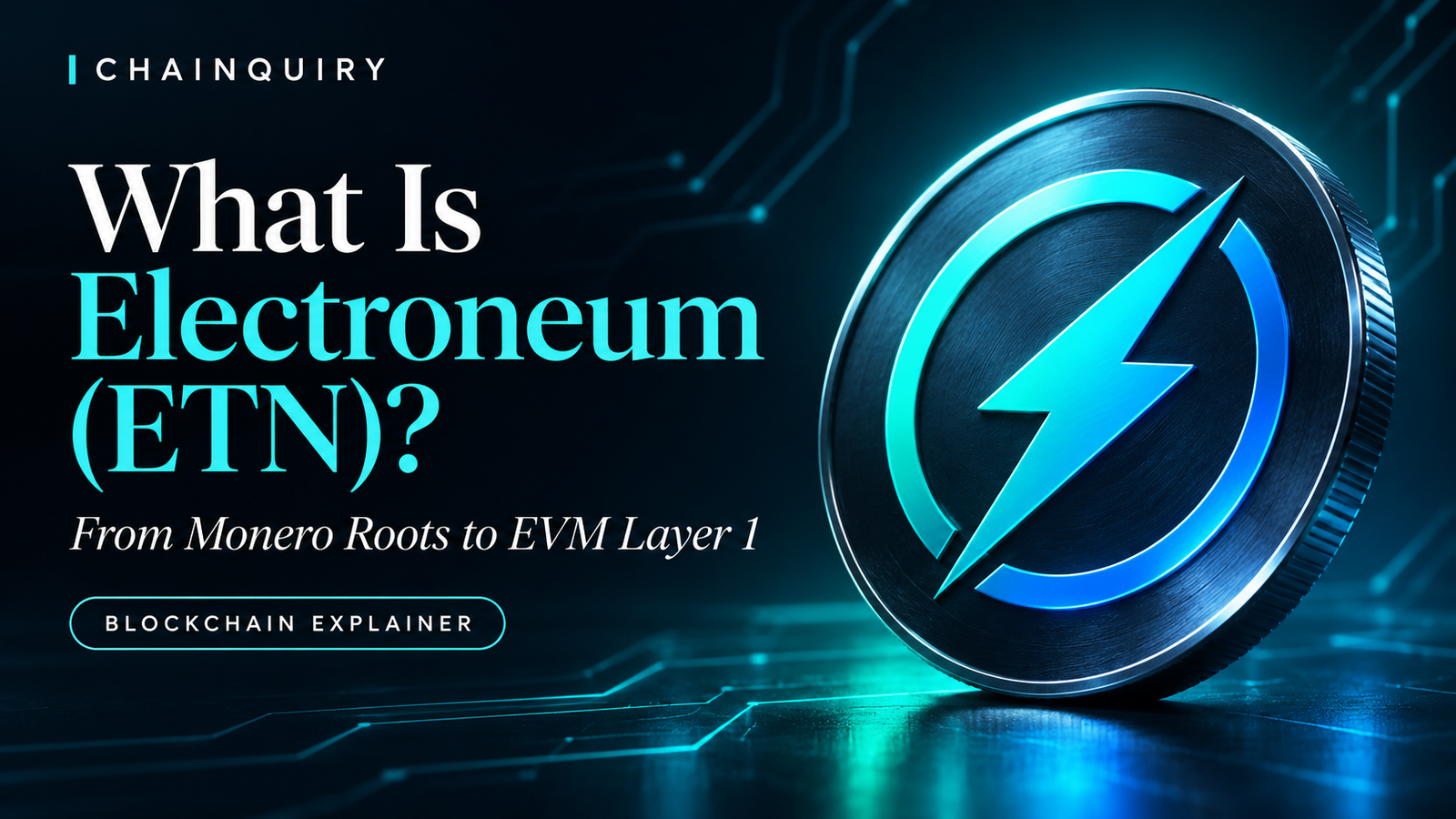
An independent look at the evolution of Electroneum from a mobile-focused cryptocurrency to an EVM-compatible blockchain, including its history, consensus model, tokenomics and challenges.
When Electroneum launched in 2017, the cryptocurrency industry looked very different.
Mobile cryptocurrency adoption was still an emerging idea. Smart contracts were gaining attention, mining was central to many independent blockchains, and accessibility remained one of the industry’s biggest challenges.
Electroneum entered that environment with an ambitious proposition: make cryptocurrency more approachable for ordinary smartphone users.
Nearly a decade later, the project looks substantially different from the cryptocurrency that originally launched.
Its Monero-derived blockchain has been superseded by an EVM-compatible Layer 1 network. Mining has given way to validator-based consensus, and its technological focus has expanded from mobile payments toward smart contracts and decentralised applications.
That transformation makes Electroneum (ETN) an interesting case study in how an established cryptocurrency can attempt to reinvent its underlying infrastructure.
But what has actually changed, what remains from its original vision, and how does Electroneum compare with other Layer 1 blockchains?
What Is Electroneum (ETN)?#
Electroneum is an independent Layer 1 blockchain project founded in 2017 by British entrepreneur Richard Ells.
The project’s native cryptocurrency, ETN, is used for transactions and network fees.
Originally built around mobile accessibility and digital payments, Electroneum now operates the Electroneum Smart Chain, an EVM-compatible blockchain introduced through its Project Aurelius upgrade in March 2024.
Its current architecture supports Ethereum-style smart contracts, decentralised applications and standard EVM development tools.
Unlike its earliest blockchain implementation, the modern Electroneum network does not use traditional Proof-of-Work mining.
Instead, it uses a modified Istanbul Byzantine Fault Tolerance consensus protocol, commonly abbreviated IBFT, with an authorised set of validators responsible for confirming blocks.
The network targets approximately five-second block intervals and single-block finality.
Electroneum’s defining characteristic is therefore not simply its transaction speed. It is the scale of its technical transition: from a Monero-derived payment cryptocurrency to a smart contract platform built on a different blockchain architecture.
Electroneum (ETN) key specifications#
| Feature | Specification |
|---|---|
| Project | Electroneum |
| Ticker | ETN |
| Original launch | 2017 |
| Founder | Richard Ells |
| Category | Layer 1 blockchain |
| Current network | Electroneum Smart Chain |
| Consensus | Modified IBFT / Proof of Authority |
| Target block time | 5 seconds |
| Finality | Single-block finality |
| Smart contracts | EVM-compatible |
| Mainnet chain ID | 52014 |
| Native cryptocurrency | ETN |
| Stated maximum supply | 21,000,000,000 ETN |
| Current PoW mining | No |
| Smart Chain launch | March 2024 |
| Source code | Open source |
Specifications are based on official project materials and developer documentation reviewed on November 9, 2026. Network operation and implementation details may change.
Readers can explore the Electroneum (ETN) project profile on Chainquiry for its structured network specifications, origins, market information and official resources.
The Origins of Electroneum: From Monero to Mobile Crypto#
Electroneum’s history begins with Monero.
The original Electroneum blockchain was derived from the Monero and CryptoNote open-source codebases. This provided an established foundation for creating an independent cryptocurrency rather than developing every protocol component from scratch.
Monero itself was designed around privacy-preserving transactions, using cryptographic mechanisms to obscure information that would otherwise be visible on a public blockchain.
Electroneum initially inherited elements of that architecture, but its objectives were different.
Rather than concentrating on confidential transactions, the project sought broader consumer accessibility, particularly through smartphones and everyday payment applications.
Its early ecosystem included a mobile application, wallet services and payment-related initiatives.
The mobile experience helped distinguish Electroneum from cryptocurrency projects that primarily appealed to miners, technical users and speculative traders.
However, mobile accessibility and actual blockchain mining are different things. Electroneum’s early mobile mining experience should not be confused with a modern smartphone performing the same network-security work as a conventional Proof-of-Work miner.
Electroneum moved away from Monero’s privacy model#
An important distinction often disappears when people describe Electroneum as a Monero fork.
Electroneum is not currently a Monero-style privacy cryptocurrency.
Its development history includes explicit changes that removed inherited privacy mechanisms.
The May 2018 Spark upgrade disabled RingCT and transaction mixins on the legacy blockchain. Later upgrades continued the move toward transparent transactions, including the 2021 Aurora upgrade.
The original code ancestry remains historically relevant, but it does not define the functionality of the modern Electroneum network.
A cryptocurrency can inherit code from another project and subsequently evolve into something technically and economically quite different.
For a contrasting example of a project that continues to emphasise Monero-derived privacy mechanisms, see Chainquiry’s Monzero (XMZ) research. Monzero and Electroneum are separate projects, with different architectures and objectives.
Electroneum’s Major Blockchain Upgrades#
Electroneum has undergone several changes to its consensus mechanism, transaction structure and development direction.
| Year | Milestone | Significance |
|---|---|---|
| 2017 | Original Electroneum launch | Monero/CryptoNote-derived blockchain with a mobile-first strategy |
| 2018 | Spark upgrade | Removed important inherited privacy mechanisms |
| 2019 | Pulse upgrade | Introduced Proof of Responsibility validation |
| 2021 | Aurora upgrade | Transitioned the legacy blockchain toward transparent transactions |
| 2024 | Flow and Project Aurelius | Enabled migration to the EVM-compatible Electroneum Smart Chain |
| 2025 | Next-generation whitepaper | Proposed broader validator participation and governance changes |
These changes did not all serve the same purpose.
The early upgrades altered the operation of Electroneum’s original blockchain. Project Aurelius went further by introducing a fundamentally different implementation built around Ethereum-compatible infrastructure.
That shift deserves particular attention.
What Changed With Electroneum Smart Chain?#
In March 2024, Electroneum launched its Smart Chain through the upgrade known as Project Aurelius.
It marked the project’s move away from the legacy CryptoNote-derived blockchain toward an EVM-compatible network based on a modified go-ethereum implementation.
This was not merely a faster version of the old blockchain.
It changed how developers could interact with Electroneum and expanded the types of applications the network could support.
1. Ethereum Virtual Machine compatibility#
The Ethereum Virtual Machine, or EVM, provides a standard environment for executing smart contracts.
By adopting EVM compatibility, Electroneum made it possible for developers familiar with Ethereum tools to build applications for its network.
That includes technologies such as Solidity smart contracts, compatible wallets and Ethereum-style JSON-RPC interfaces.
Developers do not need to learn an entirely unfamiliar programming model to begin experimenting with Electroneum.
However, EVM compatibility does not automatically make Electroneum part of Ethereum or give it Ethereum’s security guarantees.
Electroneum remains an independent blockchain with its own validator set, chain history, native currency and security assumptions.
2. Five-second block intervals#
The Electroneum Smart Chain targets one block approximately every five seconds.
In ordinary operation, validators take turns proposing blocks during designated time slots.
That provides relatively predictable confirmation intervals compared with mining systems where block discovery is probabilistic.
The five-second figure is a protocol target, not a guarantee that every transaction will always confirm in exactly five seconds.
Network conditions, validator availability and application-specific processing can affect the user’s actual experience.
3. Single-block finality#
Electroneum’s modified IBFT implementation is designed to provide finality once a block has received the required validator agreement.
This means a properly committed block does not require the same sequence of probabilistic confirmations commonly associated with Proof-of-Work networks.
For payments and smart contracts, predictable finality can simplify application design.
Its reliability nevertheless depends on the network meeting the assumptions of its consensus protocol.
How Does Electroneum’s IBFT Consensus Work?#
Electroneum’s consensus mechanism is a modified form of Istanbul Byzantine Fault Tolerance operating within a Proof-of-Authority-style validator model.
Instead of miners competing to solve computational puzzles, authorised validators participate in a coordinated process.
A simplified block-confirmation cycle works as follows:
- A validator is selected to propose the next block.
- The proposer assembles transactions and calculates the resulting blockchain state.
- Other validators independently verify the proposed block.
- A supermajority of validators must approve the block.
- Once the required agreement is reached, the block is committed and considered final.
Electroneum’s documentation describes a threshold of at least two-thirds of validators for block confirmation.
Under the relevant assumptions, the Byzantine fault-tolerant design can tolerate fewer than one-third of validators behaving maliciously or incorrectly.
What are the advantages?#
IBFT avoids the energy-intensive mining competition associated with Proof of Work.
It also offers predictable block intervals and finality without waiting for multiple mining confirmations.
For developers building applications that depend on rapid settlement, these properties can be attractive.
What is the trade-off?#
The principal trade-off involves validator access and decentralisation.
A permissioned validator system limits who can directly participate in producing blocks.
This may simplify coordination and improve performance, but it also concentrates responsibility among a smaller, authorised group.
That is a different trust model from public Proof-of-Work systems where anyone with compatible hardware can attempt to mine, or permissionless Proof-of-Stake networks where participation is governed by staking rules.
Electroneum should therefore be evaluated according to its actual validator distribution, operational independence and governance arrangements—not simply its speed.
Is Electroneum Proof of Work or Proof of Stake?#
Neither description accurately captures the current network.
Electroneum has used different consensus approaches during its history.
Its original blockchain began with Proof of Work before transitioning to Proof of Responsibility. Its modern Smart Chain uses modified IBFT Proof of Authority.
Consequently, historical guides explaining how to mine ETN with a computer are not instructions for securing the current Smart Chain.
Likewise, validator participation should not automatically be described as open Proof-of-Stake staking.
A June 2025 Electroneum whitepaper proposed a future validator model involving wider participation and ETN-based economic commitments. Such proposals must be distinguished from features independently confirmed as operational.
For researchers, the important question is not whether Electroneum can be placed under a familiar consensus label. It is how validators are selected, how they are held accountable and who can participate in maintaining the network.
What Is ETN Used For?#
ETN is Electroneum’s native cryptocurrency.
On the Smart Chain, its main protocol-level function is to pay transaction fees.
When users transfer ETN or interact with a smart contract, they consume network resources. The associated computational costs are measured using gas, with fees payable in ETN.
ETN can also function as a medium of exchange within applications and services that choose to support it.
The distinction between the blockchain and its cryptocurrency matters.
Electroneum is the network and broader project. ETN is the asset used within that network.
Understanding Electroneum’s supply#
Electroneum has historically described a maximum supply of 21 billion ETN.
That figure should not be confused with circulating supply or immediately available market liquidity.
The Smart Chain documentation describes two mechanisms affecting the amount of ETN in circulation:
Block rewards: The protocol creates ETN as rewards for confirmed blocks.
Transaction-fee burning: The base portion of transaction gas fees is permanently removed from circulation.
These processes mean that gross issuance and net changes in supply are not necessarily identical.
In periods of greater network demand, fee burning can offset some or potentially all of the ETN issued through block rewards.
This does not establish that ETN is permanently deflationary.
The net monetary effect depends on issuance parameters and actual transaction activity.
Investors and researchers should distinguish maximum supply, issued supply, circulating supply and fee-burning activity rather than treating them as interchangeable figures.
What Can Developers Build on Electroneum?#
EVM compatibility significantly expands the range of applications that can technically operate on the Electroneum Smart Chain.
Potential use cases include decentralised exchanges, payment applications, digital collectibles, token issuance, lending protocols and other smart contract systems.
Developers can use familiar Ethereum-compatible infrastructure rather than creating every integration from the beginning.
Electroneum’s ecosystem development efforts have included developer initiatives and a 2025 hackathon intended to encourage new applications.
The project highlighted applications such as ElectroSwap among its hackathon participants and winners.
However, it is important to distinguish between an application being technically deployable, a prototype demonstrating functionality and a product achieving meaningful long-term adoption.
EVM compatibility reduces an engineering barrier. It does not guarantee developer demand, sustainable liquidity or an active user base.
Those outcomes depend on the usefulness and security of the applications built on the network.
Electroneum’s Next Phase: Validator Participation and Governance#
One of the more interesting documents in Electroneum’s recent history is its June 2025 whitepaper, which sets out proposed changes to the Smart Chain.
The paper identifies limitations associated with permissioned validation and explores a model intended to increase participation.
Its proposals include:
- A permissionless validator-registration mechanism
- ETN-based economic commitments for validator candidates
- More dynamic validator selection
- Penalties for misbehaving validators
- A broader on-chain governance framework
These ideas represent a potential change to Electroneum’s security and governance model.
Opening validator participation could reduce reliance on a predetermined group. Economic penalties could introduce stronger incentives for correct behaviour.
However, these mechanisms also create new challenges.
Stake or warrant concentration, governance participation, validator selection rules and protocol complexity can all influence whether a more open system becomes meaningfully decentralised.
The June 2025 whitepaper describes proposed upgrades, not proof that every mechanism has already been deployed.
Without independently confirming the implementation and activation of a particular feature, it should not be presented as part of the live network.
The difference between a published roadmap and an operating protocol is especially important when evaluating blockchain governance.
Important: Electroneum’s Legacy Wallet Migration#
Electroneum’s transition to the Smart Chain has a practical consequence for anyone who holds older ETN.
The project’s official support page states that its original app-based wallet service and associated support system have closed.
It also warns that the legacy non-EVM blockchain is scheduled to be turned off at the end of 2026.
Users holding ETN in older paper wallets created before March 3, 2024, may need to migrate their balances to the current Smart Chain.
The project warns that balances remaining on the discontinued legacy network could be lost if they are not migrated.
This is particularly relevant to people who purchased or received ETN years ago and have not accessed their wallets recently.
Holders should consult the official Electroneum Smart Chain migration documentation and the official Electroneum support notice for current instructions.
Never enter a wallet seed phrase or private key into an unsolicited website, and never share those credentials with someone offering migration assistance.
For long-time holders, understanding which blockchain their ETN currently resides on may be more urgent than following short-term market movements.
What Are Electroneum’s Main Challenges?#
Electroneum’s long operating history is a meaningful distinction from newly launched networks.
But age and technical capability do not remove the need to evaluate its limitations.
Validator concentration#
Electroneum’s documented permissioned validator model places block production in the hands of an authorised set.
This creates different trust assumptions from a broadly permissionless network.
Independent operation, validator diversity and transparent governance remain important measures of decentralisation.
Competition among EVM chains#
Electroneum operates in a crowded environment of EVM-compatible networks.
Ethereum, its Layer 2 ecosystem, and numerous independent Layer 1 chains already offer smart contract deployment.
Electroneum needs to attract and retain applications and users for reasons beyond having compatible tooling.
Smart contract security#
EVM compatibility does not eliminate vulnerabilities in applications deployed to the network.
Smart contracts can contain coding errors, access-control problems and economic design weaknesses.
Bridges and cross-chain services introduce additional security considerations.
The security of the underlying blockchain and the security of an individual application are separate questions.
Demonstrating sustained adoption#
Registered users, wallet addresses, transaction counts and active economic participants measure different things.
Project-reported ecosystem milestones can be useful, but they should be evaluated in context and corroborated wherever possible.
Long-term adoption is better assessed through a combination of active applications, meaningful transactions, developer activity and independent infrastructure.
Completing the transition#
Legacy wallet migration and proposed changes to validator governance create additional operational responsibilities.
Maintaining clear documentation and communicating network changes will remain important for a project with holders spanning multiple generations of its technology.
How Does Electroneum Compare With Monero?#
The comparison is historically interesting because the two projects share an early code relationship.
Their present technical priorities, however, are very different.
| Feature | Electroneum (ETN) | Monero (XMR) |
|---|---|---|
| Original launch | 2017 | 2014 |
| Current architecture | EVM-compatible Layer 1 | Privacy-focused blockchain |
| Consensus | Modified IBFT / PoA | Proof of Work |
| Mining | No current PoW mining | RandomX mining |
| Primary focus | Smart contracts and applications | Confidential transactions |
| Transaction transparency | Public EVM-style ledger | Privacy-preserving transaction design |
| Smart contract platform | Yes | Not a general-purpose EVM chain |
| Native asset | ETN | XMR |
Electroneum and Monero are independent networks.
An ETN balance does not exist on Monero, and the projects do not share a common blockchain ledger.
The historical fork relationship illustrates how open-source projects can diverge over time.
One continued prioritising transaction confidentiality and open mining. The other eventually adopted a transparent smart contract architecture and validator-based consensus.
Neither approach is automatically superior across every use case.
Their suitability depends on what a user or application needs from the underlying network.
Frequently Asked Questions About Electroneum#
Is Electroneum still active?#
Yes. Electroneum operates an EVM-compatible Smart Chain, with public developer documentation, source code and blockchain exploration infrastructure. Its original cryptocurrency network has been superseded by the newer architecture.
Can you still mine Electroneum?#
Not through conventional Proof-of-Work mining on the current Smart Chain. Electroneum now uses modified IBFT Proof-of-Authority consensus. Older ETN mining tutorials generally refer to previous blockchain versions.
Is Electroneum a privacy coin?#
Not in its current form. Electroneum was originally derived from the Monero/CryptoNote codebase, but it removed inherited privacy mechanisms and subsequently transitioned to a transparent EVM-compatible blockchain.
Does Electroneum support MetaMask?#
Yes. Electroneum’s documentation explains how to connect compatible wallets to its Smart Chain.
The documented mainnet chain ID is 52014, and ETN is the native currency used for gas fees. Users should verify RPC details against official documentation before configuring a wallet.
Is Electroneum an ERC-20 token?#
No. ETN is the native cryptocurrency of an independent Layer 1 blockchain. Although Electroneum supports EVM-compatible tools and applications, that does not make native ETN an ERC-20 token issued on Ethereum.
What is Electroneum’s maximum supply?#
Electroneum has historically stated a maximum supply of 21 billion ETN. Researchers should distinguish this figure from the amount currently circulating and examine the Smart Chain’s block-reward and fee-burning mechanisms.
Is Electroneum fully decentralised?#
Electroneum’s documented modified IBFT implementation uses an authorised validator set. This involves different decentralisation and trust assumptions from permissionless mining or staking systems. Its June 2025 whitepaper proposed broader participation, but proposed features should not be treated as deployed without verification.
Is Electroneum Worth Following?#
Electroneum occupies an unusual position among established cryptocurrency projects.
Its original identity was built around making digital currency accessible through mobile devices. Over time, it moved through multiple consensus and protocol changes before adopting a fundamentally different smart contract architecture.
That history provides a useful reminder that cryptocurrency projects are not always defined permanently by the technologies with which they launch.
Electroneum’s current network offers several clearly documented capabilities: EVM compatibility, relatively short block intervals, single-block finality and a native cryptocurrency used for network fees.
Its longer-term position is less straightforward.
It must compete for developers and users in an increasingly crowded smart contract ecosystem while addressing the decentralisation and governance trade-offs associated with its validator model.
Proposed changes to validator participation could become an important part of that story, but their value will depend on actual implementation rather than roadmap language.
For anyone researching the evolution of blockchain networks, Electroneum is a relevant example of technical reinvention.
Its transition is already part of its history. The long-term results of that transition remain something to observe.
Readers can examine Electroneum’s Chainquiry profile for official links, network specifications, its documented fork lineage and additional research sources.

Editorial note: This article is intended for independent cryptocurrency research and education. It is not an endorsement or investment recommendation. Protocol specifications, services and migration procedures can change. Information reviewed November 9, 2026.