Editorial disclosure: xCoin (XID) is a Chainquiry promotional partner. This article examines the project’s publicly available technical documentation and infrastructure independently. It is not an investment recommendation.
Most cryptocurrencies were designed before quantum computing became a serious consideration for long-term financial security. Their cryptographic foundations have worked for years, but the possibility of sufficiently powerful quantum computers raises an uncomfortable question: what happens to digital assets whose ownership depends on signatures that future machines might be able to break?
xCoin (XID) approaches that question differently.
Rather than launching with conventional digital signatures and planning a future upgrade, xCoin uses post-quantum cryptography for transaction authorization from its first block. It combines that approach with MetalDAG, a memory-hard proof-of-work algorithm designed to make mining practical on Apple Silicon computers, and a monetary policy that extends new coin issuance across centuries.
The project launched its mainnet on September 26, 2026, and is developed through the open-source infrastructure maintained by Distributed Ledger Technologies.
Here is how xCoin (XID) works, what distinguishes it from established cryptocurrencies, and which risks deserve attention.
What Is xCoin (XID)?#
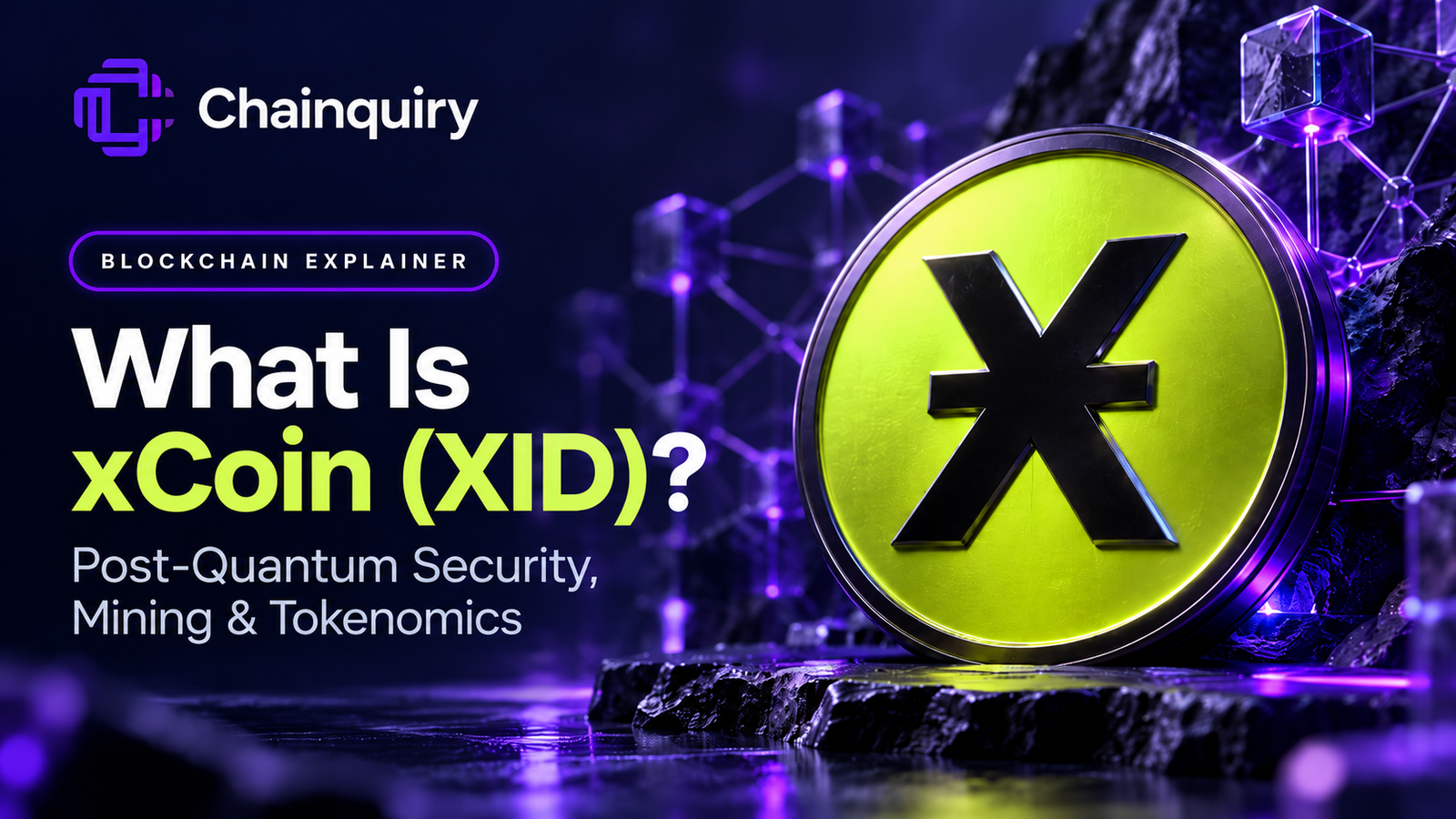
xCoin (XID) is a layer-1, proof-of-work cryptocurrency designed around post-quantum transaction security, accessible mining, and predictable monetary issuance.
Its native cryptocurrency is XID, represented by the symbol Ӿ.
Unlike a token issued on Ethereum or another existing blockchain, XID operates on its own network. Transactions are recorded and validated by xCoin nodes, while miners perform computational work to produce new blocks and receive newly issued coins.
Its transaction model resembles Bitcoin’s unspent transaction output (UTXO) architecture, but the underlying signature system and mining algorithm are substantially different.
The project’s most distinctive design choices are straightforward:
- Transaction spending requires post-quantum digital signatures.
- Mining uses MetalDAG, a memory-intensive proof-of-work algorithm.
- The maximum supply is fixed at 100 million XID.
- The emission schedule gradually reduces block rewards rather than relying on periodic 50% halvings.
- No premine or special founder allocation is specified in the protocol.
These features form the foundation of xCoin’s attempt to combine long-term cryptographic resilience with wider participation in proof-of-work mining.
xCoin (XID) key specifications#
| Feature | Specification |
|---|---|
| Project name | xCoin |
| Ticker | XID |
| Currency symbol | Ӿ |
| Blockchain | Independent layer-1 |
| Mainnet launch | September 26, 2026 |
| Consensus mechanism | Proof of Work |
| Mining algorithm | MetalDAG |
| Target block time | 300 seconds (5 minutes) |
| Maximum supply | 100,000,000 XID |
| Current reward phase | 6.25 XID per block |
| Primary signature algorithm | ML-DSA-65 |
| Alternative signature algorithm | SLH-DSA-SHA2-128s |
| Address format | xpa1r… |
| Premine | None specified |
| Development | Distributed Ledger Technologies |
| Source code | GitHub |
| Explorer | SuperKnet |
Specifications reflect the project’s published mainnet rules and publicly accessible resources reviewed on October 23, 2026. Mining conditions and network statistics may change.
Why Is xCoin Built Around Post-Quantum Cryptography?#
Bitcoin and many other established cryptocurrencies use elliptic-curve cryptography to authorize transactions.
These systems remain secure against known practical attacks using today’s computers. However, a sufficiently capable fault-tolerant quantum computer could potentially undermine the mathematical assumptions on which several conventional public-key signature schemes depend.
Such machines are not currently known to exist at the scale required for these attacks, but preparing cryptographic infrastructure before they arrive has become an important research and engineering priority.
In August 2024, the US National Institute of Standards and Technology (NIST) finalized its first major post-quantum cryptographic standards, including algorithms for digital signatures and secure key establishment.
xCoin (XID) incorporates algorithms from those standards into its transaction authorization rules.
ML-DSA-65: The primary signature system#
xCoin uses ML-DSA-65, a lattice-based digital signature algorithm standardized under NIST FIPS 204.
A digital signature proves that the person authorizing a transaction possesses the relevant private key without requiring that private key to be revealed.
In xCoin’s design, ordinary transactions can be authorized using ML-DSA-65 rather than classical ECDSA or Schnorr signatures.
This is an architectural decision, not simply an additional security feature.
The blockchain’s published consensus rules do not offer an alternative classical signing path for existing outputs. A transaction must satisfy its post-quantum authorization requirements to be valid.
SLH-DSA: A different cryptographic approach#
xCoin (XID) also supports SLH-DSA-SHA2-128s, a stateless hash-based signature algorithm standardized under NIST FIPS 205.
Its importance lies in cryptographic diversity.
ML-DSA relies on lattice-based mathematical assumptions, while SLH-DSA relies on hash-based constructions. Supporting both provides an alternative authorization mechanism if confidence in one cryptographic family changes.
The two algorithms are not identical in security level, performance, or signature size. According to xCoin’s specification, ML-DSA-65 operates at NIST security level 3, while its selected SLH-DSA variant operates at level 1.
That distinction matters: having two post-quantum options does not make their security properties interchangeable.
Does this make xCoin completely quantum-proof?#
No cryptocurrency should be described as completely immune to every possible future quantum attack.
xCoin’s design specifically addresses the digital signatures used to authorize spending. That is a meaningful part of blockchain security, but it does not eliminate every possible vulnerability.
Software bugs, compromised private keys, consensus attacks, network concentration, and weaknesses in surrounding infrastructure remain relevant.
The use of NIST-standardized algorithms also does not, by itself, establish that an entire blockchain implementation has been independently certified or audited.
The more precise conclusion is that xCoin was designed to avoid dependence on classical digital signatures for transaction spending from genesis, rather than requiring existing holders to migrate later.
How Does MetalDAG Mining Work?#
Mining is the second major part of xCoin’s design.
The network uses a purpose-built proof-of-work algorithm called MetalDAG, which belongs to the broader family of memory-hard mining approaches.
Instead of relying primarily on the speed of repeated arithmetic operations, MetalDAG requires miners to access data from a large pseudorandom dataset.
The dataset begins at approximately 4 GiB and grows by 128 MiB every 14-day epoch.
According to the project’s technical documentation, each proof-of-work attempt performs 64 pseudorandom dataset accesses.
This makes memory capacity and memory bandwidth important factors in mining performance.
Why Apple Silicon?#
Apple Silicon computers use unified memory, allowing the CPU and GPU to work with a shared pool of memory.
For a memory-intensive mining algorithm, this architecture can offer practical advantages over systems where GPU memory is more constrained.
xCoin’s developers have made Apple Silicon a particular focus, providing a native Mac miner that uses Apple’s Metal graphics-computing framework.
The project’s documentation recommends Apple Silicon Macs with at least 16 GB of memory.
That does not mean other hardware is technically excluded. Discrete GPUs and other sufficiently capable systems can potentially mine MetalDAG.
It also does not establish permanent ASIC resistance.
Specialized hardware manufacturers may eventually develop more efficient solutions, and mining performance can change considerably as the network grows.
MetalDAG is best understood as an attempt to influence the economics of mining through memory requirements, not a guarantee that mining will remain decentralized.
Why mining accessibility matters#
A proof-of-work blockchain distributes new coins through computational work.
In theory, anyone capable of meeting the network’s mining requirements can participate. In practice, hardware costs, electricity prices, mining difficulty, and competition determine who can mine economically.
xCoin’s approach attempts to make consumer hardware a meaningful part of that competition.
Whether it succeeds over the long term will depend on the actual distribution of mining power, not merely the hardware for which the algorithm was designed.
How to Mine xCoin (XID)#
The project currently provides several ways to participate in mining.
1. Create an XID wallet address#
Before mining, obtain a valid mainnet wallet address.
xCoin mainnet receiving addresses begin with xpa1r.
The project maintains an open-source command-line wallet capable of generating addresses, managing keys, and signing transactions.
Private keys and recovery seeds should be stored securely and never entered into a mining pool or shared with another person.
2. Choose your mining software#
The project’s recommended native miner is Mac Metal Miner (MMM), designed for Apple Silicon systems.
MMM provides a graphical interface for monitoring hashrate, mining shares, network status, and other operational information.
The official mining resources are available through xCoinMiner and Mac Metal Miner.
A browser-based miner is also available for experimentation and learning. However, browser mining generally provides substantially less performance than an optimized native application.
3. Choose between solo and pooled mining#
xCoin supports solo mining and a pay-per-last-N-shares (PPLNS) mining approach through its published pool infrastructure.
With solo mining, a miner who successfully discovers a block receives the applicable block subsidy and transaction fees.
With PPLNS, block rewards are allocated according to eligible contributed shares under the pool’s payout rules.
The project’s pool implementation describes direct coinbase payouts, reducing the need for a pool operator to hold newly mined coins before distribution.
These arrangements have different payout characteristics. Solo mining is highly variable, especially for miners with a small share of network hashrate.
Current pool options and connection information are published at xCoinPool.
4. Monitor blocks and rewards#
Mining activity can be monitored through the SuperKnet blockchain explorer.
Newly mined coinbase rewards require 1,000 blocks of maturity before they become spendable.
At the five-minute target block interval, this corresponds to approximately three and a half days.
Mining rewards are not guaranteed. The actual number of coins a miner receives depends on network difficulty, hardware performance, uptime, and the chosen payout method.
xCoin Tokenomics: How the 100 Million XID Supply Works#
xCoin has a maximum supply of exactly 100,000,000 XID, with eight decimal places.
Its published monetary policy does not include a premine, initial token allocation to the founder, or conventional token-sale distribution.
The genesis block minted no spendable coins, according to the project’s documented chain parameters.
Instead, new supply is created through scheduled proof-of-work block rewards.
What makes this system unusual is how slowly those rewards are designed to decline.
The Annual Tenth emission model#
Bitcoin is known for its halving schedule, which reduces the block subsidy by 50% approximately every four years.
xCoin follows a different approach.
After an initial ramp-up period, its block reward decreases by 10% every 110,000 blocks, equivalent to approximately 382 days at the target block interval.
The developers call this system the Annual Tenth.
| Block range | XID reward per block |
|---|---|
| 1–20,000 | 6.25 |
| 20,001–40,000 | 12.5 |
| 40,001–60,000 | 25 |
| 60,001–220,000 | 50 |
| 220,001–330,000 | 45 |
| 330,001–440,000 | 40.5 |
| Subsequent reduction periods | 10% reduction per step, subject to the protocol’s later phases |
The early reward increases are intended to avoid concentrating the largest rewards in the earliest days, before a broader mining community has had time to discover the project.
Once the 50-XID phase ends, the gradual reductions begin.
Why reduce mining rewards gradually?#
Large and sudden reductions in block subsidies can materially change mining profitability.
xCoin’s annual 10% reductions are designed to make the transition more gradual.
That does not mean mining profitability will necessarily decline smoothly. Electricity prices, network difficulty, hardware efficiency, transaction fees, and the market value of XID can all change independently of the programmed block reward.
The schedule controls coin issuance, not mining income.
The unusually long emission timeline#
xCoin’s monetary policy extends far beyond the time horizon associated with most cryptocurrency projects.
According to the project’s current emission model, rewards eventually reach a floor of 1.5 XID per block, projected to continue from approximately 2063 until 2325.
After that, the subsidy gradually decreases toward 0.1 XID per block before the remaining supply is issued.
The final coin is projected to be mined around 2363, assuming the intended block schedule continues.
These distant dates are projections derived from the protocol’s block intervals and emission schedule, not guaranteed calendar milestones.
The important distinction is that xCoin attempts to maintain a block subsidy for an exceptionally long period while retaining its fixed maximum supply.
This is an interesting response to a familiar proof-of-work question: how should a blockchain compensate miners as new issuance eventually approaches zero?
It does not settle that question economically. A long-lasting subsidy may help, but only if the rewards remain valuable enough to support network security.
What Makes xCoin Different From Bitcoin?#
Both projects use proof of work and a UTXO-style transaction model, but their design priorities differ.
| Feature | Bitcoin | xCoin |
|---|---|---|
| Mainnet launch | 2009 | 2026 |
| Supply cap | Approximately 21 million BTC | 100 million XID |
| Target block interval | 10 minutes | 5 minutes |
| Mining | SHA-256, ASIC-dominated | MetalDAG, memory-hard |
| Spending signatures | Classical elliptic-curve signatures | Post-quantum ML-DSA and SLH-DSA |
| Reward reduction | Halving approximately every 4 years | 10% per 110,000 blocks after warm-up |
| Network maturity | Long-established | Early-stage |
This comparison is about architecture, not an assessment of which cryptocurrency is more secure overall.
Bitcoin benefits from a much longer operating history, a substantial mining industry, mature infrastructure, and extensive scrutiny.
xCoin offers a different set of engineering choices, but its network is too young to demonstrate comparable long-term resilience.
That distinction should not be overlooked when assessing a new blockchain.
The xCoin Ecosystem#
xCoin’s supporting infrastructure extends beyond the blockchain software itself.
Distributed Ledger Technologies maintains several connected resources designed to make the network easier to use.
SuperKnet serves as the project’s public blockchain explorer, displaying blocks, transactions, network statistics, and mining activity.
xCoinMiner provides mining information, browser-based experimentation, and access to native mining tools.
Mac Metal Miner offers an Apple Silicon-focused graphical mining application.
MineDifferent, the project’s community forum, uses cryptographic signatures for account authentication rather than conventional passwords.
The ecosystem also includes wallet projects such as xPay and Xalon, reflecting an effort to provide alternative ways of managing XID.
An exchange interface called AYEDEX advertises an XID/USDC market. However, its publicly accessible interface also describes a trial phase using test assets without monetary value. That should not be interpreted as independently verified live liquidity or an established market price for XID.
Together, these projects demonstrate the developer’s broader ambition: to build not just a currency protocol but a collection of applications around it.
Whether those applications attract sustained users outside the development team remains an important measure of future adoption.
Development, Governance and Roadmap#
The xCoin reference implementation is publicly available on GitHub.
The repository contains node software derived from Bitcoin Core, along with related mining, wallet, and infrastructure components.
Public source code gives technically capable users the opportunity to examine implementation details, reproduce builds, and evaluate proposed changes.
The project’s charter is also represented in its genesis-block documentation through a cryptographic commitment.
That provides a reference for the monetary principles established at launch. It does not eliminate the possibility of future disagreements, forks, or protocol changes adopted by network participants.
What has already launched?#
The published roadmap identifies mainnet consensus, post-quantum transaction authorization, MetalDAG proof of work, a blockchain explorer, mining infrastructure, and community tools as completed components.
Mainnet began on September 26, 2026.
What comes next?#
The roadmap identifies several additional development directions:
- Stratum V2-style functionality intended to reduce the concentration of transaction-selection power in mining pools.
- Improved offline signing for the xPay wallet.
- Satellite-linked node capabilities for receiving blockchain information through alternative connectivity.
These remain future developments, not capabilities that should be assumed available today.
Risks and Challenges Facing xCoin#
The project’s technical ambitions are substantial, but several limitations are worth examining carefully.
1. A young network can be vulnerable to concentrated mining power#
Proof-of-work security depends partly on the amount and distribution of computational power securing the chain.
During research, SuperKnet displayed a warning about a large share of recent blocks being attributed to one payout address.
Such a pattern deserves scrutiny, although a payout address alone does not necessarily identify the ultimate owner or control structure behind all contributing hardware.
The critical question is whether independent miners and pools can sustain sufficient network diversity to resist reorganizations and other consensus attacks.
2. Memory-hard mining does not guarantee decentralization#
The ability to mine on consumer hardware is valuable, but it does not ensure equal economic opportunity.
Operators with more capital, cheaper electricity, or optimized equipment may still develop substantial advantages.
Network concentration must be assessed continuously rather than assumed away through algorithm design.
3. Post-quantum signatures involve real tradeoffs#
Compared with conventional signatures, the post-quantum algorithms selected by xCoin generate substantially larger cryptographic data.
The project’s specification gives an ML-DSA-65 signature size of 3,309 bytes, while SLH-DSA-SHA2-128s signatures are considerably larger.
This increases transaction data requirements and makes network capacity, verification costs, and wallet implementation important engineering considerations.
4. Public code is not the same as independent assurance#
xCoin’s whitepaper states that its consensus implementation has undergone external security review.
However, the identity, scope, and complete findings of that review were not independently established from an accessible public audit report during this research.
A published source repository is a positive transparency measure, but it should not be treated as proof that every component has received comprehensive third-party auditing.
5. Market adoption remains uncertain#
The existence of an operating blockchain does not automatically create meaningful demand for its native cryptocurrency.
Liquidity, wallet adoption, exchange access, developer participation, and genuine transactional use will all influence how the ecosystem develops.
The project’s young age also means that its long-term operational reliability remains largely untested.
Is xCoin Worth Following?#
xCoin presents an unusual combination of blockchain design choices.
It addresses quantum-related transaction security at the protocol level, deliberately accommodates Apple Silicon mining, and adopts an emission schedule that stretches across centuries.
Those decisions make it worth examining from a technical perspective, particularly for people interested in alternative proof-of-work designs and post-quantum cryptography.
Yet the project’s most important tests are still ahead.
Its long-term credibility will depend on secure implementations, independent scrutiny, distributed mining participation, reliable infrastructure, and sustained interest from users.
An ambitious specification is a starting point. A resilient public network is something that must be demonstrated over time.
For readers exploring emerging proof-of-work networks, xCoin offers a useful case study in how a cryptocurrency can be designed around different assumptions about mining accessibility, cryptographic security, and monetary issuance.
Readers can explore the project’s official website, inspect its blockchain explorer, and discover more cryptocurrency projects through Chainquiry.
Frequently Asked Questions About xCoin (XID)#
Is xCoin (XID) a proof-of-work cryptocurrency?#
Yes. xCoin operates its own proof-of-work blockchain using the MetalDAG mining algorithm. New coins are issued through block rewards according to its published monetary schedule.
Can you mine xCoin on a regular computer?#
The project particularly supports Apple Silicon Macs with sufficient memory, including through its native Mac Metal Miner application. It also provides browser-based mining tools primarily intended for experimentation. Mining performance and profitability depend on hardware and network competition.
How many xCoin (XID) will exist?#
The maximum supply is 100,000,000 XID. The protocol’s published emission schedule is designed to distribute that supply through mining over a period extending into the 24th century.
Is xCoin completely quantum-proof?#
No security system can guarantee resistance to every future attack. xCoin uses NIST-standardized post-quantum signature algorithms for transaction authorization, but this does not eliminate implementation vulnerabilities, mining attacks, or other security risks.
When did xCoin launch?#
The project’s mainnet genesis block was mined on September 26, 2026, at 00:00 UTC.
Does xCoin have a verified market price?#
A public exchange interface exists, but its trial-phase disclosures and the limited accessible market information do not establish reliable live liquidity or an independently verified market price. Readers should distinguish experimental trading interfaces from real, settled trading activity.

Research reviewed October 23, 2026. This article is intended for educational purposes and does not constitute financial or investment advice.