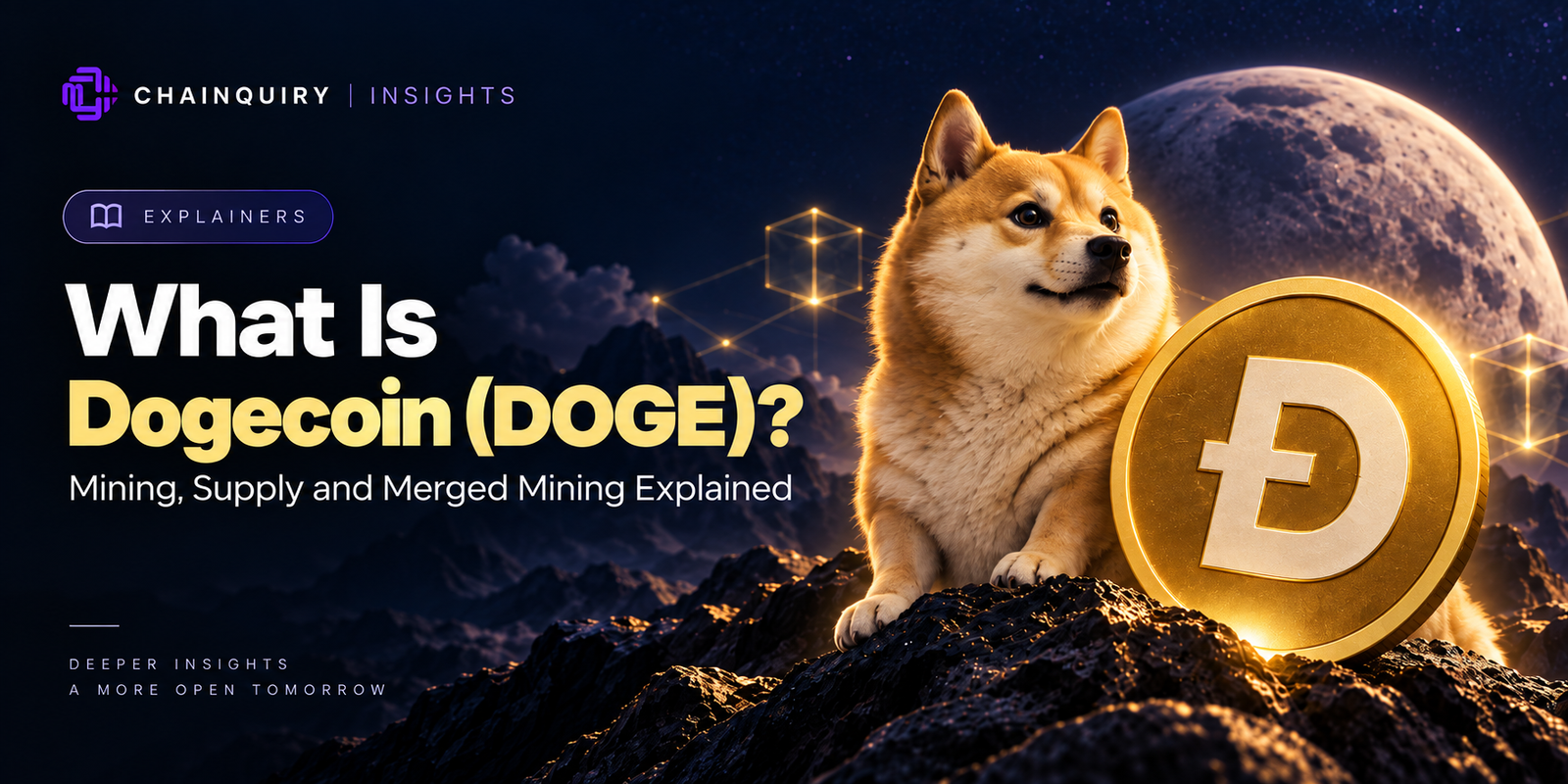
Dogecoin (DOGE) is an open-source peer-to-peer cryptocurrency launched in December 2013. What began as a lighthearted project inspired by the Doge internet meme has developed into an independently operated Proof-of-Work blockchain used for payments, tipping and transferring value.
Billy Markus and Jackson Palmer created Dogecoin at a time when cryptocurrency projects were becoming increasingly serious and speculative. Dogecoin deliberately adopted a more playful identity, using the Shiba Inu dog from the Doge meme as its symbol.
The network launched on December 6, 2013. Although its early software inherited substantial technology from Litecoin and Bitcoin-derived codebases, Dogecoin has its own blockchain, consensus rules, monetary policy, nodes and native cryptocurrency, DOGE.
How Dogecoin Works#
Dogecoin maintains a public blockchain containing the history of confirmed DOGE transactions.
When someone sends DOGE, their wallet creates and digitally signs a transaction using the private keys controlling the coins being spent. That transaction is broadcast to Dogecoin’s peer-to-peer network.
Miners collect eligible transactions into candidate blocks and perform Proof-of-Work calculations in an attempt to produce a valid block.
Other Dogecoin nodes independently verify incoming blocks and transactions against the network’s consensus rules before accepting them into their copy of the blockchain.
DOGE is the native currency of this network. It is not a token running on Ethereum, BNB Smart Chain or another host blockchain.
Dogecoin Uses Scrypt Proof of Work#
Dogecoin is secured through Proof of Work using the Scrypt hashing algorithm.
Scrypt is also used by Litecoin, which became particularly important for Dogecoin after the network introduced Auxiliary Proof of Work, or AuxPoW.
In Dogecoin’s earliest period, ordinary GPUs could participate competitively in mining. That is no longer the practical reality.
Modern profitable Dogecoin mining is dominated by specialized Scrypt ASIC hardware capable of performing substantially more hashing work than consumer CPUs or GPUs.
Miners often participate through mining pools, combining their computational power and sharing rewards according to the pool’s payout rules.
What Is Dogecoin and Litecoin Merged Mining?#
Since 2014, Dogecoin has supported merged mining with other compatible Scrypt Proof-of-Work cryptocurrencies, most notably Litecoin.
Merged mining allows the same underlying mining work to contribute toward more than one blockchain.
A Litecoin miner using compatible infrastructure can therefore contribute Proof of Work to both Litecoin and Dogecoin without having to divide the same hashing hardware into completely separate workloads.
This does not merge the two cryptocurrencies.
Litecoin and Dogecoin continue to maintain separate:
blockchains
transaction histories
native currencies
monetary policies
nodes
consensus rules
Merged mining simply allows compatible Proof of Work to help secure both networks.
This relationship has become a major part of Dogecoin’s security model because a substantial amount of Scrypt mining infrastructure can simultaneously contribute to Dogecoin.
How Fast Are Dogecoin Blocks?#
Dogecoin targets a new block approximately every:
1 minute
That is considerably shorter than Bitcoin’s roughly ten-minute block target and Litecoin’s roughly 2.5-minute target.
A one-minute target does not mean every Dogecoin payment is guaranteed to become fully settled within exactly 60 seconds.
Actual confirmation time depends on when a transaction is broadcast relative to the next block, whether miners include it promptly and how many confirmations a recipient or service requires.
It is therefore more accurate to describe Dogecoin as having a one-minute target block interval rather than claiming that every transaction is processed “within seconds.”
How Are Dogecoin Miners Paid?#
Dogecoin miners receive newly issued DOGE when they successfully mine a valid block.
The current block subsidy is:
10,000 DOGE per block
Miners can also receive transaction fees from the transactions included in the block.
Dogecoin’s early reward schedule changed substantially during the network’s first years. Earlier blocks used larger and, during part of the early history, partially randomized rewards.
Starting from block 600,000, however, the protocol settled on a permanent subsidy of 10,000 DOGE per block.
Unlike Bitcoin and Litecoin, this subsidy does not continue halving toward zero.
Does Dogecoin Have a Maximum Supply?#
No.
Dogecoin does not have a fixed maximum supply.
The network permanently issues up to 10,000 new DOGE per block, and its target block interval is approximately one minute.
At the target rate, that corresponds to roughly:
5.256 billion DOGE per 365-day year
The important distinction is that Dogecoin’s issuance is fixed in absolute terms per block rather than as a percentage of the existing supply.
As the total amount of DOGE grows, approximately the same annual issuance represents a progressively smaller percentage of the overall supply.
Dogecoin’s supply is therefore uncapped over an unlimited time horizon, but the amount that can be issued during any finite period is constrained by the block subsidy and block-production schedule.
The continuing reward is intended to provide miners with an ongoing incentive to contribute Proof of Work and secure the blockchain.
Is Dogecoin Inflationary?#
Dogecoin is inflationary in the sense that additional DOGE continues to enter circulation through mining.
However, its monetary model differs from a currency whose issuance increases proportionally with the existing supply.
The protocol does not increase the 10,000 DOGE block reward simply because more DOGE already exists.
As a result, the percentage rate of new issuance relative to total supply declines over time even though nominal annual issuance remains approximately constant.
This distinction is useful when comparing Dogecoin with fixed-supply cryptocurrencies such as Bitcoin or Litecoin.
Bitcoin’s block subsidy gradually approaches zero.
Dogecoin instead maintains a permanent miner subsidy.
These are different approaches to funding long-term Proof-of-Work security.
How Do Dogecoin Transaction Fees Work?#
Dogecoin transactions include fees, but those fees should not be described simply as low because the network removes banks or financial intermediaries.
Fees are part of the blockchain’s transaction and relay system.
They depend primarily on factors such as transaction size, wallet settings, node policies and the conditions under which miners choose to include transactions.
Dogecoin Core nodes also maintain configurable relay-fee policies determining which transactions they will propagate across the network.
Historically, Dogecoin has generally offered relatively inexpensive blockchain transactions, but fees are network parameters rather than a guaranteed fixed amount.
Miners receive transaction fees in addition to the block subsidy.
Is Dogecoin Anonymous?#
No.
Dogecoin’s blockchain is public.
Transactions, addresses and balances associated with public addresses can be inspected through blockchain data.
Dogecoin addresses do not automatically contain a person’s real-world identity, which makes ordinary use pseudonymous rather than inherently anonymous.
Privacy can be weakened when users reuse addresses or when addresses become associated with identifiable activity such as exchange deposits, public donations or merchant payments.
Anyone researching Dogecoin should therefore avoid assuming that meme-oriented branding or peer-to-peer payments provide transaction privacy.
Who Controls Dogecoin?#
No company owns the Dogecoin blockchain.
The network operates through independently run software, nodes and miners.
Dogecoin Core is open-source software, meaning its source code and proposed changes can be inspected publicly.
Developers can write and publish updates, but software developers cannot simply force every participant to adopt a new set of consensus rules.
Miners create candidate blocks through Proof of Work, while independently operated nodes verify whether those blocks and transactions comply with the rules they are running.
Users, wallet operators, exchanges, miners, node operators and developers therefore participate in different parts of the ecosystem rather than one organization acting as the network administrator.
What Is the Dogecoin Foundation?#
The Dogecoin Foundation is a nonprofit organization that supports parts of the wider Dogecoin ecosystem through development, advocacy, trademark protection and technical initiatives.
It should not be confused with the Dogecoin blockchain itself.
The Foundation does not own users’ DOGE and does not function as a central ledger operator.
Dogecoin Core development is also open and permissionless. Contributors can participate publicly through the project’s GitHub repository rather than requiring approval from a corporation that owns the protocol.
Dogecoin’s Community and Meme Origins#
Dogecoin’s community identity is unusual among major cryptocurrencies.
The project intentionally embraced humor from the beginning rather than presenting itself as a highly formal financial or technical project.
The Doge meme was based on Kabosu, a Japanese Shiba Inu whose image became an internet meme before Dogecoin existed.
Dogecoin’s community subsequently became associated with online tipping, fundraising, charitable campaigns and other grassroots activities.
Those cultural characteristics helped Dogecoin attract attention, but they are separate from the technical properties of the blockchain.
A meme can contribute to a project’s identity and community without determining how its consensus mechanism, mining or monetary policy functions.
Is Dogecoin Just a Meme Coin?#
Calling Dogecoin only a meme coin captures its origins but misses the network itself.
Dogecoin operates a real Proof-of-Work blockchain with:
Scrypt mining
full nodes
a public transaction ledger
one-minute target blocks
AuxPoW merged mining
transaction fees
a defined monetary policy
open-source node software
At the same time, its meme culture remains an important part of its identity.
Dogecoin is therefore both a meme-origin cryptocurrency and an independently operating blockchain network.
Those two descriptions are not mutually exclusive.
What Are Dogecoin’s Trade-Offs?#
Dogecoin’s architecture involves several trade-offs.
Its Proof-of-Work security requires specialized mining hardware and ongoing electricity consumption.
Merged mining gives Dogecoin access to a large Scrypt mining ecosystem, but it also means much of its hashpower is closely connected to mining infrastructure used by Litecoin and other Scrypt networks.
DOGE also has no fixed supply cap. Users who prefer cryptocurrencies with permanently capped issuance should understand that Dogecoin follows a different monetary model.
Its one-minute blocks provide relatively frequent confirmations, but shorter block intervals do not eliminate blockchain settlement risk.
DOGE’s market price can also fluctuate substantially and is not stabilized by the protocol.
Finally, normal Dogecoin transactions are public, and self-custody requires users to protect their private keys. There is no central authority capable of reversing a valid transaction or recovering coins from a lost wallet.
Is Dogecoin Still Being Developed?#
Yes.
Dogecoin Core remains an active open-source project.
The most recent tagged stable release listed by the project is Dogecoin Core 1.14.9, while development on the master branch has continued throughout 2026.
Recent 2026 work has included improvements to peer diversity, RPC authentication, build dependencies and ongoing proposals covering areas such as compact block filters, release infrastructure and newer test-network functionality.
The public Dogecoin Core repository had new commits as recently as September 2026.
This is important because Dogecoin is sometimes portrayed as an abandoned joke project whose technology stopped developing after its early popularity.
The public development history shows otherwise.
How to Research Dogecoin Independently#
Dogecoin publishes its primary technical resources openly.
Dogecoin.com and Dogepedia provide introductory and educational documentation.
The Dogecoin Core GitHub repository contains the reference node software, consensus implementation, development history and release information.
Users can also operate their own Dogecoin node and independently verify blocks and transactions rather than relying exclusively on an exchange or third-party service.
For structured network details, official links and current project information, see the Dogecoin (DOGE) profile on Chainquiry.
Final Perspective#
Dogecoin began as a joke, but the blockchain operating today is more than an internet meme.
It is an independent Scrypt Proof-of-Work cryptocurrency with one-minute target blocks, Litecoin-compatible merged mining and a permanent miner subsidy of 10,000 DOGE per block.
Its monetary policy is especially different from Bitcoin and Litecoin. DOGE does not have a fixed maximum supply, and new coins continue to be issued indefinitely to compensate miners securing the network.
Dogecoin’s culture remains inseparable from its identity, but understanding the project requires separating that culture from the protocol itself.
The meme explains where Dogecoin came from.
Scrypt mining, AuxPoW, full nodes, one-minute blocks and permanent issuance explain how the network actually works.