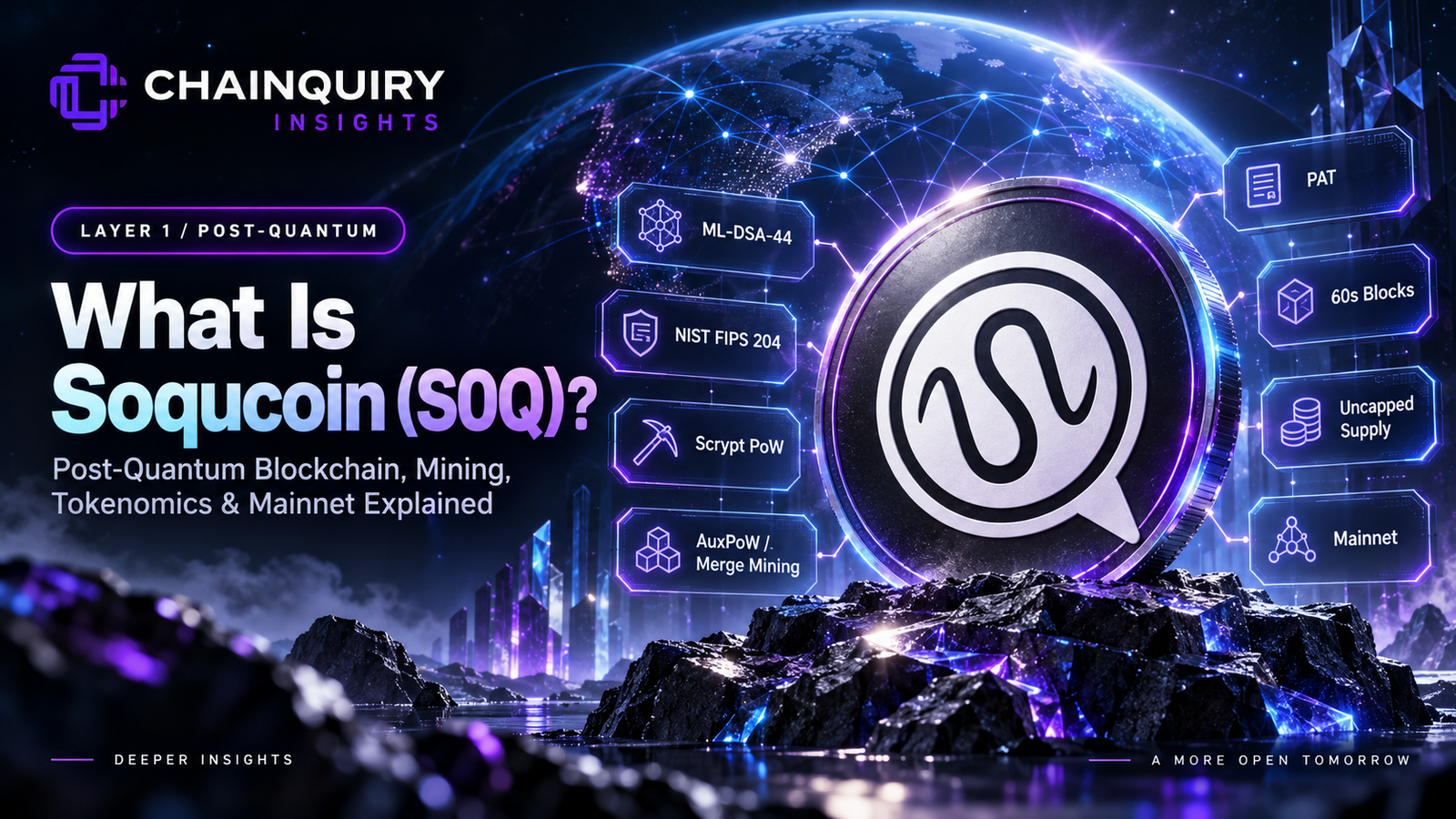
Quantum computing presents one of the most significant long-term challenges to public-key cryptography. Soqucoin (SOQ) is taking an unusual approach to that challenge: instead of planning to replace vulnerable signatures later, it is building a Proof-of-Work blockchain around post-quantum digital signatures from the beginning.
That decision shapes almost every part of the network, from wallet addresses and transaction validation to its mining infrastructure.
Soqucoin combines NIST-standardized ML-DSA-44 cryptography with Scrypt Proof of Work, Auxiliary Proof of Work (AuxPoW) merge mining, and a native cryptocurrency called SOQ.
But how does Soqucoin actually work? What makes it different from Bitcoin and Dogecoin? How is SOQ distributed, and what should users know before its mainnet launch?
This Chainquiry research guide examines the project’s technical architecture, tokenomics, security assessments, ecosystem and development status using publicly available primary sources.
What Is Soqucoin (SOQ)?#
Soqucoin is an open-source Layer 1 cryptocurrency network designed around post-quantum cryptographic security.
Like Bitcoin and Dogecoin, Soqucoin uses Proof of Work to produce blocks and maintain a shared transaction history. Unlike traditional cryptocurrency implementations that depend on elliptic-curve digital signatures, Soqucoin uses ML-DSA-44, a lattice-based digital signature algorithm standardized by the US National Institute of Standards and Technology (NIST).
SOQ is the native cryptocurrency of the Soqucoin blockchain. It is used for network transactions, transaction fees and Proof-of-Work mining rewards.
Soqucoin is not an ERC-20 token or a cryptocurrency running on another network. It has its own blockchain, consensus rules and native transaction format.
The project builds on software architecture derived from Dogecoin Core while introducing its own genesis block, post-quantum transaction signatures, address format, issuance schedule and additional protocol mechanisms.
Its central design principle is straightforward: make quantum-resistant transaction authentication a foundational property rather than a future upgrade.
For a structured project overview, official links and verification references, visit the Soqucoin (SOQ) listing on Chainquiry.
Why Is Post-Quantum Security Important for Cryptocurrency?#
Most established cryptocurrencies use digital signature systems based on mathematical problems believed to be difficult for classical computers.
Bitcoin, for example, has historically used elliptic-curve cryptography to authorize transactions.
A sufficiently powerful fault-tolerant quantum computer running Shor’s algorithm could threaten the underlying mathematical assumptions of widely used elliptic-curve signatures.
That does not mean existing quantum computers can currently steal arbitrary Bitcoin or other cryptocurrency funds. The scale and reliability required for such attacks remain major engineering challenges.
Nevertheless, the possibility creates a genuine long-term security problem.
Digital signatures are essential to proving that a cryptocurrency transaction was authorized by the holder of the corresponding private key. If the signature scheme becomes vulnerable, exposed public keys may become a serious attack surface.
Projects can respond by planning future migrations to post-quantum algorithms, implementing hybrid signing systems or adopting post-quantum signatures from the outset.
Soqucoin follows the third approach.
Rather than introducing quantum-resistant signing as an optional later feature, the network is designed around ML-DSA-44 transaction signatures.
This is what Soqucoin means when it describes itself as post-quantum from genesis.
How Does Soqucoin Use ML-DSA-44 and Dilithium?#
One of Soqucoin’s most important technical decisions is its use of ML-DSA-44.
ML-DSA stands for Module-Lattice-Based Digital Signature Algorithm. It is part of NIST Federal Information Processing Standard 204, published in August 2024.
The algorithm is derived from the CRYSTALS-Dilithium family of post-quantum digital signatures.
Unlike elliptic-curve systems, ML-DSA relies on mathematical problems involving structured lattices. No efficient quantum algorithm is currently known to solve the underlying problems at the security levels for which the scheme was designed.
Soqucoin uses the ML-DSA-44 parameter set, corresponding to NIST security category 2.
Its published signature specifications include:
- Digital signature algorithm: ML-DSA-44 (Dilithium)
- Cryptographic standard: NIST FIPS 204
- Public key size: 1,312 bytes
- Signature size: 2,420 bytes
- Blockchain model: UTXO-based transactions
According to the project’s cryptographic documentation, ML-DSA-44 replaces ECDSA in the transaction authorization path.
This matters because post-quantum protection is not achieved merely by changing a blockchain’s marketing terminology, hashing algorithm or wallet interface.
The relevant cryptographic verification rules must be implemented consistently in transactions, wallets, nodes and consensus-critical software.
There is also an important limitation: using a NIST-standardized algorithm does not automatically make every software implementation secure. Coding errors, wallet vulnerabilities, key-management failures and other protocol weaknesses remain possible.
Post-quantum cryptography addresses a particular category of cryptographic risk. It does not eliminate every blockchain security risk.
How Does Soqucoin Handle Larger Post-Quantum Signatures?#
Post-quantum signatures introduce practical engineering trade-offs.
An ML-DSA-44 signature is substantially larger than the compact signatures commonly associated with traditional cryptocurrency systems.
Larger signatures can increase blockchain data requirements, bandwidth usage, storage costs and the amount of information nodes must process.
To address parts of this problem, Soqucoin has developed the Practical Attestation Technique, or PAT.
According to its technical specification, PAT uses Merkle-based commitments to represent a batch of post-quantum signatures through a compact on-chain commitment.
The project’s documentation describes a fixed 100-byte commitment structure.
A critical distinction is that this does not mean the underlying 2,420-byte signatures disappear. The signatures remain in witness data, and the compact commitment must not be confused with complete elimination of their storage or verification costs.
PAT illustrates the broader engineering problem facing post-quantum blockchains: cryptographic security must be balanced against transaction size, verification efficiency and network performance.
The design is technically interesting, but production performance, implementation correctness and long-term operational reliability must still be evaluated independently.
How Does Soqucoin Mining Work?#
Soqucoin uses Scrypt Proof of Work to secure its blockchain.
In a Proof-of-Work system, miners perform computational work while attempting to create blocks that satisfy the network’s difficulty requirements.
Other nodes verify valid blocks and enforce the protocol’s transaction and issuance rules.
Soqucoin targets an average block interval of approximately 60 seconds.
Its mining model shares important characteristics with Litecoin and Dogecoin, both of which use Scrypt-based mining infrastructure.
Modern Scrypt mining is primarily associated with specialized ASIC hardware, although the project’s documentation also discusses other hardware configurations.
Soqucoin’s Scrypt compatibility provides a practical advantage: existing mining operators may be able to support the network without investing in an entirely new category of mining hardware.
However, hardware compatibility alone does not guarantee profitable mining.
Actual returns depend on network difficulty, block rewards, electricity costs, pool fees, uptime, equipment efficiency and the market value of SOQ.
What Is Soqucoin AuxPoW and Merge Mining?#
One of Soqucoin’s distinguishing characteristics is support for Auxiliary Proof of Work, commonly called AuxPoW.
AuxPoW enables compatible cryptocurrency networks to share underlying mining work.
For Soqucoin, this creates the possibility of participating alongside the established Litecoin and Dogecoin Scrypt mining ecosystem.
Instead of dedicating separate hardware exclusively to SOQ, a compatible mining pool can construct mining work that helps secure multiple networks.
This is known as merge mining.
Importantly, merge mining does not combine the cryptocurrencies into one blockchain.
Soqucoin, Litecoin and Dogecoin maintain distinct transaction histories, native assets, monetary policies and consensus rules.
Their relationship concerns compatible mining infrastructure and the use of shared proof-of-work computations.
The project’s official AuxPoW documentation explains the intended integration for miners and mining pool operators.
For more background on the established Scrypt ecosystem, Chainquiry also covers Dogecoin’s Proof of Work and merged mining architecture.
A newly launched merge-mined network should not automatically be assumed to possess the full economic security of its more established mining partners. Actual security depends on participating hashpower, pool adoption, network conditions and consensus behavior.
Soqucoin Tokenomics: Supply, Block Rewards and Inflation#
Soqucoin follows a predictable Proof-of-Work issuance model with scheduled reductions in block rewards.
Unlike Bitcoin, however, SOQ does not have a permanently fixed maximum supply.
The network starts with a relatively high block reward and transitions through several issuance epochs before reaching a perpetual block subsidy.
According to the official Soqucoin tokenomics documentation, the planned issuance schedule is:
| Block range | Reward per block | Cumulative scheduled mining issuance |
|---|---|---|
| 1–250,000 | 100,000 SOQ | 25 billion SOQ |
| 250,001–500,000 | 50,000 SOQ | 37.5 billion SOQ |
| 500,001–750,000 | 25,000 SOQ | 43.75 billion SOQ |
| 750,001–1,000,000 | 12,500 SOQ | 46.875 billion SOQ |
| 1,000,001 onward | 2,500 SOQ | Perpetual additional issuance |
The four initial mining epochs are designed to distribute approximately 46.875 billion SOQ over roughly 1.9 years, assuming average one-minute blocks.
Thereafter, the 2,500 SOQ perpetual subsidy corresponds to approximately 1.314 billion newly mined SOQ annually at the target block rate.
Because issuance continues indefinitely, Soqucoin has no hard maximum supply.
The continuing subsidy is designed to maintain an economic incentive for miners rather than eventually depending exclusively on transaction fees.
Although the absolute number of newly issued coins remains substantial, the same annual issuance represents a progressively smaller percentage of total supply as the circulating amount grows.
This model should not be described as deflationary or as having Bitcoin-style fixed scarcity.
Its long-term economic results will depend on network adoption, security expenditure, market demand and how the actual mining ecosystem develops.
Does Soqucoin Have a Premine or Team Allocation?#
The Soqucoin Foundation describes its distribution philosophy as having no founder premine, development tax or reserved insider allocation.
There is, however, an important distinction between its regular mining emission schedule and the one-time pSOQ migration.
The Foundation’s published migration record identifies a finalized allocation of approximately 328.6 million SOQ to 70 eligible addresses, intended to be included in the first mainnet block.
These allocations relate to holders participating in an earlier Solana-based pSOQ migration process, not to ordinary newly mined block rewards.
Consequently, readers should distinguish the project’s no-founder-premine claim from the separate genesis migration allocation.
This is particularly relevant when evaluating the initial circulating supply and distribution of native SOQ.
What Is pSOQ, and How Is It Different From Native SOQ?#
Soqucoin also has an associated token called pSOQ on the Solana blockchain.
pSOQ should not be confused with native SOQ.
Native SOQ is the cryptocurrency of Soqucoin’s independent Layer 1 network, while pSOQ exists as a token on Solana.
The Foundation documented a one-time conversion process that ran from September 29 to October 5, 2026.
According to its public records, eligible participants acted from their own wallets during this process, with the resulting native allocations intended to appear at mainnet genesis.
The published process has closed and should not be interpreted as an ongoing swap service.
Users should also be cautious of unofficial migration websites, requests to send funds to unknown addresses or anyone claiming to reopen a completed migration window.
For the authoritative technical record, refer directly to the Soqucoin Foundation’s migration page.
Has Soqucoin Been Audited? Reviewing the Halborn Security Assessment#
Independent security research is especially important for blockchains introducing new cryptographic implementations and consensus-critical functionality.
Soqucoin commissioned Halborn to examine parts of its blockchain node and post-quantum infrastructure.
The principal assessment took place between February 17 and March 24, 2026.
The published Halborn blockchain node assessment reported 30 findings:
- 3 critical
- 1 high
- 3 medium
- 3 low
- 20 informational
All 30 findings were subsequently marked as resolved in the published report.
The assessed components included post-quantum cryptographic code, wallet encryption, key management, signature aggregation and block validation logic.
Some findings involved particularly serious weaknesses, including signature verification and memory-safety issues.
Their documented remediation is meaningful because it demonstrates that independent examination identified concrete technical problems and that fixes were reported.
A separate Halborn architecture assessment also recorded six resolved findings in a narrower cryptographic review.
Nevertheless, an assessment is not a guarantee that software is free from vulnerabilities.
Audit conclusions apply to the code, scope and period examined. Later changes, unreviewed components and the operational conditions of a live network can introduce additional risks.
The project also documents further security work required before certain experimental features can become active.
For users considering mining, development or financial exposure, publicly accessible audit reports provide a stronger research foundation than unsupported claims of complete security.
Soqucoin’s 288-Block Finality Rule#
Another technically distinctive part of Soqucoin’s design is a consensus-level limit on deep blockchain reorganizations.
Traditional Proof-of-Work blockchains generally provide increasing probabilistic confidence as more blocks are built on top of a transaction.
Soqucoin introduces an additional rule under which synchronized nodes reject reorganizations exceeding 288 blocks.
At a target interval of one minute per block, this represents approximately 4.8 hours.
The purpose is to make sufficiently deep transaction history difficult to replace, including in scenarios involving rented mining power and competing chains.
However, this introduces its own trade-offs.
Transactions younger than the finality horizon can still be exposed to chain reorganizations. A sufficiently long network partition can also create conflicting histories that cannot automatically reconcile under the bounded-reorganization rule.
New or long-disconnected nodes may require a trustworthy recent chain reference to establish the correct network history.
These limitations are discussed in the project’s chain finality documentation.
This is an example of why blockchain security cannot be judged from cryptographic signatures alone. Consensus assumptions, node connectivity, mining participation and operational recovery procedures are also important.
Soqucoin Wallets, Developer Tools and Ecosystem#
A blockchain’s long-term usefulness depends on more than its cryptographic design.
Users need functioning wallets, developers need reliable tools, miners need infrastructure, and network operators need accessible software.
Soqucoin has been developing several components around its Layer 1 protocol.
SoquShield Wallet#
SoquShield is presented as a self-custodial wallet supporting the project’s post-quantum signing architecture.
The official documentation describes mobile wallet availability and support for native SOQ alongside pSOQ.
Users should obtain wallet applications through verified official channels and confirm that the wallet matches the network they intend to use.
SOQUPOOL Mining Infrastructure#
SOQUPOOL provides Scrypt mining infrastructure associated with the Soqucoin ecosystem.
It is intended to help miners participate in supported mining operations, including the project’s AuxPoW model.
Mining pool compatibility, payouts, fees and production network support should be checked against the pool’s current information.
Developer SDK and Full Nodes#
Soqucoin provides developer documentation, a TypeScript SDK, RPC references and an in-browser developer playground.
The project’s GitHub repository publishes the node software and related technical materials.
These resources allow developers to inspect implementations, experiment with transactions and participate in technical development.
Soqucoin Foundation#
The Soqucoin Foundation is a nonprofit organization involved in protocol stewardship, research support, public documentation and ecosystem development.
The Foundation is distinct from the blockchain’s individual users, miners and node operators.
Research: Confidential Transactions and Payment Channels#
Soqucoin also publishes research into confidential assets and post-quantum payment-channel infrastructure.
The SoquObscura system, for example, is a research-stage confidential-asset proposal with no scheduled production activation.
The project’s payment-channel work includes stagenet experimentation, but research results and prototype measurements should not be treated as production network guarantees.
Similarly, USDSOQ is described as native stablecoin issuance technology being developed for licensed operators; it is not an active mainnet stablecoin.
These initiatives show the direction of the project’s research, but readers should distinguish working stagenet demonstrations from independently audited, active mainnet features.
When Is the Soqucoin Mainnet Launch?#
According to the updated launch information provided to Chainquiry, Soqucoin’s mainnet is scheduled for:
October 13, 2026, at 15:00 UTC.
The event represents the intended transition from pre-production testing toward a live native SOQ network.
The project previously published an October 8 target, which remains in some official documentation. The updated schedule should therefore be verified through Soqucoin’s current official announcements.
At the time of this review on October 8, the project’s website continued to identify the operational network as stagenet.
A scheduled launch should not be confused with confirmation of a successful genesis block, live network stability or exchange availability.
Readers can follow the Soqucoin mainnet launch countdown on Chainquiry for the scheduled event and updated countdown information.
Following launch, independent confirmation should include a functioning mainnet explorer, accessible full nodes, published genesis information and operational mining infrastructure.
What Makes Soqucoin Different From Bitcoin and Dogecoin?#
Soqucoin shares several architectural ideas with established Proof-of-Work cryptocurrencies, particularly the UTXO transaction model and Scrypt mining ecosystem.
However, important differences remain.
Compared with Bitcoin, Soqucoin uses Scrypt instead of SHA-256 mining, targets shorter block intervals, does not have a fixed maximum supply, and adopts ML-DSA-44 instead of Bitcoin’s existing signature architecture.
Bitcoin has a much longer operational history and a substantially larger established security and infrastructure ecosystem.
Compared with Dogecoin, Soqucoin shares Scrypt and AuxPoW-compatible mining characteristics, but introduces its own post-quantum signing model, monetary schedule and consensus modifications.
Dogecoin is an established production network with years of mining and transaction history, whereas Soqucoin is approaching its first production launch.
For readers comparing proof-of-work architectures, Chainquiry has additional research covering Bitcoin and Dogecoin.
The most meaningful distinction is not that Soqucoin is automatically superior to either network. It is that Soqucoin prioritizes post-quantum transaction authentication from genesis while pursuing compatibility with existing Scrypt mining infrastructure.
What Are the Risks and Challenges Facing Soqucoin?#
Soqucoin’s technical ambitions should be evaluated alongside the challenges of deploying a new Layer 1 blockchain.
Cryptographic implementation risk: Standardized algorithms provide an important foundation, but the surrounding wallet, signing, verification and consensus software must also be correct.
New-network risk: A young blockchain must establish stable block production, reliable node participation, adequate mining support and resilient infrastructure.
Consensus trade-offs: Bounded-reorganization finality can limit deep history changes but introduces operational challenges during long network partitions or node recovery.
Supply and market risk: SOQ has continuing issuance and an uncapped maximum supply. Its market price, liquidity and demand are not guaranteed by the protocol.
Research-versus-production risk: Some ecosystem components, including confidential assets and advanced payment channels, remain experimental or inactive on mainnet.
Self-custody risk: Users remain responsible for protecting private keys, recovery information and wallet authenticity.
The existence of a security assessment, a technical whitepaper or a functioning test environment should not be confused with a guarantee of future reliability or financial performance.
These are normal considerations when examining emerging blockchain infrastructure, particularly projects experimenting with new cryptographic and consensus designs.
Is Soqucoin Worth Watching?#
Soqucoin is an interesting example of how blockchain developers are responding to the future risks posed by quantum computing.
Rather than simply outlining a future migration, it attempts to integrate NIST-standardized post-quantum signatures directly into its transaction architecture.
Its combination of ML-DSA-44, Scrypt mining, AuxPoW compatibility, PAT signature commitments and bounded-reorganization finality creates a distinctive set of technical choices.
The presence of open-source code, detailed documentation and published security assessments also gives researchers tangible material to examine.
Whether the project achieves its longer-term goals will depend on successful mainnet operation, developer participation, mining adoption, continued security work and demand for the network’s capabilities.
Frequently Asked Questions About Soqucoin#
What is Soqucoin?#
Soqucoin is a Proof-of-Work Layer 1 blockchain designed around post-quantum ML-DSA-44 digital signatures. Its native cryptocurrency is SOQ.
Is Soqucoin quantum-resistant?#
Soqucoin uses the NIST-standardized ML-DSA-44 signature algorithm, which is designed to resist known attacks from sufficiently powerful quantum computers. That does not guarantee the security of every surrounding implementation or future feature.
What is the Soqucoin mining algorithm?#
Soqucoin uses Scrypt Proof of Work with support for Auxiliary Proof of Work (AuxPoW) merge mining.
Can Soqucoin be mined alongside Litecoin and Dogecoin?#
Its AuxPoW design allows compatible Scrypt mining infrastructure to support Soqucoin alongside Litecoin or Dogecoin. Actual participation depends on mining pool and network support.
Does SOQ have a maximum supply?#
No. Its issuance schedule eventually reaches a perpetual mining reward of 2,500 SOQ per block.
Is Soqucoin an ERC-20 token?#
No. Native SOQ belongs to the independent Soqucoin Layer 1 network. The related pSOQ token exists on Solana and should not be confused with native SOQ.
Has Soqucoin been audited?#
Yes. Halborn published security assessments covering selected blockchain and cryptographic components during 2026. The principal assessment identified 30 findings, all reported as resolved.
When does Soqucoin mainnet launch?#
The updated launch schedule supplied to Chainquiry is October 13, 2026, at 15:00 UTC. Readers should verify any further changes through official project communications.
Final Perspective#
Soqucoin is attempting something more specific than simply launching another Proof-of-Work cryptocurrency.
It is building a blockchain whose transaction authorization model starts with post-quantum digital signatures, while its mining infrastructure remains compatible with an established Scrypt ecosystem.
That combination is worth studying.
The most important questions now concern how the theoretical and implemented advantages translate into a stable production network, how successfully miners and developers participate, and whether its broader ecosystem moves from research to dependable live applications.
Soqucoin’s public documentation provides unusually detailed material for investigating those questions. Independent assessments provide additional context, although neither documentation nor auditing eliminates the uncertainties associated with a new blockchain.
For ongoing project information, explore the Soqucoin directory profile and upcoming network events on Chainquiry.

Research note: Reviewed October 8, 2026, using official protocol documentation, the public source repository, Foundation migration records, NIST standards and published Halborn assessments. This is document-based editorial research, not an independent source-code audit or production mainnet test. Soqucoin is a paid featured project on Chainquiry; factual claims and research references are independently presented. Cryptocurrency participation involves risk. Always verify current information and conduct your own research.