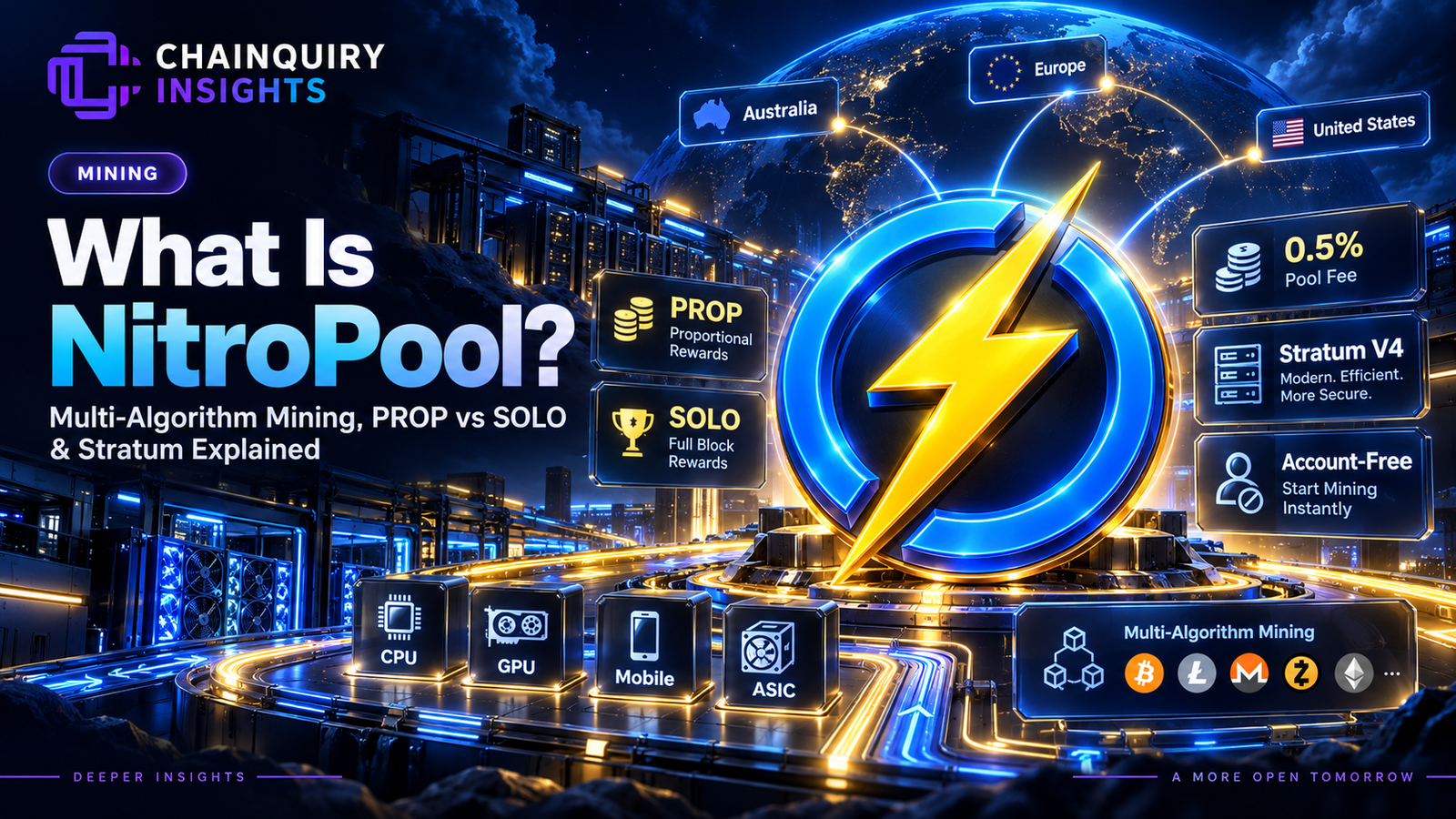
NitroPool is an independently operated cryptocurrency mining pool built around multi-coin Proof-of-Work mining, account-free connections and support for a wide range of mining hardware.
Instead of requiring miners to create an account, NitroPool uses the miner’s cryptocurrency wallet address as the primary identifier. The platform supports both PROP and SOLO mining, operates regional Stratum endpoints in Australia, Europe and the United States, and currently publishes a pool fee of 0.5%.
NitroPool describes itself as a small, community-driven project that remains under active development. Its public Bitcointalk announcement states that the service is maintained by a single developer, while its infrastructure has expanded over time to support different algorithms, mining devices and cryptocurrency networks.
That makes NitroPool somewhat different from large mining operations centered almost exclusively around Bitcoin or another major network.
Its role is closer to a multi-network mining infrastructure provider, with support extending across smaller and emerging Proof-of-Work chains alongside different classes of hardware.
How NitroPool Works#
At a basic level, NitroPool sits between miners and the blockchain network they want to mine.
A miner connects compatible mining software or hardware to one of NitroPool’s Stratum servers. Work is distributed to the miner, shares are submitted back to the pool, and the pool tracks those shares while attempting to discover valid blocks.
NitroPool does not require a traditional user account.
Instead, miners generally connect using a payout wallet address and, where supported, an optional worker identifier.
The pool then associates submitted shares, workers, hashrate, earnings and payments with that mining address.
This account-free model allows miners to begin mining without registering, creating login credentials or providing personal information.
NitroPool continues to perform the normal operational functions of a mining pool. It distributes mining work, validates submitted shares, calculates earnings and processes payouts.
Any earnings are recorded as an unpaid balance against the miner’s wallet address, rather than through a separately registered pool account.
Once rewards are confirmed and the balance meets the applicable payout threshold, NitroPool automatically sends the funds to the miner’s wallet according to its published payout schedule.
PROP vs SOLO Mining on NitroPool#
One of NitroPool’s main features is the availability of both PROP and SOLO mining modes.
These represent two very different approaches to distributing mining rewards.
PROP Mining#
PROP stands for proportional mining.
Under a proportional pool model, miners contribute shares during a mining round. If the pool discovers a block, the available pool reward is distributed among participating miners according to the amount of qualifying work they contributed.
A miner therefore does not normally need to be the individual machine that discovered the block to receive part of the reward.
The trade-off is that the reward is divided between multiple miners.
PROP can make reward distribution less dependent on a single miner personally finding an entire block, although income remains variable and ultimately depends on the pool discovering blocks.
SOLO Mining#
SOLO mining works differently.
The pool still provides the Stratum infrastructure and handles communication with the blockchain network, but a miner generally receives the relevant mining reward only when their own submitted work produces the successful block.
That creates significantly higher variance.
A small miner could theoretically discover a block quickly — or could mine for a very long period without finding one at all.
SOLO mining should therefore not be interpreted as a predictable income mechanism.
NitroPool currently advertises both PROP and SOLO mining across a number of its supported networks.
NitroPool’s 0.5% Pool Fee#
NitroPool currently publishes a 0.5% pool fee.
The same figure appears in both NitroPool’s public announcement information and Chainquiry’s structured NitroPool platform profile.
NitroPool has also stated that qualifying balances are processed automatically according to its payout schedule, with thresholds and conditions varying depending on the supported network.
Because NitroPool supports multiple independent cryptocurrency networks, miners should always verify the current payout rules for the particular coin they intend to mine before allocating hardware.
Pool settings can change, and differences in coin denomination, minimum payouts and network conditions can materially affect mining results.
Regional Stratum Infrastructure#
Rather than operating through only one endpoint, NitroPool provides regional Stratum servers for:
Australia
Europe
United States
Individual coin integrations use corresponding ports depending on the network being mined.
This matters because mining communication is latency-sensitive.
Mining hardware continuously receives work from the pool and submits shares back to it. Excessive network delays can increase the chance that submitted work becomes stale by the time it reaches the server.
A geographically closer Stratum endpoint does not guarantee better mining performance, but regional infrastructure can help reduce unnecessary network latency and gives miners alternative connection points.
NitroPool expanded its regional Stratum infrastructure as part of an effort to improve connectivity and provide additional options for miners in different parts of the world.
What Is NitroPool Stratum V4?#
NitroPool describes its current backend as NitroPool Stratum V4.
There is an important naming distinction here.
NitroPool Stratum V4 should not be confused with Stratum V2, the separately developed mining protocol commonly discussed in the Bitcoin mining industry.
In NitroPool’s terminology, “V4” refers to the fourth generation of its own pool implementation.
According to NitroPool’s technical information, its backend remains based around the Stratum V1 protocol rather than representing a new industry-wide Stratum protocol.
NitroPool describes its implementation as including features such as:
Adaptive variable difficulty
Miner and firmware detection
Miner-aware starting difficulty
ASICBoost support
Version rolling
Mining-rental compatibility
Support for newer algorithms
Support for non-standard blockchain implementations
These capabilities are particularly relevant for a pool attempting to support hardware ranging from small hobby miners to conventional ASIC systems.
Some of these backend details are operator-provided technical descriptions rather than independently audited specifications, so they should be understood in that context.
CPU, GPU, Mobile and ASIC Mining#
NitroPool is designed to accommodate several different types of mining hardware.
Depending on the selected cryptocurrency and algorithm, its infrastructure may be used with:
CPUs
GPUs
Mobile miners
Small ASIC devices
Full-sized ASIC miners
The hardware that can actually be used is determined primarily by the Proof-of-Work algorithm of the chosen network.
A SHA-256 ASIC cannot simply be redirected toward an unrelated CPU-oriented algorithm, for example.
NitroPool therefore acts as a common pool interface across multiple mining ecosystems rather than making every device compatible with every supported coin.
Its public activity has included support for several algorithm families, including SHA-256, Scrypt, Argon2id, YescryptR16 and CivicLight-based mining.
What Coins Does NitroPool Support?#
NitroPool supports multiple Proof-of-Work networks, and its supported coin list can change as new integrations are added or existing ones are updated.
Examples appearing in NitroPool’s public information include networks such as:
Bitweb
CivicNet
Block Zero
Krypton
FairBrix
LitecoinII
NitoCoin
BitcoinII
BlackGold
Kvanta5
BitcoinValue
Fennec
This list should be treated as a snapshot rather than a permanent catalog.
Smaller cryptocurrency networks can change quickly. Pools may add support, remove networks, update daemon software or temporarily disable mining when a blockchain undergoes upgrades or technical problems.
NitroPool has also publicly documented individual integrations over time.
For example, its Bitweb support uses Argon2id mining, while CivicNet uses the CivicLight algorithm. Several other supported networks use SHA-256 or Scrypt.
NitroPool’s Mining Software#
NitroPool’s role is not limited to operating pool servers.
Its public GitHub organisation contains mining-related repositories associated with several supported networks, including software for projects such as:
Kvanta5
Bitweb
Fennec
CivicNet
The CivicLight CPU miner provides one example.
Its public repository describes optimized Linux and Windows x86-64 builds, automatic CPU feature detection, Intel and AMD processor support and several instruction-set-specific binaries.
These include builds supporting technologies such as AVX2, SHA-NI and AVX-512 where compatible hardware is available.
According to the repository documentation, the miner is distributed without a developer fee.
The repository also publishes NitroPool regional connection endpoints for CivicNet mining.
There is an important distinction between NitroPool itself and the open-source software associated with its ecosystem.
NitroPool was originally built on the open-source YiiMP mining-pool codebase, but the production platform has since been significantly modified with privately developed code. NitroPool itself, including its complete production backend, should therefore not be described as an open-source mining pool.
Separately, NitroPool publishes some miners and related software projects as open-source repositories. These publicly available tools represent individual components of the broader NitroPool ecosystem rather than the source code for the pool’s complete production infrastructure.
Miner Detection and Variable Difficulty#
Mining pools have to accommodate devices with enormous differences in hashrate.
A hobby miner may submit work at a dramatically different rate from a large ASIC.
This is where variable difficulty, commonly shortened to vardiff, becomes useful.
Instead of forcing every miner to submit shares at exactly the same difficulty, the pool can adjust share difficulty according to the miner’s observed performance.
Higher-hashrate devices can receive more difficult share targets while lower-powered devices can receive easier ones.
NitroPool states that its system uses adaptive difficulty together with miner detection and miner-aware starting difficulty.
This affects how efficiently miners communicate with the pool.
It does not, however, change the underlying blockchain’s consensus difficulty or make block discovery inherently easier.
Pool share difficulty and blockchain mining difficulty are separate concepts.
ASICBoost and Version Rolling#
For compatible SHA-256 mining environments, NitroPool advertises ASICBoost and version-rolling support.
ASICBoost is a mining optimisation that can improve the efficiency of certain SHA-256 mining operations.
Version rolling allows compatible miners to modify designated parts of the block header version field while exploring additional mining work.
Whether these capabilities matter to an individual miner depends on the network, mining firmware and hardware being used.
Support should therefore be confirmed for the exact coin and device before mining begins.
Is NitroPool Account-Free?#
Yes, in the conventional website-account sense.
NitroPool does not require miners to register a username, password and hosted pool account before they begin mining.
The mining wallet address functions as the primary payout identity.
That has some practical advantages.
There is no ordinary account password to secure, no exchange-style account balance to maintain and no identity profile required merely to connect mining hardware.
But miners should not interpret “account-free” as meaning that all operational trust has been removed.
The pool still controls its own servers and payout infrastructure and determines how submitted shares are accounted for.
Until a reward has reached a miner’s own wallet, the miner remains exposed to pool availability and payout-processing risk.
What Are the Risks of Mining Through NitroPool?#
The largest risks are not unique to NitroPool.
They are characteristics of pool mining and smaller Proof-of-Work ecosystems more generally.
Mining results can be affected by:
Network difficulty
Total network hashrate
Block discovery
Coin price
Electricity costs
Hardware efficiency
Pool uptime
Stale shares
Payout thresholds
Network stability
The continued operation of the cryptocurrency itself
SOLO miners face particularly high variance because finding a valid block is probabilistic.
PROP miners spread block rewards across participating miners, but they still depend on the pool actually discovering blocks.
There is also operator concentration to consider.
NitroPool’s public announcement describes the project as being maintained by a single developer.
That may allow development decisions to be made quickly, but it also creates dependency on one primary operator for maintenance and infrastructure.
The supported cryptocurrencies create another layer of risk.
Many are comparatively small Proof-of-Work networks.
Smaller chains can experience limited liquidity, changing hashrates, software upgrades, reorganisations, limited exchange support or development interruptions.
A functioning mining pool does not itself establish the economic value or long-term viability of the cryptocurrency being mined.
What Should Miners Verify Before Using NitroPool?#
Before pointing hardware at any mining pool, miners should independently verify several important details.
Confirm that the Stratum hostname and port come from an official NitroPool source.
Make sure the payout wallet belongs to the cryptocurrency network being mined.
Check the current pool fee.
Check the minimum payout threshold.
Confirm whether the connection is using PROP or SOLO mode.
Verify any required worker or password parameters.
Check whether mining software comes from the expected project repository.
Monitor rejected and stale shares after connecting.
Verify received payouts independently through the relevant blockchain explorer.
Understand the cryptocurrency being mined rather than evaluating only the pool.
Calculate electricity and hardware costs separately from estimated mining rewards.
Mining software can also place sustained load on CPUs, GPUs and ASICs.
Users should monitor cooling, device temperatures and power consumption during operation.
NitroPool Today#
NitroPool has developed into mining infrastructure spanning multiple Proof-of-Work algorithms, several classes of mining hardware and regional Stratum locations across Australia, Europe and the United States.
Its distinguishing characteristics are less about operating at the scale of the largest mining pools and more about flexibility.
Miners can connect without creating a traditional account, choose between PROP and SOLO operation and access infrastructure supporting networks across several different Proof-of-Work algorithms.
The project has also released several miners and related software projects as open-source repositories, although these are separate from NitroPool’s privately developed production pool infrastructure.
For miners researching NitroPool, the most useful approach is the same one that applies to mining pools generally:
Verify the connection details.
Understand the payout system.
Research the network being mined.
Check the current fee and threshold.
Monitor submitted shares.
Independently confirm payouts.
A mining pool can provide infrastructure.
It cannot remove the underlying uncertainty of Proof-of-Work mining.
Frequently Asked Questions#
What is NitroPool?#
NitroPool is a multi-coin Proof-of-Work mining pool supporting multiple mining algorithms and hardware types.
It offers PROP and SOLO mining and operates regional Stratum infrastructure in Australia, Europe and the United States.
Does NitroPool require an account?#
No traditional pool account is required.
Miners connect using their cryptocurrency wallet address, which is used to associate mining activity and payouts.
What is the NitroPool fee?#
NitroPool currently publishes a pool fee of 0.5%.
Miners should verify the current fee before connecting because pool conditions can change.
Does NitroPool support SOLO mining?#
Yes.
NitroPool supports both PROP and SOLO mining across supported networks.
Where are NitroPool’s Stratum servers?#
NitroPool publishes regional Stratum infrastructure in:
Australia
Europe
United States
Is NitroPool Stratum V4 the same as Stratum V2?#
No.
NitroPool uses “Stratum V4” as the name of its own fourth-generation backend implementation.
It should not be confused with the separate Stratum V2 mining protocol used elsewhere in the cryptocurrency mining industry.
Is NitroPool open source?#
No. NitroPool itself is not open source.
The platform was originally built on the open-source YiiMP codebase, but its production infrastructure has since been significantly modified with privately developed code.
Some miners and related projects developed within the wider NitroPool ecosystem are released separately as open-source software, but those repositories should not be interpreted as the source code for NitroPool’s production pool backend.
Are NitroPool mining rewards guaranteed?#
No.
Mining rewards depend on factors such as block discovery, miner hashrate, network difficulty, pool performance and the selected payout mode.
SOLO mining in particular can involve long periods without finding a successful block.
Final Thoughts#
NitroPool combines account-free mining access, PROP and SOLO modes, regional Stratum infrastructure and support for multiple Proof-of-Work ecosystems.
Its approach may be particularly relevant to miners exploring smaller networks or hardware and algorithms that receive less support from larger mining pools.
Those capabilities should still be evaluated alongside the normal risks of cryptocurrency mining.
Pool infrastructure, low fees and technical compatibility cannot guarantee profitability, reliable block discovery or the future value of the cryptocurrency being mined.
Miners should verify current connection details, fees, payout conditions and supported networks directly before committing hardware or electricity costs.

View the full NitroPool platform profile on Chainquiry for structured technical details, official links, mining information and independent research sources.