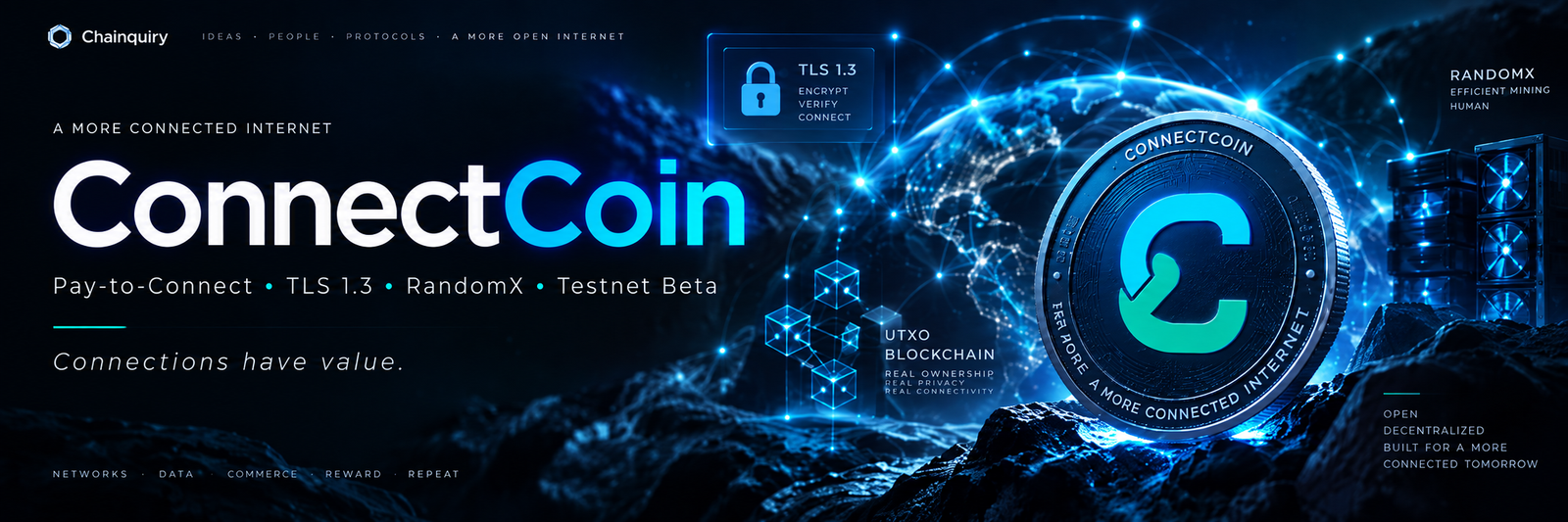
What Is ConnectCoin? How Pay-to-Connect Turns TLS Connections Into Verifiable Crypto Rewards
Most cryptocurrencies define fairly familiar conditions for spending coins. A wallet proves control of a private key, signs a transaction and broadcasts it to the network.
ConnectCoin is experimenting with another possibility: what if a cryptocurrency payment could also be claimed by proving that a particular cryptographically authenticated network interaction took place?
That is the idea behind Pay-to-Connect, or P2C. It is the defining feature of ConnectCoin, developed at connectcoincrypto.com.
ConnectCoin is a Bitcoin-derived, UTXO-based blockchain that introduces a new transaction-output type linked to TLS 1.3 connection proofs. Users can fund a reward tied to a domain, creating an incentive for verification through cryptographic evidence that maintains privacy and security while remaining verifiable by the network.
Another participant can contest the reward by presenting qualifying TLS evidence that the network can verify without establishing any direct internet connection. The proof is designed to be checked by multiple nodes, enabling decentralized validation of claims. This approach reduces centralized risk, supports trustless interaction, and aligns with the system’s goal of proving domain ownership and secure contributions without exposing extra network traffic.
As of September 2026, however, this is still an experimental network. ConnectCoin is running a public testnet beta, its GitHub repository says the software is not production-ready, and mainnet has not launched. Testnet coins are explicitly not intended to become mainnet coins.
That status is important. ConnectCoin is better understood today as a technically unusual blockchain project being tested in public rather than as an established mainnet cryptocurrency.
ConnectCoin at a Glance
The project describes itself as a peer-to-peer cryptocurrency with Pay-to-Connect functionality. Its current software stack includes a Qt wallet, full node, command-line tools, an optional CPU miner and automatic P2C claiming functionality. The code is publicly available under the MIT license.
ConnectCoin Core is based on the Bitcoin Core codebase and retains the UTXO accounting model, but this should not be interpreted to mean that ConnectCoin is compatible with Bitcoin.
Its white-paper explicitly says that changes to transaction encoding, proof-of-work and network parameters make ConnectCoin a separate network. Bitcoin balances, wallets and historical blocks are not carried across.
The distinction matters because the interesting part of ConnectCoin is not that it reuses Bitcoin-derived infrastructure. It is what the project adds to it.
That addition is Pay-to-Connect.
What Is Pay-to-Connect?
Pay-to-Connect is a special ConnectCoin transaction output designed around a DNS domain and a verifiable TLS 1.3 interaction.
In simplified terms, one participant funds a bounty. That bounty specifies a domain, an amount, a connection-work target and the TLS signature schemes the output will accept.
A claimant then prepares the transaction that would spend the bounty and attempts to obtain qualifying TLS evidence from the specified server. The resulting evidence is submitted as part of the spending transaction. ConnectCoin nodes verify the proof and, if the transaction satisfies all of the encoded conditions, the bounty can be spent.
The unusual part is that validators do not need to contact the website themselves.
Every handshake message and certificate required for consensus verification is carried with the claim. That allows nodes to evaluate the evidence deterministically rather than reproducing the external connection.
Conceptually, the process looks like this:
Founder creates P2C output → claimant fixes the payout transaction → claimant obtains qualifying TLS evidence → ConnectCoin nodes verify the evidence and settle the transaction.
Why TLS Is Involved
TLS is the protocol behind encrypted HTTPS connections.
When a compatible server establishes a TLS connection, part of the handshake is authenticated using a certificate-backed signing key. ConnectCoin uses a restricted subset of that authenticated handshake as evidence for satisfying a P2C output.
The claimant embeds a transaction-derived challenge into the connection attempt. The server then authenticates part of the handshake. That transcript, along with the necessary certificate information, becomes evidence that can be checked by ConnectCoin validators.
The proof is also bound to the intended claim transaction. Changing important transaction details changes the challenge and therefore requires fresh evidence.
This design is intended to prevent someone from simply copying a completed proof and redirecting the reward to another transaction.
But the white-paper is careful about what such evidence actually establishes.
A valid ConnectCoin proof demonstrates an authenticated transcript under a key accepted for the specified domain. It does not prove that a human visited a website, that particular application content was delivered, or that the server is independent from whoever is claiming the bounty.
That limitation is important when considering potential uses for the system.
Proof-of-Connect Is Not ConnectCoin Mining
One of the easiest aspects of ConnectCoin to misunderstand is the relationship between P2C and mining.
They are separate mechanisms.
ConnectCoin calls the evidence condition behind its connection rewards Proof-of-Connect. Pay-to-Connect then attaches that condition to a funded UTXO.
But producing a successful P2C proof does not create a block and does not mint new coins. It simply allows an already-funded reward to be spent.
The blockchain itself is secured separately through RandomX proof-of-work.
That means ConnectCoin has two distinct forms of computational activity: miners compete to produce blocks and secure transaction ordering, while P2C claimants compete for rewards that other users have already placed on the network.
They interact through the same blockchain, but they perform different jobs.
How ConnectCoin Mining Works
The current ConnectCoin testnet uses RandomX V2 for block proof-of-work.
RandomX is designed around general-purpose CPU execution and substantial memory use. ConnectCoin’s white-paper says the choice is intended to favor widely available CPUs and reduce the relative advantage of specialized mining hardware.
The ConnectCoin Core wallet includes an optional solo CPU miner for testnet4 and regtest. Mining is disabled by default and has to be deliberately started by the user. The built-in miner is not a Stratum pool client.
The current public-network design targets approximately 10-second blocks. The development parameters specify an initial recurring subsidy of 15 CC and a halving interval of three million blocks. At the target block interval, the white-paper calculates that interval at roughly 347 days, although actual block production can differ from its target schedule.
These are development and proposed monetary parameters for a project whose mainnet has not yet launched, rather than historical mainnet issuance data.
ConnectCoin’s Planned Supply
The September 2026 white-paper describes a nominal supply budget of 100 million CC.
Its proposed launch allocation assigns 90% of that nominal amount to ordinary mining, 5% to a Development Fund and 5% to a Developer’s Fund. The two 5 million CC allocations are planned to be created through the mainnet genesis block, with the white-paper also describing withdrawal limits intended to phase access to those funds over time.
Because the block-subsidy calculations use integer accounting and ConnectCoin also reduces available subsidy according to non-coinbase transaction weight, actual maximum issuance is not stated as exactly 100 million.
The white-paper calculates a theoretical maximum of approximately 99,999,984.9955 CC under its specified issuance assumptions, while noting that actual issuance could be lower.
There is an important caveat here: CC is currently a development display unit, not a final globally cleared ticker.
ConnectCoin’s own pre-launch identity document says the symbol CC is already associated with Canton Coin and that ConnectCoin needs to resolve naming, ticker and registry issues before public mainnet interoperability is advertised.
For that reason, it would be premature to treat CC as an established exchange ticker for ConnectCoin.
An Unusual Block-Space Incentive
ConnectCoin also modifies the economics around block space.
Under the proposed system, a miner can claim the scheduled block subsidy when producing a block containing only its coinbase transaction. As non-coinbase transaction weight is added, the amount of subsidy available to the miner is gradually reduced.
At half of the maximum non-coinbase block weight, the white-paper gives a subsidy reduction of about 5%. As usage approaches the consensus weight limit, the reduction approaches 10%.
The withheld amount is not sent to a treasury or redistributed to someone else. According to the white-paper, it is simply never created.
This creates an explicit trade-off for miners: including more transactions can produce fee revenue, but those transactions can also reduce the available block subsidy.
ConnectCoin’s native block-assembly policy is designed to consider that marginal subsidy cost when selecting transaction packages.
It is an uncommon variation on the usual relationship between transaction fees and block rewards.
How P2C Bounties Are Claimed
Each Pay-to-Connect bounty is represented by a single-use UTXO.
Multiple people can try to produce qualifying evidence for the same bounty at the same time, but only one conflicting spend can ultimately survive in the accepted blockchain history. Producing a valid proof therefore does not guarantee payment; another participant could have a competing claim confirmed first.
The current ConnectCoin wallet includes an Automatic Claims feature that can discover eligible P2C outputs and attempt to obtain the required connection evidence.
Automatic claiming is opt-in. According to the current policy described in the white-paper, the wallet periodically refreshes available candidates and considers factors such as the potential bounty value, probability of obtaining a qualifying work hash and observed connection performance.
Importantly, the white-paper says that this estimated reward calculation does not account for operating costs or competing claims.
So an apparently attractive bounty is not equivalent to a guaranteed profitable claim.
What Happens if a Domain Stops Working?
P2C also introduces risks that do not exist in an ordinary public-key payment.
Under the current transaction design, anyone can create a P2C bounty and anyone satisfying its spending conditions can claim it. But there is no creator-only refund mechanism and no built-in deadline allowing the funder to recover the coins if the specified domain becomes permanently unusable.
Funding a bounty is therefore a commitment to the conditions encoded in that output.
This could be consequential if the domain disappears, its TLS configuration changes in an incompatible way, certificates no longer satisfy the required conditions, or the bounty otherwise becomes difficult to claim.
The lack of a refund branch is not hidden in the project documentation, but it is an important limitation prospective testers should understand.
What Can Pay-to-Connect Be Used For?
The project describes its goal fairly narrowly: create a market for verifiable network interactions.
That wording is worth preserving.
ConnectCoin is not claiming that a TLS transcript provides a universal oracle for everything that happens on the internet. Instead, the construction attempts to prove a much more specific event: that a qualifying authenticated interaction associated with a domain produced evidence satisfying the output’s rules.
In principle, that could allow cryptocurrency rewards to be attached to connection-based tasks without requiring the person funding the bounty to manually approve the winner after the fact.
Compatible web servers also do not need to run ConnectCoin-specific software simply to generate the underlying TLS authentication used by the proof.
Whether this mechanism develops meaningful real-world demand will depend on what applications developers build around it and how the design performs outside a test environment.
For now, Pay-to-Connect is primarily notable as an experimental consensus and transaction mechanism rather than an established commercial network.
ConnectCoin Core and the Public Testnet
The current way to participate is through ConnectCoin Core.
The repository provides source-build instructions for Linux, macOS, Windows and several BSD systems. The standard build can include the Qt wallet, full node, daemon, CLI, testing tools and optional CPU mining functionality.
On its first launch, the beta defaults to ConnectCoin’s own testnet4. Users can create or restore a wallet, synchronize the chain, use conventional public-key transfers, create P2C bounties, enable automatic claims or start the optional CPU miner.
The project also operates a public blockchain explorer for the testnet, allowing blocks and transactions to be inspected separately from the local wallet interface.
All of this remains experimental. The GitHub documentation explicitly says that mainnet startup is currently rejected and that testnet balances will not become mainnet balances.
Is ConnectCoin Open Source?
Yes. ConnectCoin Core is publicly available on GitHub and is licensed under the MIT license. The repository retains Bitcoin Core attribution and copyright notices for inherited portions of the codebase.
The repository also includes protocol documentation for typed transaction outputs, Pay-to-Connect, mining, wallet behavior, testing and network operation.
This makes substantial portions of the project’s implementation available for independent review.
However, public code should not automatically be interpreted as independently audited code. The official repository itself encourages independent testing and review, particularly for consensus, networking, wallet and P2C changes.
No third-party security audit of the complete ConnectCoin implementation was identified in the sources reviewed for this article.
The ConnectCoin Name Needs an Important Clarification
Anyone researching the project through a search engine is likely to encounter an older cryptocurrency called Connect Coin, commonly identified by the ticker XCON.
That is not the project covered in this article.
CoinMarketCap still has an entry for the older Connect Coin as an Ethereum-based asset, including an ERC-20 contract address.
The current ConnectCoin project’s own development documentation acknowledges the conflict. Its August 2026 branding review explicitly states that “Connect Coin” has previously been used by XCON and says the current name has not yet been cleared for public mainnet launch. It also identifies other potential naming and ticker conflicts that need to be resolved before launch.
This distinction is essential when researching prices, exchanges, token contracts or historical information.
Current ConnectCoin at connectcoincrypto.com has not launched mainnet, so market data associated with the old XCON Ethereum token should not be attributed to this project.
What Are the Main Risks and Limitations?
ConnectCoin remains at an unusually early stage.
The largest limitation is straightforward: there is currently no production mainnet. Network behavior, economics, identifiers and other parameters may still change before a public launch. The project’s own branding document describes several unresolved pre-launch issues, including name, ticker and standards-registration conflicts.
P2C itself also depends on a restricted TLS 1.3 profile rather than supporting every possible TLS configuration. The white-paper notes that this deliberate restriction simplifies consensus interpretation but can reduce compatibility with some servers.
There are economic uncertainties as well. A claimant can spend resources searching for a valid proof but still lose the reward to another claimant. A bounty can become difficult or impossible to redeem if its domain can no longer satisfy the encoded conditions, and the current P2C design does not include a creator refund branch.
Finally, the project is still under active development. Open source code and a public testnet improve transparency, but neither guarantees that the eventual mainnet design will be secure, widely adopted or economically sustainable.
ConnectCoin’s Current Status
As of 17 September 2026, ConnectCoin is best described as an experimental Bitcoin-derived Layer 1 blockchain running a public testnet beta.
Its defining technical idea is Pay-to-Connect: the ability to fund transaction outputs that can be redeemed with a qualifying TLS 1.3 connection proof. RandomX proof-of-work separately secures the blockchain, while the project is also experimenting with a monetary policy that makes block subsidy partly dependent on transaction weight.
The project is notable because the P2C mechanism tries to connect a cryptocurrency transaction to independently verifiable evidence of an external network interaction without requiring every blockchain node to recreate that interaction.
At the same time, ConnectCoin is not yet a finished cryptocurrency network.
There is no mainnet, the current ticker remains provisional, name conflicts are unresolved, and the implementation is explicitly labeled experimental and not production-ready.
For researchers and technically inclined users, that makes ConnectCoin an interesting project to examine precisely for what it is today: a public experiment in using TLS authentication as a cryptocurrency spending condition.
FAQ
What is ConnectCoin?
ConnectCoin is an experimental Bitcoin-derived cryptocurrency project that adds Pay-to-Connect outputs, allowing funded bounties to be claimed using qualifying TLS 1.3 connection evidence. It currently operates on a public testnet rather than a production mainnet.
What is Pay-to-Connect?
Pay-to-Connect, or P2C, is a ConnectCoin transaction-output type associated with a DNS domain, reward, connection-work target and accepted TLS authentication schemes. A claimant can spend the output by submitting valid TLS evidence satisfying those conditions.
Does ConnectCoin mine coins through website connections?
No. Pay-to-Connect claims and block mining are separate. P2C transfers rewards already funded by participants. New block issuance is handled through RandomX proof-of-work mining.
What mining algorithm does ConnectCoin use?
The current testnet uses RandomX V2 proof-of-work. ConnectCoin Core includes an optional solo CPU miner for testnet and regtest use.
Has ConnectCoin launched its mainnet?
No. The official website and repository state that ConnectCoin is currently on testnet beta and that mainnet has not launched. Testnet coins do not become mainnet coins.
What is the ConnectCoin ticker?
The software currently uses CC as a development display unit, but the project explicitly says this is not a claim of global ticker uniqueness. CC already conflicts with Canton Coin, and the ConnectCoin documentation says a unique ticker or appropriate registration needs to be addressed before public interoperability is promoted.
What is ConnectCoin’s maximum supply?
The white-paper describes a nominal 100 million CC supply budget. Under its exact integer issuance schedule, the theoretical maximum is approximately 99,999,984.9955 CC, and actual issuance could be lower because of weight-dependent subsidy reductions or unclaimed subsidies. These are planned development parameters for an unlaunched mainnet.
Is ConnectCoin the same as Connect Coin XCON?
No. The current ConnectCoin project itself acknowledges that the name was previously used by the Ethereum-based XCON project. ConnectCoin at connectcoincrypto.com is a separate 2026 project whose mainnet has not launched.
Sources / Fact-Checking Notes
The primary sources used were the ConnectCoin September 2026 white-paper, the official ConnectCoin website, the ConnectCoin Core GitHub repository, its Pay-to-Connect specification, CPU-mining documentation and pre-launch branding/identity review. The public testnet explorer was also confirmed to be linked from the official website.
The most important editorial qualification is that ConnectCoin remains testnet-only. No mainnet price, circulating supply, exchange availability or mainnet market capitalization has therefore been presented.
The project currently displays CC, but this should not be presented as a finalized market ticker. ConnectCoin’s own pre-launch documentation says CC conflicts with Canton Coin and labels it a development ticker.
Search results also surface an older Ethereum token called Connect Coin (XCON). Its price pages and Ethereum contract data belong to a different historical project and should not be used as market data for the current ConnectCoin described here.
The white-paper is attributed to Paula and dated September 2026. I did not find reliable public evidence in the reviewed primary sources establishing a corporate headquarters, legal entity or broader named executive team, so those details have intentionally been omitted rather than inferred.

ConnectCoin is now listed on Chainquiry!