
Layer 1 PoW / PoS

Aetheris AETH
Open-source Layer 1 blockchain combining Scrypt Proof of Work and Proof of Stake, with self-custody wallet software and public network…
9 official links Reviewed Sep 2026
StatusLive
LaunchedDec 2025
NetworkAetheris

Combining Proof of Stake with Proof of History, Solana (SOL) is a high-performance Layer 1 blockchain supporting smart contracts, tokens and decentralized applications through the Solana Virtual Machine.
Overview
Solana (SOL) is an open-source Layer 1 blockchain designed for high-throughput applications, low-cost transactions and programmable on-chain services. The project was conceived in 2017 by Anatoly Yakovenko, with its mainnet beta launching in March 2020.
The network uses Proof of Stake for consensus. Validators process transactions, produce blocks and cast stake-weighted votes, while SOL holders can delegate their tokens to validators to contribute to network security and earn staking rewards.
One of Solana’s defining technologies is Proof of History (PoH), a cryptographic mechanism that provides a verifiable ordering of events and passage of time. PoH is not a separate consensus mechanism; instead, it reduces coordination overhead by giving validators a common method for ordering network events.
Solana also uses a parallel execution model through the Solana Virtual Machine. Transactions declare the accounts they read or modify, allowing non-conflicting workloads to be processed concurrently. This architecture supports applications across decentralized finance, payments, trading, gaming, NFTs, tokenization and other Web3 use cases.
SOL is the native asset of the Solana network. It is used to pay transaction fees and can be delegated for staking. Solana follows an inflationary issuance model: its inflation rate began at 8% annually, declines by 15% each year and is designed to reach a long-term rate of 1.5%. As a result, SOL does not have a fixed maximum supply.
Solana’s core validator software has also evolved since launch. Development of the original Solana Labs validator repository transitioned to Agave, maintained by Anza, and the former Solana Labs repository was archived in 2025. Agave remains actively developed as a validator implementation for the Solana network.
Solana mainnet remains permissionless, with independently operated validators maintaining the network and public explorers, RPC interfaces and open-source software allowing users and developers to inspect blockchain activity directly.
Technology
Tokenomics
Chainquiry Insights
Explore how Solana works, from Proof of History and Proof of Stake to parallel SVM execution, SOL staking, fees, Token-2022 and current network upgrades.
Read the article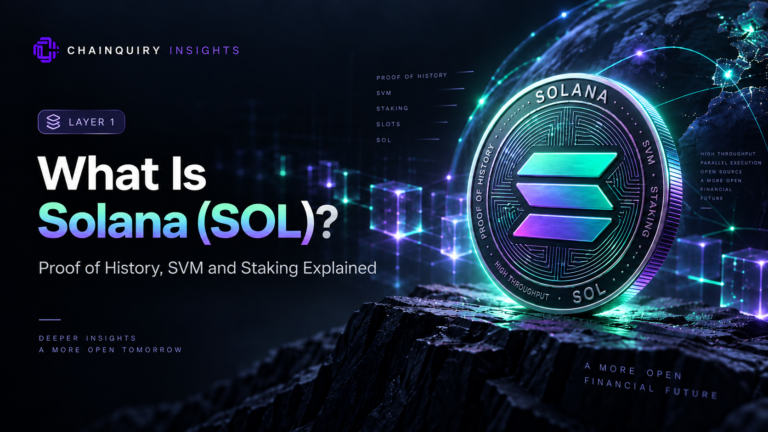
Reference material
EXPLORE MORE
Open-source Layer 1 blockchain combining Scrypt Proof of Work and Proof of Stake, with self-custody wallet software and public network…

Sharded Proof-of-Work Layer 1 with BlockFlow scaling, Ralph smart contracts, Blake3 mining and the native ALPH coin.

Permissionless Layer 1 blockchain using Pure Proof-of-Stake consensus for fast, low-cost transactions and smart contract execution.
PROJECT PULSE
The Chainquiry profile review date was updated to 2026-09-22.
Chainquiry project profile ↗A new block explorer has been added to the project profile.
Block explorer ↗The listed github repository destination has changed.
GitHub repository ↗Get important project changes by email. No account is required for a single-project watch.
Want a full watchlist and notification history? Create a free account.