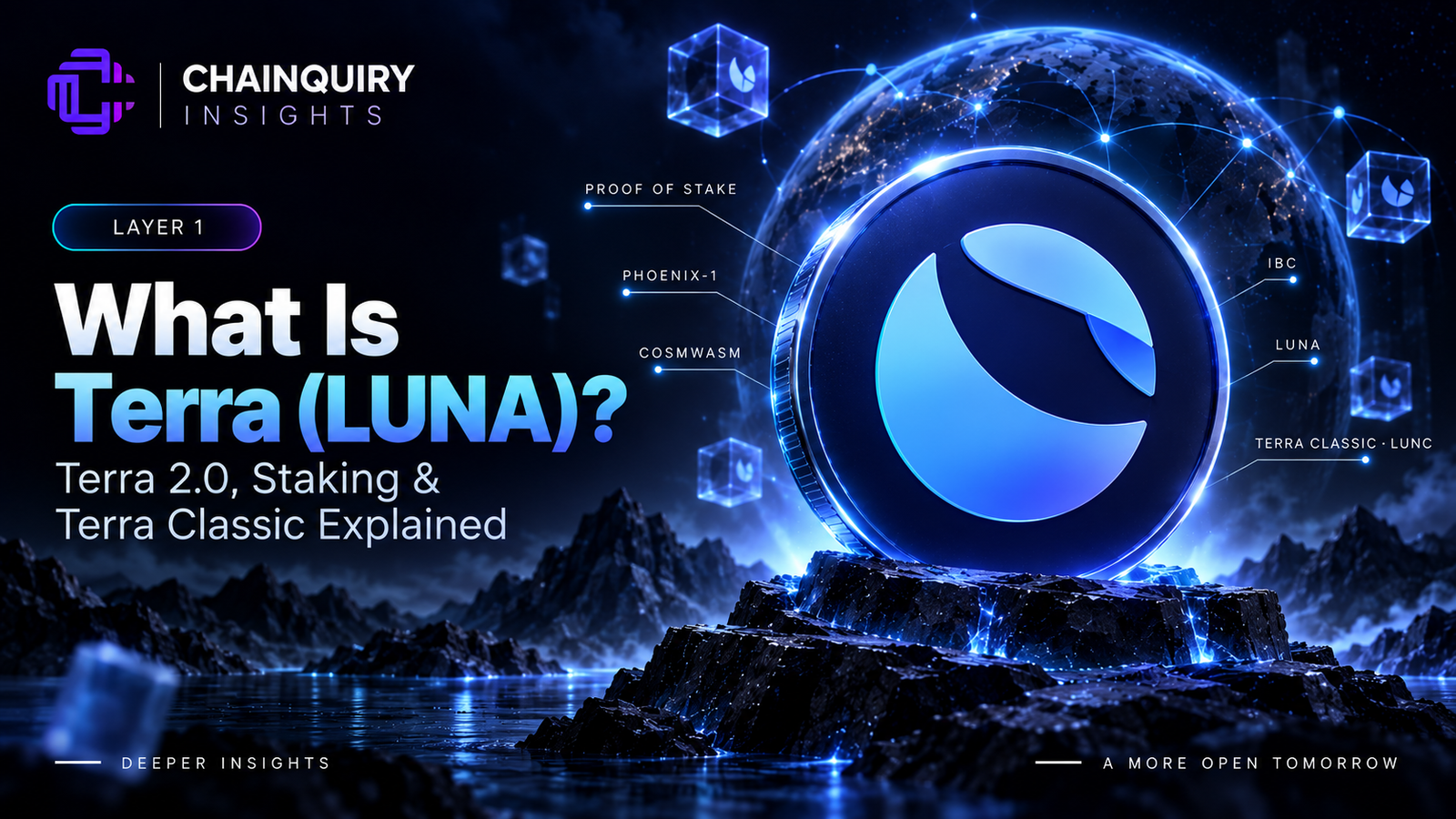
Terra (LUNA) is an open-source Proof-of-Stake Layer 1 blockchain built with the Cosmos SDK and designed to support decentralized applications, staking, governance and CosmWasm smart contracts.
The Terra network operating today is not the original Terra blockchain that became widely associated with the UST stablecoin.
Following the failure of the original ecosystem in May 2022, the original blockchain was renamed Terra Classic, while a new blockchain launched as Terra with the native asset LUNA.
That distinction is essential when researching the project today.
The current Terra mainnet is known as Phoenix-1, while the original network continues separately as Terra Classic, with LUNC as its native asset and USTC as the renamed version of the former UST stablecoin.
Terra at a Glance#
| Project | Terra |
| Ticker | LUNA |
| Type | Layer 1 blockchain |
| Consensus | Proof of Stake |
| Mainnet | Phoenix-1 |
| Mainnet launch | 27 May 2022 |
| Framework | Cosmos SDK |
| Smart contracts | CosmWasm |
| Native asset | LUNA |
| Governance | On-chain |
| Interoperability | IBC |
| Original chain | Terra Classic |
| Original-chain asset | LUNC |
What Is Terra?#
Terra is a Layer 1 blockchain designed for decentralized applications and programmable financial infrastructure.
Its current implementation uses Proof of Stake and the Cosmos SDK, with validators securing the network and LUNA serving as the native staking and governance asset.
Terra also supports CosmWasm, a smart-contract framework widely used across the Cosmos ecosystem.
This enables developers to deploy decentralized applications without building a separate blockchain.
Terra should therefore be understood as its own smart-contract network rather than as a token running on Ethereum or another external chain.
What Happened to the Original Terra?#
The history of Terra is unusual because two separate networks now exist.
Before May 2022, Terra operated a blockchain ecosystem centered around LUNA and several algorithmic stablecoins, most notably UST.
Following the severe disruption to that system in May 2022, the Terra community passed governance proposal 1623.
The proposal created a new blockchain that assumed the Terra name.
The original blockchain continued operating but was renamed:
Terra Classic
The original LUNA token was renamed:
Luna Classic (LUNC)
The original UST stablecoin was renamed:
TerraClassicUSD (USTC)
The new chain launched without the original Terra stablecoin system.
Terra vs Terra Classic#
The distinction can be summarized simply:
Terra#
- Native token: LUNA
- Mainnet: Phoenix-1
- Launched: 27 May 2022
- Proof-of-Stake blockchain
- Supports CosmWasm smart contracts
- Does not contain the original native UST stablecoin mechanism
Terra Classic#
- Native token: LUNC
- Mainnet: Columbus-5
- The original Terra blockchain
- Contains the historical architecture associated with UST, now called USTC
- Operates independently from the newer Terra chain
Both networks continue to have separate software, governance and communities.
LUNA and LUNC should therefore never be treated as interchangeable assets.
What Is LUNA?#
LUNA is the native staking and governance asset of the current Terra blockchain.
It is used for several core network functions:
- staking with validators
- securing network consensus
- governance voting
- transaction fees
- interacting with applications built on Terra
LUNA is native to Terra and does not require a token contract to exist on the Phoenix-1 network.
Official Terra documentation describes LUNA as the protocol’s native staking token.
How Does Terra Consensus Work?#
Terra uses Proof of Stake.
Validators run Terra full nodes and participate in consensus by proposing and voting on new blocks.
LUNA holders who do not operate validators themselves can delegate their LUNA to validators.
The amount staked to a validator contributes to that validator’s voting power.
Terra documentation currently describes an active validator set containing the top 130 validators by stake.
Validators and delegators can receive rewards from transaction fees and protocol inflation.
They can also face penalties for validator misconduct or extended downtime.
Staking LUNA#
LUNA holders can delegate their tokens to Terra validators.
Delegating contributes to the security of the network while allowing users to receive a portion of validator rewards.
The Terra documentation separates LUNA into three staking states:
Unbonded — available for transfer.
Bonded — delegated to a validator and participating in staking.
Unbonding — leaving the bonded state before becoming freely transferable again.
The documented unbonding period is 21 days.
Staking carries risks.
Rewards can change, LUNA’s market value can fluctuate, and validator penalties can affect delegated stake in certain circumstances.
Governance#
LUNA also gives holders a role in Terra governance.
Community members can submit and vote on proposals affecting the blockchain.
Governance decisions can concern areas such as:
- software upgrades
- blockchain parameters
- community-pool spending
- protocol changes
Voting power is connected to staked LUNA.
Terra’s current governance documentation defines quorum, approval and veto thresholds that determine whether proposals pass.
Governance participation should not be confused with owning equity in a company. It relates to decisions concerning the blockchain protocol and its community-controlled resources.
CosmWasm Smart Contracts#
Terra supports decentralized applications through CosmWasm.
CosmWasm is a smart-contract framework designed for blockchains in the Cosmos ecosystem.
Contracts are compiled to WebAssembly and executed by the blockchain.
This gives developers the ability to create applications such as:
- decentralized exchanges
- lending protocols
- NFT applications
- DAOs
- token systems
- other blockchain-based services
Terra’s current software stack includes Wasm support and CosmWasm-compatible infrastructure.
Terra and the Cosmos Ecosystem#
Terra is built using technology from the Cosmos ecosystem.
That includes the Cosmos SDK and interoperability through IBC, or Inter-Blockchain Communication.
IBC allows compatible blockchains to transfer assets and communicate through standardized channels.
Terra documentation provides support for moving assets between Terra and other IBC-enabled Cosmos networks.
This means Terra can participate in a broader multi-chain environment rather than functioning entirely in isolation.
Does Terra Still Have UST?#
The current Terra blockchain does not contain the original native UST stablecoin mechanism.
When the new Terra chain launched in 2022, the treasury, oracle and market modules associated with the original stablecoin system were not included.
The original UST became TerraClassicUSD (USTC) and remained associated with Terra Classic.
This distinction is particularly important because many older articles still describe Terra as though LUNA is directly connected to the original UST mint-and-burn system.
That is no longer accurate for the current Terra chain.
What Was the LUNA Airdrop?#
When the new Terra chain was created, an initial supply of 1 billion LUNA was established.
Part of that supply was distributed through an airdrop based on holdings captured at specified snapshots of the original Terra Classic network.
Allocations included groups such as:
- pre-depeg LUNA holders
- pre-depeg aUST holders
- post-depeg LUNA holders
- post-depeg UST holders
- the Terra community pool
Different allocations were subject to different vesting schedules.
This genesis distribution was part of the transition to the new Terra network rather than an ongoing airdrop system.
What Is Phoenix-1?#
Phoenix-1 is the mainnet identifier of the current Terra blockchain.
The network began at a new genesis block rather than continuing the block history of the original Terra chain.
The original Terra Classic chain retained its existing block history under the columbus-5 network.
Official Terra node documentation continues to list phoenix-1 as the Terra mainnet.
Terra Station#
Station is the wallet and blockchain interface associated with Terra.
Official documentation describes Station as supporting functions including:
- sending and receiving tokens
- staking LUNA
- governance voting
- wallet connections
- interacting with Terra applications
Developers can also integrate Station wallet functionality into applications through Terra’s Wallet Kit.
Users should always verify wallet downloads and browser extensions through official resources.
Is Terra Still Active?#
The current Terra documentation continues to identify Phoenix-1 as its mainnet and provides instructions for running nodes, building applications, staking and interacting with the network.
Terra Core remains publicly available as the reference implementation of the blockchain.
This is important because Terra should not be confused with an abandoned blockchain simply because of the collapse of the original ecosystem in 2022.
The current Terra network and Terra Classic are separate chains with separate development paths.
Terra Core#
Terra Core is the open-source node software used by the network.
The software is written in Go and forms the reference implementation for operating a Terra node.
Developers and validators can inspect the source code publicly through the official Terra GitHub organization.
The official network documentation provides version requirements across different Phoenix-1 block-height ranges.
Open-source software allows independent inspection of the implementation, although public code availability alone does not guarantee security.
What Should You Verify Before Using Terra?#
The most important verification step is making sure you are using the correct chain.
Terra (LUNA) and Terra Classic (LUNC) are separate networks.
Before transferring assets or interacting with an application, verify:
- the network name
- whether the asset is LUNA or LUNC
- the correct wallet
- validator information before staking
- the smart-contract address of an application
- IBC channels when transferring across Cosmos networks
- whether documentation refers to Terra or Terra Classic
Older articles can be especially confusing because information published before May 2022 usually refers to the blockchain now known as Terra Classic.
Terra Today#
The current Terra blockchain is substantially different from the system that existed before May 2022.
It no longer contains the original native algorithmic-stablecoin architecture.
Instead, Terra operates as a general-purpose Proof-of-Stake Layer 1 supporting CosmWasm applications, governance, staking and interoperability through the Cosmos ecosystem.
LUNA remains central to its consensus and governance model.
Understanding the project therefore requires separating three different concepts:
Terra — the current Phoenix-1 blockchain.
LUNA — the current Terra network’s native staking and governance asset.
Terra Classic / LUNC — the original Terra network and its renamed native asset.
That distinction eliminates much of the confusion surrounding Terra today.
Frequently Asked Questions#
What is Terra (LUNA)?#
Terra is a Proof-of-Stake Layer 1 blockchain built with the Cosmos SDK. LUNA is its native staking and governance asset.
Is Terra the same blockchain as the original Terra?#
No. The current Terra chain launched on 27 May 2022 as Phoenix-1. The original blockchain continues separately as Terra Classic.
What is the difference between LUNA and LUNC?#
LUNA is the native asset of the current Terra blockchain. LUNC is the renamed native asset of the original Terra blockchain, now called Terra Classic.
Does Terra still use UST?#
The current Terra blockchain does not contain the original native UST stablecoin mechanism. The former UST exists on Terra Classic under the name USTC.
Is Terra Proof of Work or Proof of Stake?#
Terra uses Proof of Stake.
Can LUNA be mined?#
Not through Proof-of-Work mining. LUNA participates in a Proof-of-Stake system using validators and delegators.
What is Phoenix-1?#
Phoenix-1 is the mainnet identifier of the current Terra blockchain launched in May 2022.
Does Terra support smart contracts?#
Yes. Terra supports CosmWasm smart contracts.
Is Terra part of Cosmos?#
Terra is built using the Cosmos SDK and supports interoperability with other compatible blockchains through IBC.
What is Terra Station?#
Station is Terra’s wallet and blockchain interface for functions such as transfers, staking and governance.