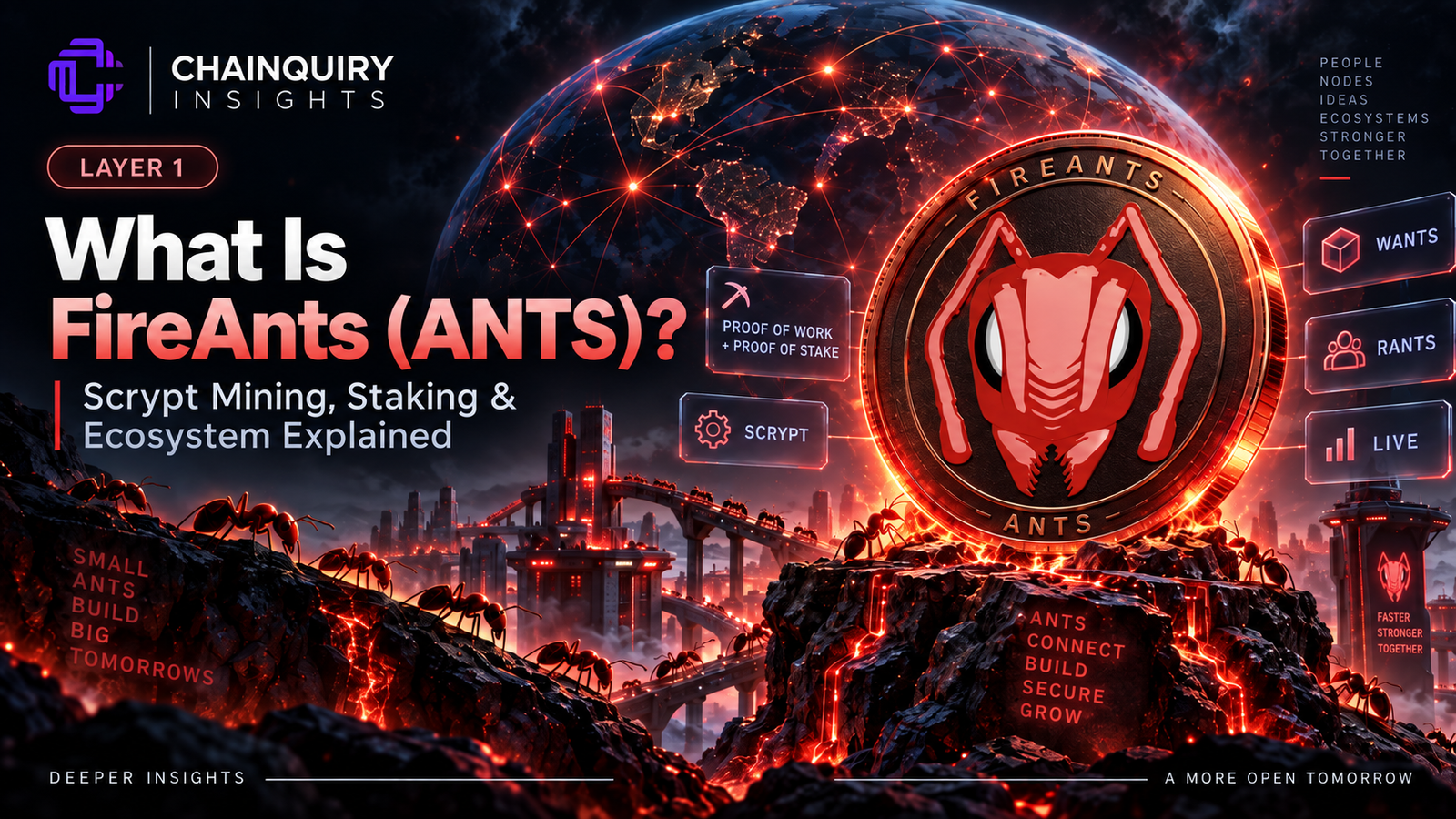
FireAnts (ANTS) is an independent cryptocurrency network launched in April 2021 around a hybrid Proof-of-Work and Proof-of-Stake design.
Its native currency, ANTS, operates on the FireAnts blockchain and has historically been distributed through both Scrypt mining and staking.
The wider FireAnts ecosystem has also included wrapped and tokenized versions of ANTS on other blockchain networks, alongside earlier plans involving NFTs, digital identity, metaverse applications and payment infrastructure.
That makes it useful to separate two things when researching FireAnts today:
the FireAnts blockchain itself and the wider business/application ideas developed around it.
FireAnts at a Glance#
| Project | FireAnts |
| Ticker | ANTS |
| Type | Layer 1 blockchain |
| Network | FireAnts |
| Consensus | Proof of Work + Proof of Stake |
| Mining algorithm | Scrypt |
| Native asset | ANTS |
| Launch | April 2021 |
| Maximum supply | Approximately 210,000,000 ANTS |
| Staking | Yes |
| Wrapped asset | wANTS |
| Additional ecosystem token | rANTS |
| Current Chainquiry status | Live |
Independent market records date the FireAnts coin to 19 April 2021, while the project’s whitepaper describes the native chain as the successor to an earlier ERC-20 version of ANTS.
What Is FireAnts?#
FireAnts is an independent blockchain rather than simply an ERC-20 or BEP-20 token.
The project’s whitepaper describes a native ANTS coin running on its own blockchain, with approximately 210 million ANTS as the intended maximum supply.
FireAnts combines Scrypt-based Proof of Work with Proof-of-Stake participation.
This hybrid model allows the network to use both mining hardware and staking wallets as part of block production and distribution.
The project has also experimented with moving ANTS value between blockchain environments through wrapped assets and additional tokens.
How Does FireAnts Consensus Work?#
FireAnts was designed around a combination of:
Proof of Work — miners contribute Scrypt hashing power.
Proof of Stake — eligible ANTS holders participate using coins held in staking wallets.
The project’s 2022 whitepaper described blocks as being distributed between mining and staking, with an approximate three-minute target block time at that stage of the network.
It listed:
- Scrypt as the mining algorithm
- 100 ANTS as the original PoW block reward
- 100 ANTS as the original PoS reward
- a six-hour minimum staking age
- an approximate three-minute block target
Those figures describe the project’s historical protocol configuration and should not automatically be treated as permanent current values.
Blockchain reward schedules can change as networks pass milestone heights or implement protocol upgrades.
FireAnts and Scrypt Mining#
FireAnts uses the Scrypt mining algorithm.
Scrypt is also historically associated with cryptocurrencies such as Litecoin and differs from Bitcoin’s SHA-256 algorithm.
Mining-pool data from July 2026 still identified FireAnts as a Scrypt network and recorded active network hashrate and blocks above height 1.1 million.
This is significant because it shows that FireAnts should not simply be described according to older roadmap expectations.
The 2022 whitepaper anticipated that Proof-of-Work mining would eventually end around block 691,200, followed by a transition toward full Proof of Stake.
However, 2026 pool data continued to identify active Scrypt mining well beyond that block height.
The observable network therefore appears to have diverged from at least part of the older roadmap.
Why the Old Roadmap Needs Context#
FireAnts’ whitepaper projected several future protocol changes.
One of the most important was a planned transition away from Proof of Work after block 691,200.
That document said the network would move toward full Proof of Stake and introduce masternodes and additional data-layer capabilities.
Yet independent mining-pool records from 2026 continued to show Scrypt mining after block 1.1 million.
This is a useful example of why cryptocurrency roadmaps should not be treated as proof that a feature was actually implemented.
For current research, observed network behavior should take priority over an older planned milestone.
ANTS Supply#
The FireAnts whitepaper specifies a long-term supply of approximately:
210,000,000 ANTS
It states that this limit is encoded into the native blockchain’s economic design.
The same document describes the original distribution broadly as:
- 25% premine
- 16.5% intended for Proof-of-Work mining
- 58.5% intended for staking and masternode-related issuance
These percentages come from the project’s 2022 whitepaper and describe its intended token distribution model at that time.
CoinPaprika currently records a total supply of approximately 152.3 million ANTS and a maximum of 210 million.
A maximum supply and current issued supply are not the same thing.
What Is ANTS Used For?#
ANTS is the native coin of the FireAnts blockchain.
Historically, it has been used for:
- blockchain transactions
- staking
- mining rewards
- transfers between users
- ecosystem participation
- wrapping into versions used on other networks
The wider project also proposed uses around digital identity, payments, NFTs and community-oriented blockchain applications.
Those broader applications should be evaluated separately from the native network itself.
A blockchain continuing to produce blocks does not automatically mean that every application described in an older roadmap remains active.
What Is wANTS?#
wANTS, or Wrapped FireAnts, is a wrapped representation of the native ANTS coin on BNB Smart Chain.
The purpose of a wrapped asset is to represent an asset from one blockchain inside another blockchain environment.
The FireAnts whitepaper described ANTS as being wrappable 1:1 onto BNB Smart Chain.
This allowed FireAnts value to interact with BSC-based applications without converting the FireAnts native blockchain itself into a BNB Smart Chain token.
BscScan continues to identify the historical wANTS token contract in on-chain transaction records.
What Is rANTS?#
FireAnts also introduced redFireAnts, or rANTS, on BNB Smart Chain.
This is distinct from native ANTS and from wANTS.
The project’s whitepaper described rANTS as a separate BEP-20 ecosystem token with its own distribution model.
Historical allocations included amounts for donations, investors, liquidity, network security, marketing, development and project infrastructure.
Because multiple assets use FireAnts branding, researchers should always verify which one they are interacting with.
ANTS — native FireAnts blockchain coin.
wANTS — wrapped representation of ANTS on BNB Smart Chain.
rANTS — separate redFireAnts BEP-20 token.
These should not be assumed to be interchangeable.
FireAnts Began With an ERC-20 Token#
FireAnts’ history predates the launch of its native blockchain.
The project’s whitepaper describes an ANTS ERC-20 token created in 2020.
The native FireAnts blockchain followed approximately one year later.
Its roadmap identifies:
2020 — ANTS ERC-20 token and early community distribution.
2021 — launch of the native FireAnts blockchain.
This means references to ANTS in older records may refer to different implementations depending on the date and network involved.
FireAnts Crypto Inc.#
FireAnts has also operated through FireANTS Crypto Inc.
The project’s whitepaper describes the entity as a Delaware C-Corporation with a broader focus on blockchain technology, cybersecurity, philanthropy and digital applications.
The company historically promoted projects involving:
- NFTs
- metaverse environments
- digital identity
- payment systems
- 3D modelling
- blockchain education
- tribal and sovereign-community technology
These business initiatives should not be confused with the technical properties of the ANTS blockchain.
A company can build applications around a blockchain while the blockchain itself remains a separate network infrastructure layer.
Tribal Technology and Digital Identity#
One distinctive part of FireAnts’ historical strategy involved technology for Native American and sovereign communities.
A 2022 TribalNet publication described FireAnts concepts involving:
- blockchain-backed tribal identification
- data integrity
- digital assets
- NFTs
- customized virtual environments
- payment systems
The publication specifically referenced the FireAnts blockchain alongside ANTS, wANTS, rANTS and the earlier ERC-20 implementation.
These references document FireAnts’ intended business direction, but they should not automatically be interpreted as evidence that every proposed system achieved large-scale deployment.
NFTs and the Metaverse#
FireAnts historically promoted NFTs and customized virtual environments as part of its commercial ecosystem.
The project discussed digital art, avatars, virtual spaces and NFT-based identity or cultural assets.
Those ideas reflected the broader Web3 and metaverse focus common during the 2021–2022 market cycle.
For current research, however, the strongest independently verifiable part of FireAnts remains its blockchain infrastructure rather than the scale of its metaverse adoption.
Claims about active products should therefore be checked separately from the native chain.
Is FireAnts Still Active?#
Chainquiry currently classifies FireAnts as Live.
MiningPoolStats recorded an operating Scrypt network in July 2026 with blocks above height 1,109,000 and measurable network hashrate.
A separate mining-pool API indexed several weeks before this review also continued to report a FireAnts blockchain height above 1.13 million.
However, market activity appears considerably weaker than network activity.
CoinPaprika currently reports zero active ANTS exchange markets and no current trading volume.
That distinction matters.
A blockchain can continue producing blocks even when its exchange liquidity or market activity is extremely limited.
Website Availability#
The project’s historical websites include:
fireants.onlinefireants.global
Both were unreliable during Chainquiry’s September 2026 web review, although FireAnts documents hosted on those domains remain indexed and accessible.
Website availability alone does not determine whether a decentralized blockchain is operational.
For FireAnts, current network and pool data provide stronger evidence of blockchain activity than the availability of the project’s marketing website.
Is FireAnts Open Source?#
A public FireAnts source-code repository remains accessible on GitHub.
The repository contains the cryptocurrency’s reference implementation along with build files, consensus-related code and supporting components.
The software is distributed under the MIT License.
Open source makes it possible to inspect the network implementation, but it does not guarantee security or continued development.
Network activity, software maintenance and code availability should be considered separately.
Is FireAnts a Mineable Coin?#
Yes.
FireAnts has historically supported Scrypt Proof-of-Work mining alongside staking.
Independent mining trackers continued to observe Scrypt mining activity during 2026.
That makes ANTS different from a pure ERC-20 token, which cannot itself be mined through an independent Proof-of-Work blockchain.
Can ANTS Be Staked?#
Yes.
Proof-of-Stake participation has been part of the FireAnts design since the native blockchain’s early development.
The original whitepaper describes staking wallets as participating in block rewards alongside miners.
Specific reward rates, maturity requirements and wallet behavior should be checked against current software rather than assumed from the 2022 whitepaper.
Is FireAnts Proof of Work or Proof of Stake?#
The most accurate current description is:
Hybrid Proof of Work / Proof of Stake
The original network was explicitly designed to combine the two mechanisms.
Although the whitepaper anticipated a future move to full Proof of Stake, mining data from 2026 continued to show Scrypt Proof-of-Work activity after the planned transition height.
This is why Chainquiry currently classifies FireAnts as PoW/PoS rather than describing the roadmap’s proposed transition as already completed.
What Should You Verify Before Using FireAnts?#
FireAnts has several similarly branded assets across different networks.
Before transferring or acquiring anything, verify:
- whether you are using native ANTS, wANTS or rANTS
- the blockchain network
- the correct wallet software
- the token contract for wrapped assets
- current staking rules
- current mining configuration
- whether an exchange or DEX market actually has liquidity
- whether information comes from a current source or an older roadmap
This is especially important because older FireAnts materials describe features and milestones that do not always match the network behavior observable today.
The Bottom Line#
FireAnts (ANTS) is an independent Layer 1 cryptocurrency launched in April 2021.
Its native blockchain was designed around a hybrid Proof-of-Work and Proof-of-Stake model, with Scrypt mining, wallet staking and an intended maximum supply of approximately 210 million ANTS.
The project also created wrapped and tokenized FireAnts assets, including wANTS and rANTS, and historically explored applications involving payments, NFTs, digital identity, metaverse technology and tribal-community infrastructure.
One of the most important findings when researching FireAnts today is that its older roadmap does not perfectly describe the observable network.
The 2022 whitepaper planned to end Proof-of-Work mining around block 691,200, yet independent mining data continued to report Scrypt activity above block 1.1 million in 2026.
That makes FireAnts a useful example of why blockchain research should compare project documentation with what can actually be observed on the network.
Chainquiry currently classifies FireAnts as Live, while noting that exchange-market activity appears extremely limited despite continuing blockchain activity.
Frequently Asked Questions#
What is FireAnts?#
FireAnts is an independent Layer 1 cryptocurrency network using the ANTS native coin.
What is the FireAnts ticker?#
The native FireAnts coin uses the ticker ANTS.
When did FireAnts launch?#
The native FireAnts blockchain dates to April 2021.
What mining algorithm does FireAnts use?#
FireAnts uses Scrypt for Proof-of-Work mining.
Is FireAnts Proof of Work or Proof of Stake?#
FireAnts is best described as a hybrid Proof-of-Work / Proof-of-Stake network based on currently observable network behavior and its original architecture.
What is the maximum ANTS supply?#
The FireAnts whitepaper specifies approximately 210 million ANTS as the long-term maximum supply.
What is wANTS?#
wANTS is a wrapped representation of native ANTS designed for use on BNB Smart Chain.
What is rANTS?#
rANTS, or redFireAnts, is a separate BEP-20 ecosystem token associated with FireAnts.
Is FireAnts still active?#
Chainquiry currently classifies FireAnts as live. Mining data from 2026 continued to show an operating blockchain, although current exchange-market activity appears very limited.
Can ANTS still be mined?#
FireAnts was still being tracked as an active Scrypt mining network during 2026, despite an older roadmap that had proposed ending Proof-of-Work mining earlier.