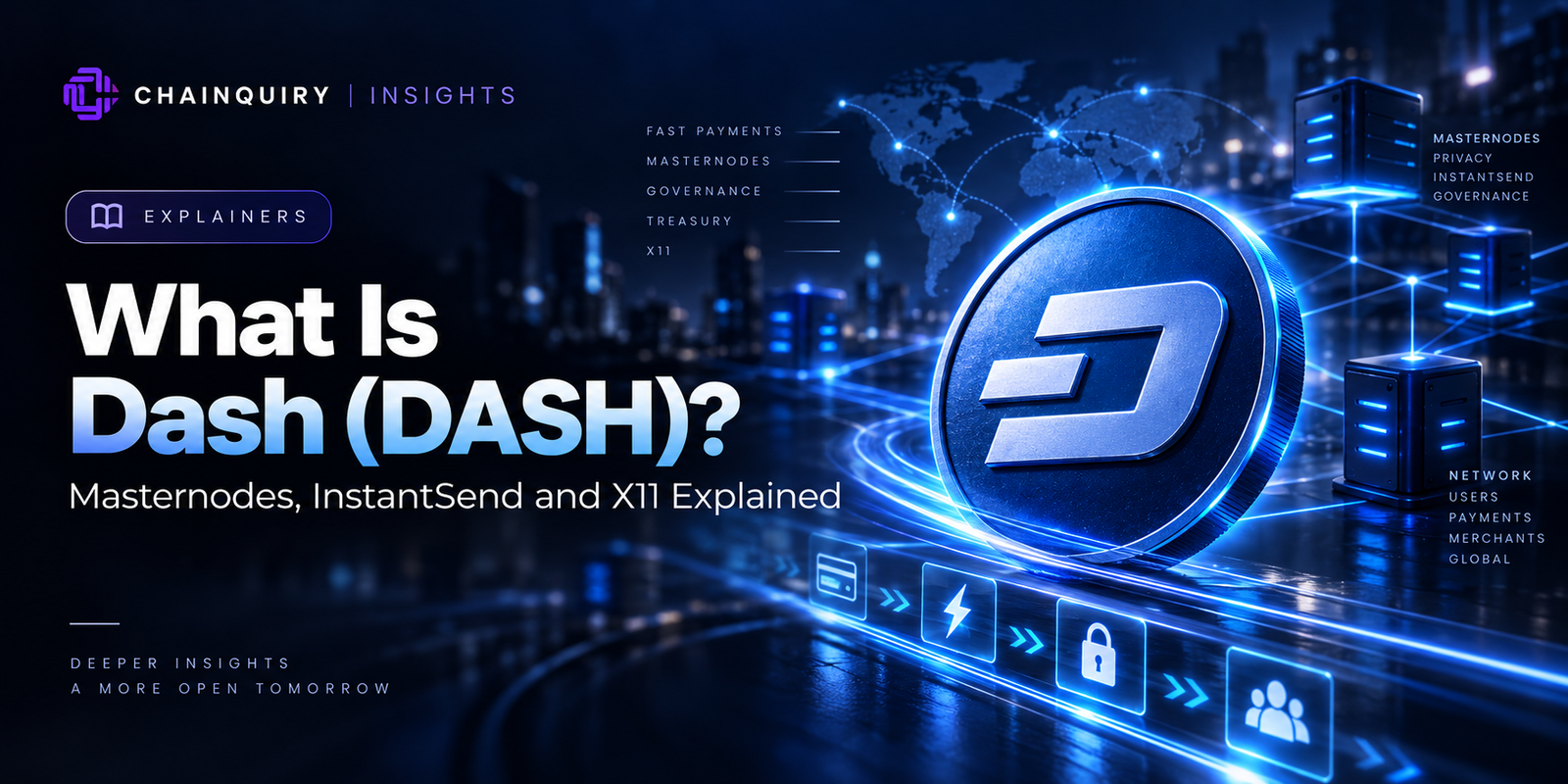
Dash (DASH) is an open-source Layer 1 cryptocurrency launched in January 2014 with a focus on digital payments, fast transaction settlement and decentralized network governance.
The network uses Proof of Work for its base blockchain but adds a second tier of incentivized servers called masternodes. These masternodes provide additional services including InstantSend, ChainLocks, CoinJoin and governance voting.
Dash began as XCoin in January 2014, was renamed Darkcoin shortly afterward and adopted the name Dash in March 2015. The name is derived from “Digital Cash,” reflecting the project’s long-running emphasis on payments.
Over time, Dash has developed beyond its original payment-focused blockchain. The ecosystem now also includes Dash Platform, a separate application and data layer hosted by high-performance Evolution Masternodes, or evonodes.
How Dash Works#
Dash maintains its own public blockchain and native cryptocurrency, DASH.
When a user sends DASH, their wallet creates and digitally signs a transaction using the private keys controlling the funds. The transaction is broadcast across Dash’s peer-to-peer network, where miners and nodes process it according to the protocol rules.
Miners gather transactions into blocks and compete through Proof of Work to produce a valid block.
Other nodes independently verify those blocks before accepting them.
Dash differs from many conventional Proof-of-Work cryptocurrencies because it adds a second network tier composed of masternodes.
This two-tier structure allows Dash to provide additional functions without requiring miners alone to handle every network service.
X11 Proof of Work#
Dash uses an algorithm called X11 for Proof-of-Work mining.
X11 chains together eleven different cryptographic hashing functions rather than relying on a single hash function such as Bitcoin’s SHA-256.
The algorithm was originally designed partly to delay the development of specialized ASIC mining hardware.
That resistance did not last permanently.
Specialized X11 ASIC miners now exist and represent the practical way to mine Dash competitively. Modern Dash mining should therefore not be described as realistically accessible to ordinary CPUs or GPUs.
The network targets a block approximately every:
2.6 minutes
Mining difficulty is adjusted using Dark Gravity Wave, a difficulty-adjustment system developed for Dash.
Rather than waiting thousands of blocks between adjustments, Dark Gravity Wave responds more frequently to changes in network hashrate.
What Are Dash Masternodes?#
Masternodes are one of Dash’s defining features.
A masternode is a server that maintains a full copy of the Dash blockchain and performs additional network services beyond ordinary transaction relay and verification.
Operating a regular Dash masternode currently requires collateral of:
1,000 DASH
The collateral remains under the owner’s control but must remain unspent while the masternode operates.
If the collateral is moved or spent, the associated masternode stops being eligible for network services and rewards.
Masternodes participate in functions including:
InstantSend
ChainLocks
CoinJoin
governance voting
treasury funding
Long-Living Masternode Quorums
Masternode operators receive part of the Dash block subsidy in return for providing these services.
What Are Evonodes?#
Dash also operates a higher-performance class of masternodes called Evolution Masternodes, or evonodes.
An evonode requires collateral of:
4,000 DASH
Evonodes perform the regular responsibilities of masternodes while also hosting Dash Platform.
They have higher hardware requirements because Dash Platform runs its own consensus and application infrastructure.
Within Dash governance, evonodes receive voting weight proportional to their collateral. Since an evonode requires four times the collateral of a regular masternode, it carries four times the standard masternode voting weight.
Evonodes also participate in Platform rewards and receive Platform-related fees.
What Is InstantSend?#
InstantSend is Dash’s mechanism for providing rapid transaction certainty.
Ordinary Proof-of-Work blockchains often require users or merchants to wait for one or more block confirmations before considering a payment sufficiently settled.
Dash adds another layer through masternode quorums.
When a transaction is propagated across the network, Long-Living Masternode Quorums can lock its inputs before the transaction is included in a block.
Once those inputs are locked, conflicting transactions attempting to spend the same funds can be rejected.
Dash documentation states that InstantSend locks are typically produced within a few seconds.
The transaction is still subsequently recorded in a normal Dash block.
InstantSend therefore does not replace the blockchain. It provides additional certainty before the usual block-confirmation process finishes.
What Are ChainLocks?#
ChainLocks are designed to protect the Dash blockchain against deep chain reorganizations.
In a conventional Proof-of-Work network, an attacker with sufficient mining power may attempt to create a competing chain and replace recently confirmed blocks.
Dash adds masternode-quorum signatures to the block-production process.
When a valid block receives a ChainLock signature from the relevant quorum, Dash nodes recognize that block as the authoritative block at that height.
This makes reorganizing already ChainLocked blocks substantially more difficult even if an attacker controls significant mining power.
ChainLocks therefore add another security layer on top of Dash’s X11 Proof-of-Work system.
Does Dash Have Private Transactions?#
Dash supports optional transaction privacy through CoinJoin.
CoinJoin combines transactions from multiple participants so that the relationship between individual inputs and outputs becomes harder to trace.
Dash historically called this functionality PrivateSend, although current documentation generally describes the underlying mechanism directly as CoinJoin.
This distinction matters.
Dash does not make every transaction private by default.
Standard Dash transactions remain visible on the public blockchain.
Users who choose CoinJoin gain additional transaction-history obfuscation, but this is not the same privacy model used by cryptocurrencies where sender, receiver and amounts are cryptographically hidden at the protocol level.
Dash is therefore more accurately described as offering optional CoinJoin-based privacy rather than as an inherently anonymous cryptocurrency.
How Does Dash Governance Work?#
Dash has an on-chain governance and treasury system.
Governance decisions are made through registered masternodes and evonodes rather than through one-DASH-one-vote participation by every token holder.
Each regular masternode receives one governance vote.
Evonodes receive greater voting weight because they use 4,000 DASH collateral rather than 1,000 DASH.
Masternodes can vote:
yes
no
abstain
on proposals submitted to the network.
Anyone can create a treasury proposal by paying the required proposal fee.
Approved proposals can receive funding directly from Dash’s blockchain through periodic superblocks.
Dash’s Treasury System#
Dash reserves part of its block subsidy for decentralized governance and ecosystem funding.
The current approximate allocation across a budget cycle is:
20% — miners
60% — masternodes and evonodes
20% — governance and treasury
The treasury allocation is not paid automatically to a centralized company.
Instead, approved governance proposals can receive payments through special superblocks created approximately once per month.
If the entire available treasury budget is not allocated, the unused portion is not necessarily created.
That detail affects Dash’s eventual total supply.
The modern 20% treasury allocation was introduced after governance approved an expansion of the budget system in 2023.
How Are Masternode Rewards Divided?#
The masternode portion of Dash’s issuance supports both regular masternodes and Dash Platform evonodes.
Part of the masternode reward is paid through the Core blockchain.
Another portion is directed into the Dash Platform credit pool for evonode rewards.
Current Dash documentation describes the masternode reward allocation as approximately:
62.5% — Core-chain masternode payments
37.5% — Platform credit pool for evonodes
This arrangement helps fund both the payment-focused Core network and the newer Dash Platform infrastructure.
What Is Dash’s Supply Limit?#
Dash has a declining issuance model rather than Bitcoin-style four-year halvings.
The block subsidy decreases by approximately:
7.14% per year
This gradual reduction continues over a long period.
Dash’s final total supply is not represented by one perfectly fixed number because unused treasury allocations may never be created.
Official Dash documentation estimates that ultimate supply will fall somewhere between approximately:
17.74 million DASH
and
18.92 million DASH
The lower value assumes no treasury allocation is used, while the upper estimate assumes full treasury usage.
This makes it more accurate to describe Dash as having a bounded long-term supply range rather than simply stating one exact maximum-supply figure without explanation.
How Do Dash Transaction Fees Work?#
Dash transactions include fees similar to other UTXO-based cryptocurrencies.
Fees are primarily related to transaction size and network policy rather than the monetary value being transferred.
A transaction using many inputs and outputs generally occupies more blockchain space than a simpler transaction and may therefore require a larger fee.
Dash has historically targeted low-cost payments, but fees should not be described as permanently or universally low.
The cost depends on wallet behavior, transaction construction and network conditions.
InstantSend also does not mean transactions bypass the normal blockchain fee system.
What Is Dash Platform?#
Dash Platform is a Web3 application and data layer built on top of the Dash ecosystem.
It launched on mainnet in 2024 after many years of development under the broader “Dash Evolution” roadmap.
Platform is designed for applications that need decentralized structured data, identities, usernames and queryable application state without relying entirely on a centralized backend.
Developers define data contracts describing the structure of information their application stores.
Users then submit state transitions that create or modify that data.
Dash Platform’s primary components include:
Drive — decentralized application-data storage
DAPI — decentralized API access
Dash Platform identities
DPNS usernames
data contracts
documents
native token functionality
DashPay
Platform is hosted by evonodes rather than ordinary Core masternodes.
Does Dash Platform Use Proof of Work?#
No.
Dash Platform has its own blockchain and consensus process separate from Dash Core’s X11 Proof of Work.
The Platform Chain is hosted by evonodes.
It uses a Byzantine fault-tolerant consensus system rather than mining.
Platform blocks target approximately five-second intervals and become final once the required validator threshold agrees.
Dash Platform can read information from the Dash Core blockchain, while Dash Core does not depend on Platform to continue functioning.
This separation allows the original payment blockchain to remain operational even if Platform experiences application-layer issues.
What Is DPNS?#
DPNS stands for Dash Platform Name Service.
It allows human-readable names to be associated with Dash Platform identities.
Instead of interacting only through long cryptographic identifiers, applications can use recognizable names.
DPNS is part of Dash’s broader effort to make cryptocurrency payments feel more similar to conventional payment applications.
Names exist within the Dash Platform architecture rather than replacing blockchain addresses at the Core layer.
What Is DashPay?#
DashPay is a social-payment system built using Dash Platform.
Its goal is to make payments easier by combining Platform identities, usernames and contact relationships.
Rather than requiring every payment interaction to begin with manually copying a long blockchain address, DashPay can allow users to interact through registered names and contacts.
Dash’s 2026 roadmap shows continued development around DashPay, Platform wallets and username-based payments.
How Has Dash Changed Since 2014?#
Dash today is significantly different from the network that first launched as XCoin.
Major changes over its history include:
masternodes
InstantSend
CoinJoin
ChainLocks
decentralized treasury governance
Long-Living Masternode Quorums
Evolution Masternodes
Dash Platform
DPNS usernames
DashPay
The project has therefore evolved from a Bitcoin-derived digital-cash blockchain into a two-layer ecosystem combining a Proof-of-Work payment network with an application and identity platform.
Is Dash Still Being Developed?#
Yes.
Dash Core remains actively maintained.
Dash Core version 23.1.8 was released in August 2026 and included networking hardening, peer-to-peer handler fixes, RPC improvements and several fixes for remotely triggerable node crashes.
The release was mandatory for masternodes and strongly recommended for other node operators.
Dash Platform has also continued evolving.
Platform v4.1 was completed in July 2026 with features including DPNS username transfers, document history, Android/Kotlin tooling and expanded DashPay functionality.
The Dash roadmap also lists continuing Platform and Core development into late 2026 and beyond.
This makes older descriptions of Dash as simply “a faster Bitcoin with PrivateSend” incomplete.
Dash’s Early Distribution#
Dash’s early launch is an important part of its history.
The network launched without a formal premine, but an issue in the early difficulty-adjustment logic allowed a large number of DASH to be mined during the initial period.
Official historical Dash material acknowledges that approximately 1.9 million coins were produced during the early launch window.
Founder Evan Duffield proposed restarting the network or redistributing coins, but the community chose to continue with the existing chain.
Researchers evaluating Dash should therefore distinguish between the claim that there was no conventional premine and the reality of the unusually rapid early issuance.
What Are Dash’s Trade-Offs?#
Dash’s design offers several capabilities but also introduces trade-offs.
Proof of Work requires specialized X11 mining hardware and ongoing energy consumption.
The second-tier network requires large collateral positions. A regular masternode requires 1,000 DASH, while an evonode requires 4,000 DASH.
Governance voting power is therefore tied to masternode collateral rather than being equally available to every user.
CoinJoin can improve transaction privacy but is optional and does not provide the same cryptographic privacy guarantees as privacy-by-default protocols.
Dash Platform adds useful application functionality but also introduces another technical layer, separate consensus system and larger infrastructure requirements.
The network’s long-term security also depends on maintaining sufficient mining participation and a distributed masternode ecosystem.
Finally, DASH remains a volatile cryptocurrency. Its protocol does not attempt to maintain a stable fiat exchange rate.
Who Controls Dash?#
There is no single organization that owns the Dash blockchain.
Miners perform Proof of Work.
Full nodes verify consensus rules.
Masternodes and evonodes provide additional services and participate in governance.
Developers maintain open-source software.
Treasury proposals can fund multiple organizations or community initiatives.
Dash Core Group is an important development organization within the ecosystem, but it is not equivalent to the Dash network itself.
Protocol changes ultimately depend on software adoption, network rules and governance mechanisms rather than unilateral control by one company.
How to Research Dash Independently#
Dash publishes extensive technical material publicly.
The Dash documentation covers mining, masternodes, governance, InstantSend, ChainLocks, CoinJoin and network specifications.
Dash Platform maintains separate developer documentation covering Platform consensus, data contracts, identities, usernames and application infrastructure.
The Dash Core and Dash Platform codebases are also publicly available.
For structured project information, official links and current network details, see the Dash (DASH) profile on Chainquiry.
Final Perspective#
Dash is more than a fast-payment cryptocurrency.
Its Core blockchain combines X11 Proof of Work with a second tier of collateralized masternodes that provide InstantSend, ChainLocks, CoinJoin and decentralized governance.
Its treasury system directs part of the block subsidy toward community-approved proposals, while masternodes and evonodes receive rewards for providing network services.
Dash Platform extends the ecosystem further with decentralized application data, identities, usernames and DashPay.
That architecture also introduces complexity.
Dash combines miners, full nodes, masternodes, evonodes, Core governance and a separate Platform consensus layer rather than relying on one simple blockchain role.
Understanding those layers provides a much more accurate picture of modern Dash than describing it simply as a cryptocurrency offering fast transactions and low fees.