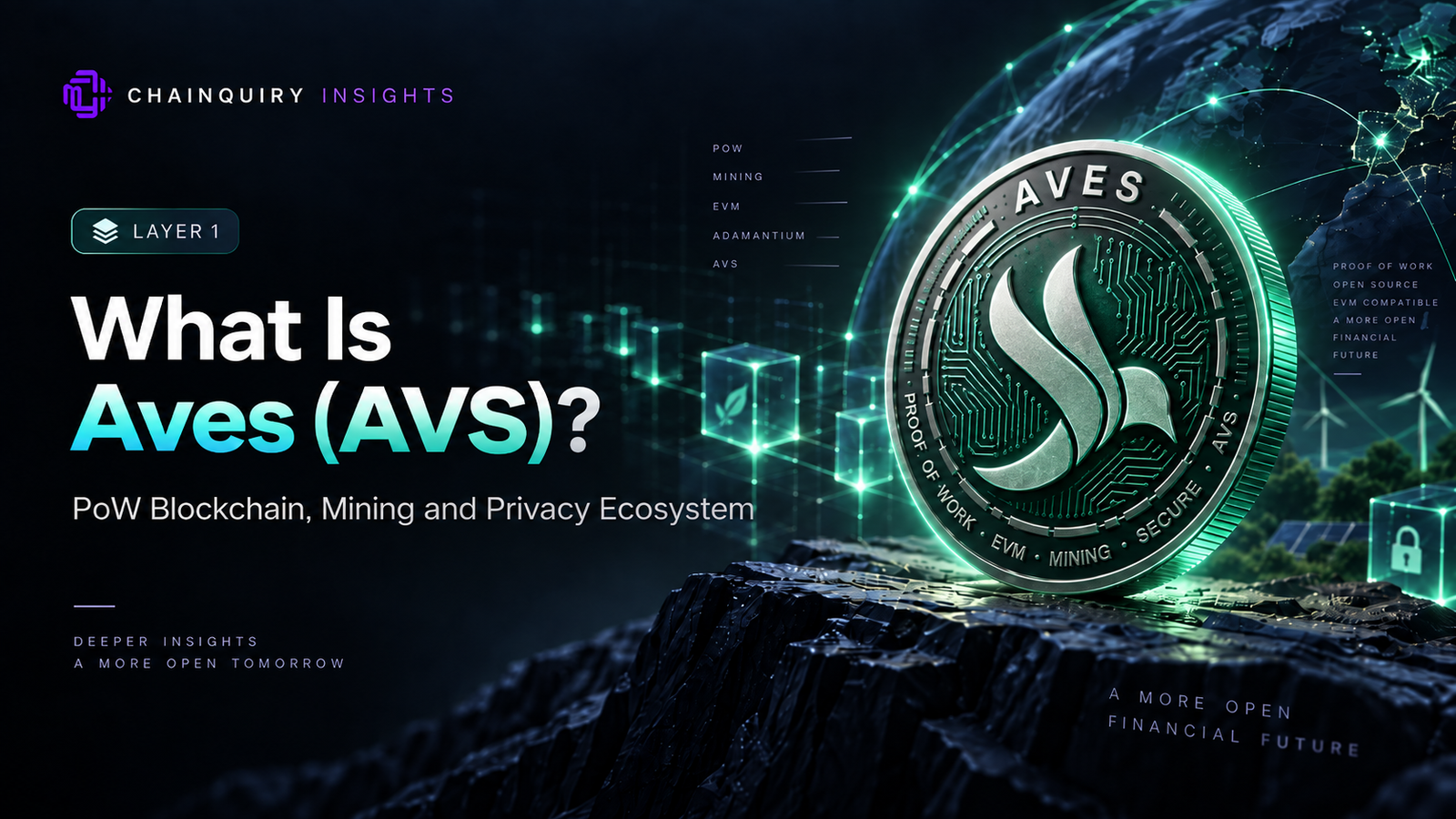
Aves (AVS) is an EVM-compatible Proof-of-Work Layer 1 blockchain launched in December 2022.
The network is built from Ethereum-derived technology but retains Proof-of-Work mining, while the wider Aves ecosystem has expanded into wallets, encrypted communications, payments, data-security tools and green-energy initiatives.
Its native currency, AVS, is used for transactions and network fees on the Aves blockchain.
Aves at a Glance#
| Project | Aves |
| Ticker | AVS |
| Type | Layer 1 blockchain |
| Consensus | Proof of Work |
| EVM compatible | Yes |
| Network | Aves |
| Chain ID | 33333 |
| Native currency | AVS |
| Launched | December 2022 |
| Core implementation | Go Aves / Ethereum-derived |
What Is Aves?#
Aves is an independent blockchain network designed around Proof-of-Work consensus and Ethereum-compatible infrastructure.
Its core node implementation, Go Aves, is built on top of the Go Ethereum codebase. This gives Aves an architecture familiar to developers working with Ethereum tooling while allowing the project to operate its own Layer 1 network.
Unlike Ethereum today, Aves continues to use Proof of Work.
That makes mining an important part of how the blockchain creates blocks and secures network history.
How Does the Aves Blockchain Work?#
Aves operates as its own blockchain rather than as a token issued on another network.
Its mainnet uses:
- Chain ID: 33333
- Native currency: AVS
- Consensus: Proof of Work
- EVM compatibility: Yes
Because the network is EVM-compatible, developers can work with many of the same concepts and tools used across Ethereum-compatible blockchains.
The project’s open-source node software also retains much of the architecture inherited from Go Ethereum.
This should not be confused with Aves running on Ethereum itself. AVS is the native asset of the Aves network.
Proof-of-Work Mining#
Aves uses Proof of Work to secure its blockchain.
Miners contribute computational work to produce valid blocks, while network nodes independently verify those blocks before accepting them into the blockchain.
The project’s technical materials retain Ethereum’s earlier Proof-of-Work architecture, including code associated with Ethash-style mining.
This is one reason Aves has historically described itself as bringing earlier Ethereum-style mining infrastructure back into use after Ethereum moved away from Proof of Work.
Aves therefore belongs more naturally alongside independent mineable Layer 1 networks than ERC-20 tokens or Proof-of-Stake chains.
Aves and Ethereum#
Aves has a close technical relationship with Ethereum without being part of the Ethereum mainnet.
The project’s Go Aves implementation is derived from go-ethereum, commonly known as Geth.
That gives the network compatibility with Ethereum-style accounts, smart contracts and development concepts while allowing Aves to define its own network parameters.
The distinction is important:
Ethereum and Aves are separate blockchains.
Sending assets or configuring a wallet therefore requires the correct Aves network settings rather than Ethereum mainnet settings.
What Is AVS Used For?#
AVS is the native currency of the Aves blockchain.
It is used for transferring value and paying transaction fees across the network.
Because Aves is an independent Layer 1, AVS does not require an ERC-20 contract address to function as its native currency.
The wider ecosystem has also connected AVS with products including payment infrastructure and applications developed around the Aves network.
Aves Adamantium and Encrypted Communications#
Aves has expanded beyond basic blockchain transfers through a product called Aves Adamantium.
The project describes Adamantium as a blockchain-powered communications wallet designed to combine asset management with encrypted messaging and communication features.
Official Aves materials describe support for functions including blockchain-based messaging and audio/video communication.
The project promotes triple AES-256 encryption as part of this system.
Security claims around any encrypted communications product should be interpreted carefully. Encryption algorithms can be well established while the security of a complete application still depends on implementation, key management, endpoints and other components.
Users should therefore distinguish between the strength of an underlying encryption standard and claims about an entire application being impossible to compromise.
Wallets and Applications#
The Aves ecosystem includes several wallet implementations.
These include desktop, web and mobile wallet software as well as the broader Adamantium communications platform.
The project maintains public repositories through its GitHub organisation, including its blockchain node and wallet code.
Open-source availability gives researchers and developers the ability to inspect portions of the project’s implementation directly rather than relying exclusively on marketing material.
Data Security and AI#
More recent Aves materials place increased emphasis on data protection.
The project describes an architecture combining blockchain infrastructure, encryption and AI-based monitoring intended to identify suspicious activity around protected information.
It has also discussed future development around quantum-resistant encryption.
Those ambitions should be separated from currently verifiable network functionality.
The Aves blockchain, wallets and existing software can be examined today, while forward-looking security capabilities should be treated as development goals unless their implementation can be independently verified.
Aves and Green Energy#
Environmental funding has been part of Aves’ stated mission since its early development.
The project’s GitHub description explains a model in which a portion of block output is intended to support alternative-energy initiatives.
Aves has also described work around a separate private-chain system for green-energy distribution and trading.
These initiatives form part of the project’s broader ecosystem, but claims about funding distributions or real-world energy projects should be checked against current project disclosures rather than assumed from the blockchain design alone.
Aves Blockchain Explorer#
Aves operates a public blockchain explorer through Avescan.
The explorer allows users to inspect:
- blocks
- transactions
- addresses
- AVS transfers
- network activity
- miners
- smart-contract activity
This is particularly useful when verifying whether network activity claimed by a project is actually observable on-chain.
A public explorer provides transparency into blockchain activity, although it does not independently validate every off-chain claim made by an ecosystem.
Is Aves Open Source?#
Important components of Aves are publicly available through the project’s GitHub organisation.
The primary aves-go repository contains the project’s Go-based blockchain implementation and identifies itself as the official Golang execution-layer implementation of the Aves protocol.
The organisation also publishes wallet-related repositories and other ecosystem software.
Its codebase reflects its technical origins in Ethereum’s Geth implementation.
What Makes Aves Different?#
Aves combines several areas that are often separate in cryptocurrency projects.
Its core is a mineable EVM-compatible Layer 1.
Around that network, the project is developing products involving:
- encrypted communication
- self-custody wallets
- blockchain payments
- data security
- AI-assisted monitoring
- green-energy applications
That broader scope makes Aves more than a simple mineable cryptocurrency, although individual ecosystem products should be evaluated separately according to what is currently operational.
What Should You Verify Before Using Aves?#
Before interacting with Aves, verify the correct network configuration and obtain wallet software only through official project resources.
For mainnet, the key identifier is:
Chain ID: 33333
Users should also distinguish between functionality that is currently available and features described as being under development.
For mining, wallets and node software, checking the project’s public repositories can provide additional technical context.
For blockchain transactions, Avescan provides an independent way to inspect network activity directly.
The Bottom Line#
Aves is an independent EVM-compatible Proof-of-Work Layer 1 with AVS as its native currency.
Its technical foundations are closely related to Ethereum’s earlier Go Ethereum architecture, but Aves operates its own blockchain and continues to use mining.
Since launching, the project has expanded beyond its original mining and green-energy focus into encrypted communications, wallets, payments and data-security products.
That makes the clearest way to research Aves to separate the pieces: examine the Layer 1 network and open-source code first, verify activity through its explorer, and then assess each additional ecosystem product according to what is actually available today.
Frequently Asked Questions#
What is Aves (AVS)?#
Aves is an EVM-compatible Proof-of-Work Layer 1 blockchain. AVS is its native currency.
Is AVS an ERC-20 token?#
AVS is the native asset of the independent Aves blockchain rather than an ERC-20 token on Ethereum.
What is the Aves Chain ID?#
The Aves mainnet uses Chain ID 33333.
Can Aves be mined?#
Yes. Aves uses Proof-of-Work consensus and supports cryptocurrency mining.
Is Aves built on Ethereum?#
Aves is a separate blockchain. Its node software is derived from Go Ethereum, which provides Ethereum-compatible architecture and tooling.
What is Avescan?#
Avescan is the public blockchain explorer for the Aves network. It can be used to inspect blocks, transactions, addresses and other on-chain activity.
What is Aves Adamantium?#
Aves Adamantium is an ecosystem application focused on wallet functionality and encrypted communications.
Is Aves open source?#
Core Aves software, including the Go Aves node implementation and wallet repositories, is publicly available through the project’s GitHub organisation.
General information only — always do your own research.