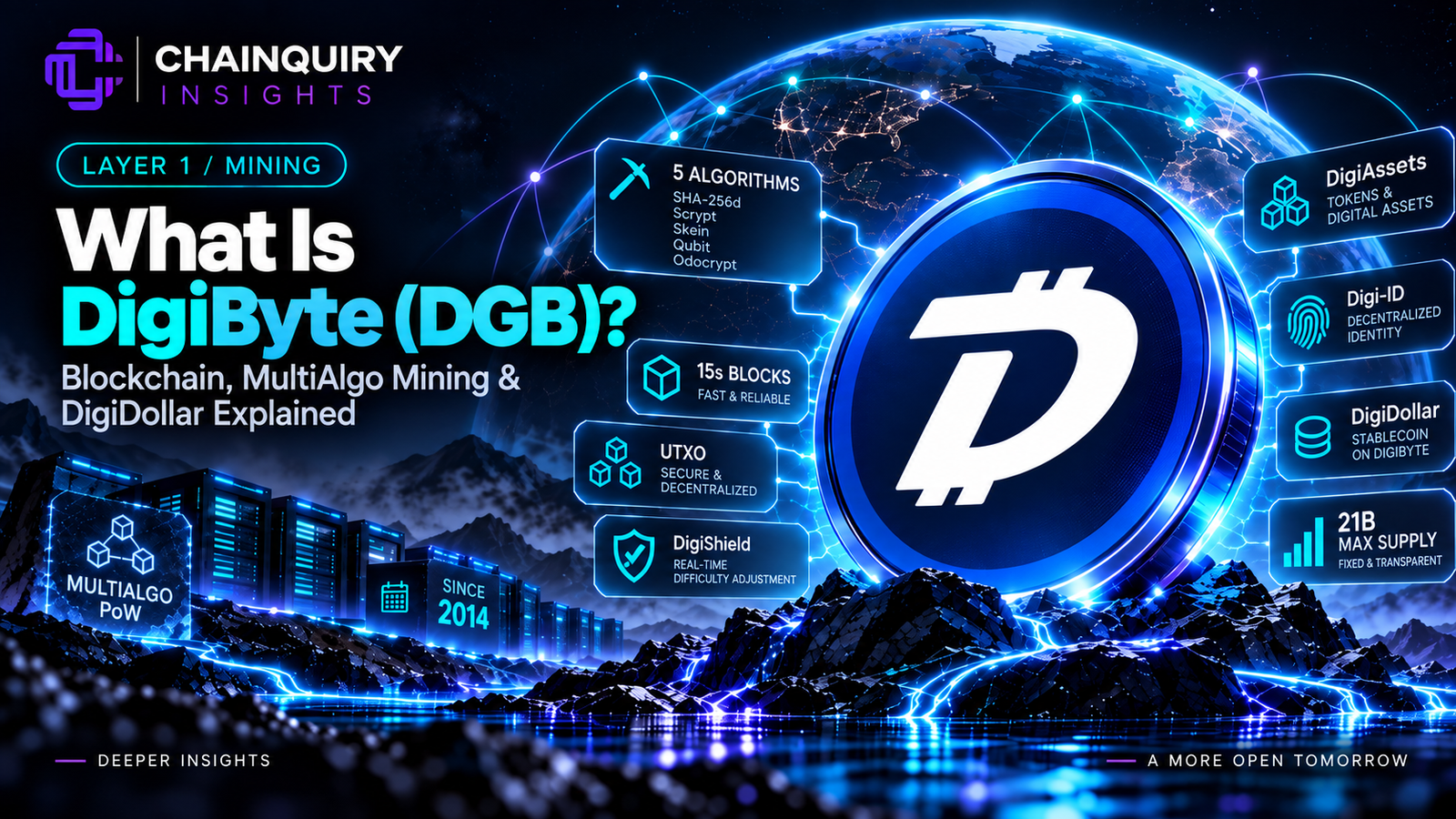
DigiByte is easy to underestimate if it is viewed only through the price history of DGB.
The network has been operating since January 2014, uses a UTXO-based architecture, targets blocks roughly every 15 seconds, and distributes Proof-of-Work mining across five separate algorithms.
Over more than a decade, DigiByte has also introduced or adopted technologies including DigiShield, MultiAlgo mining, SegWit, Odocrypt, DigiAssets and Digi-ID.
In 2026, another major component arrived: DigiDollar.
Activated directly on DigiByte mainnet in July 2026, DigiDollar introduced a native, DGB-collateralized, USD-pegged system into the DigiByte ecosystem.
Its arrival makes DigiByte worth revisiting as more than an older payment-focused cryptocurrency.
This Chainquiry Insight examines what DigiByte actually is today, how its security model works, why five mining algorithms matter, what DigiAssets and Digi-ID add to the ecosystem, and how DigiDollar has expanded the network in 2026.
Quick Answer: What Is DigiByte?#
DigiByte (DGB) is an open-source, public Proof-of-Work Layer 1 blockchain launched on 10 January 2014.
Like Bitcoin, DigiByte uses a UTXO accounting model and miners compete to add blocks to the chain.
Unlike Bitcoin, however, DigiByte does not rely on one mining algorithm.
Its MultiAlgo system distributes mining across five algorithms:
- SHA-256d
- Scrypt
- Skein
- Qubit
- Odocrypt
DigiByte targets an approximately 15-second network-wide block interval and has a maximum supply of 21 billion DGB.
Its wider ecosystem includes DigiAssets for blockchain-based assets, Digi-ID for cryptographic authentication and, since 2026, DigiDollar — a native USD-pegged system backed by DGB locked under on-chain rules.
From 2014 to 2026: A Blockchain With a Long Operating History#
DigiByte’s genesis dates to 10 January 2014.
That places the network among the older still-active Proof-of-Work blockchains.
The project was launched by Jared Tate and began as a public Proof-of-Work network.
Official DigiByte material describes an initial 0.5% premine that was used for giveaways and early development.
What followed was not a static Bitcoin clone.
Several protocol changes made during DigiByte’s early years became defining parts of the network.
DigiShield arrived in 2014 as a rapid difficulty-adjustment mechanism.
MultiAlgo followed later that year, distributing mining across multiple algorithms.
DigiSpeed later reduced the target block interval to approximately 15 seconds.
SegWit was activated in 2017, while Odocrypt and Dandelion++ arrived in 2019.
Development has continued beyond those earlier upgrades.
The historical DigiByte GitHub repository is now archived, with current development centered around the DigiByte-Core organization.
That distinction matters when researching DigiByte today because older repositories and older articles can present an incomplete picture of the software currently being maintained.
How DigiByte Works#
At its base layer, DigiByte is a UTXO blockchain.
Rather than maintaining account balances in the style of an account-based network, the chain tracks unspent transaction outputs that can later be consumed as inputs to new transactions.
DGB is the native asset used for value transfer, transaction fees, mining rewards and other functions within the wider DigiByte ecosystem.
DigiByte targets a block approximately every 15 seconds.
The most unusual part of the architecture, however, is not simply the shorter block interval.
It is the decision to distribute Proof of Work across five mining algorithms.
Why Does DigiByte Use Five Mining Algorithms?#
Many Proof-of-Work networks rely on one hashing algorithm.
Bitcoin, for example, uses SHA-256d.
Litecoin uses Scrypt.
DigiByte instead uses five:
- SHA-256d
- Scrypt
- Skein
- Qubit
- Odocrypt
The network manages mining across these separate algorithms rather than making the entire chain dependent on one hardware and hashing ecosystem.
The objective is to spread block production across several different mining markets and hardware categories.
This does not mean DigiByte is immune to mining concentration, economic attacks or specialized hardware.
It means the network deliberately avoids placing all Proof-of-Work competition inside one algorithm.
That design choice has remained one of DigiByte’s defining technical characteristics.
DigiShield: Responding to Hashrate Changes#
DigiShield is one of the technologies most closely associated with DigiByte’s history.
Proof-of-Work networks need to adjust mining difficulty so block production remains reasonably close to the intended schedule as hashrate rises or falls.
This becomes especially important when miners can rapidly enter or leave a network.
DigiShield was introduced in 2014 to allow DigiByte’s mining difficulty to respond more quickly to changes in available hashrate.
Instead of allowing long periods of unusually fast or unusually slow blocks after a major change in mining power, difficulty can adjust much more responsively.
The concept later influenced difficulty-adjustment approaches used by other cryptocurrency networks.
MultiShield subsequently extended this kind of difficulty management across DigiByte’s multi-algorithm mining system.
Odocrypt and DigiByte’s Approach to Mining Diversity#
Odocrypt became part of DigiByte in 2019, replacing Myr-Groestl as one of the network’s five mining algorithms.
Unlike a permanently fixed mining function, Odocrypt periodically changes its internal configuration.
Its design was intended to make permanent fixed-function specialization more difficult and preserve another path for specialized but re-programmable mining hardware such as FPGAs.
That does not eliminate hardware specialization as an economic force.
It does, however, demonstrate a recurring theme in DigiByte’s architecture: mining diversity has been treated as something that can be influenced at the protocol level rather than simply assumed.
15-Second Blocks#
DigiByte’s approximately 15-second block target is another major difference from Bitcoin.
A shorter block interval means the network creates opportunities for transactions to be included in blocks more frequently.
That should not be confused with saying that every transaction becomes economically final after exactly 15 seconds.
Applications, exchanges and users may require multiple confirmations depending on their own risk models.
The important distinction is that DigiByte produces blocks considerably more frequently than chains with multi-minute block intervals.
Newer protocol activity, including DigiDollar transactions, settles on the same underlying DigiByte network.
DGB Supply and Issuance#
DGB has a maximum supply of 21 billion units.
That number resembles Bitcoin’s 21 million maximum supply, but at a 1,000-to-one unit scale.
DigiByte also uses a different issuance schedule.
Instead of relying on large block-reward halvings approximately every four years, DigiByte gradually reduces block rewards through a continuous monthly reduction model.
The result is a smoother decline in new issuance over time rather than large step changes at multi-year intervals.
Official DigiByte documentation describes the supply as mathematically capped at 21 billion DGB.
DigiAssets: Assets on DigiByte#
DigiByte is not limited to transfers of DGB.
DigiAssets provides infrastructure for issuing and working with blockchain-based digital assets using DigiByte as the underlying chain.
The DigiAsset ecosystem has changed over time, so older articles may refer to tooling that is no longer the main development path.
The active DigiAsset-Core ecosystem now maintains software used to work with DigiAsset data and transactions.
The broader concept is important because it expands DigiByte beyond a single native currency.
The underlying blockchain can also serve as infrastructure for representing additional digital assets.
For researchers, however, DigiByte itself and software built around DigiAssets should be treated as related but distinct components of the wider ecosystem.
Digi-ID: Authentication Without a Traditional Password#
Digi-ID takes DigiByte in a different direction.
Instead of focusing on payments or asset issuance, Digi-ID is an open authentication protocol built around public-key cryptography.
A user can prove control of a cryptographic identity by signing an authentication challenge rather than handing a website a reusable password.
This changes the security model.
With conventional password authentication, a service generally needs to protect passwords or password-derived credentials.
Digi-ID instead allows authentication to rely on cryptographic signatures generated using keys controlled by the user.
Digi-ID therefore represents one of the clearest examples of DigiByte-related infrastructure being used for something other than transferring DGB between addresses.
Then Came DigiDollar#
For years, DigiByte’s better-known features were its MultiAlgo architecture, DigiShield, fast blocks, DigiAssets and Digi-ID.
In 2026, the network gained something materially different.
DigiDollar.
DigiDollar, commonly represented as DD, is a native USD-pegged system integrated into the modern DigiByte ecosystem.
It activated on DigiByte mainnet at block 23,869,440 on 17 July 2026.
This distinction is important.
DigiDollar is not a separate blockchain.
It is not an ERC-20 token bridged onto DigiByte.
It is also not simply a conventional company issuing tokens while holding dollars in a bank account.
DigiDollar’s core minting and collateral mechanics are enforced through DigiByte’s protocol and Core software.
How DigiDollar Works#
DigiDollar approaches stable value differently from conventional fiat-backed stablecoins.
Instead of an issuer holding dollars or cash-equivalent assets with a bank or custodian, DigiDollar uses DGB locked on-chain as collateral.
At a simplified level:
- A user locks DGB into a DigiDollar collateral position.
- The system determines the USD value of that collateral using oracle price data.
- DigiDollar can be minted subject to protocol-defined collateral and lock conditions.
- DD can then be transferred over the DigiByte network.
- Redemption follows DigiDollar’s protocol rules and the conditions attached to the collateral position.
The DGB collateral remains governed by on-chain conditions rather than being deposited with a conventional centralized stablecoin issuer.
DigiDollar is designed around overcollateralization.
In other words, the value of DGB committed to a position must exceed the amount of DigiDollar created under the relevant protocol conditions.
This creates a very different risk model from a stablecoin backed by cash, Treasury securities or bank deposits.
How DigiDollar Handles Oracle Pricing#
A DGB-backed asset targeting the US dollar requires reliable information about the external DGB/USD market price.
Because blockchain consensus cannot independently observe prices on external markets, DigiDollar uses an oracle system to bring that information into the protocol.
Official DigiByte material describes a MuSig2 Schnorr oracle architecture in which participating oracle operators contribute price information that can be combined and validated cryptographically.
This design is intended to avoid dependence on a single centralized price feed while providing DigiDollar with the external market information needed to evaluate collateral positions.
The oracle layer is therefore an important part of DigiDollar’s architecture.
Rather than relying on one centralized source to determine DGB’s market value, DigiDollar uses a distributed oracle mechanism designed to provide price information to the network while reducing reliance on any individual oracle operator.
Because collateral requirements and other DigiDollar mechanics depend on the DGB/USD price, the reliability and operation of this oracle system remain important to the protocol as a whole.
DigiDollar Growth After Mainnet Activation#
DigiDollar’s first months provide one of the more interesting reasons to revisit DigiByte in 2026.
The system activated on DigiByte mainnet on 17 July 2026.
By 26 September 2026, a live DigiByte Stats snapshot showed:
- $234,121.61 DD in network supply
- 162,208,835.19 DGB locked
- 312% network collateralization
- DGB/USD oracle price of $0.004518 at the time of the snapshot
- DCA level of 1x
- Emergency Redemption Ratio listed as inactive
- Network status reported as healthy
These figures represent a point-in-time snapshot rather than permanent network statistics.
DigiDollar supply, DGB collateral, oracle prices, collateralization and other system conditions can change as the network is used.
For that reason, readers should check DigiByte’s live network statistics for the most current values.
What the snapshot does demonstrate is that DigiDollar has moved beyond a proposal or test environment. The system is operating on DigiByte mainnet, DGB is being committed as collateral, and DigiDollar is being minted and transferred through the production network.
What Makes DigiDollar Different From USDT or USDC?#
The most important difference is the backing architecture.
Fiat-backed stablecoins such as USDT and USDC rely on centralized issuers and reserves held outside the blockchain.
DigiDollar does not represent a conventional claim against a company holding one dollar of reserve assets for every unit issued.
Instead, its backing comes from DGB committed under DigiByte’s protocol rules.
That removes certain forms of issuer and custodian dependency but introduces a different set of risks.
DigiDollar depends on factors including:
- the market value and liquidity of DGB
- sufficient collateralization
- functioning oracle infrastructure
- accurate external price information
- correct consensus implementation
- wallet and node software
- continued DigiByte network security
- the lock and redemption conditions attached to positions
“Decentralized” therefore does not mean “risk-free.”
It means several responsibilities normally handled by a stablecoin issuer are instead handled through collateral, cryptography, protocol rules and distributed infrastructure.
DigiDollar Is Not Free Liquidity#
DigiDollar does not allow users to create dollars from nothing.
Minting requires DGB collateral, and that collateral becomes subject to protocol-defined conditions and timelocks.
Current DigiDollar methodology documentation notes that locked collateral cannot simply be withdrawn early through a conventional exit mechanism.
That trade-off is important.
Users can create USD-denominated liquidity against DGB, but doing so means accepting collateral requirements, lock conditions, oracle dependency and the wider risks of the DigiDollar system.
Understanding those restrictions is essential to understanding what DigiDollar actually provides.
What Can Users Verify Themselves?#
One of the advantages of researching a public blockchain is that many claims can be independently checked.
For DigiByte, researchers can inspect information such as:
- blocks and transactions
- network activity
- DigiByte Core source code
- software release history
- consensus parameters
- mining algorithms
- DGB issuance rules
- DigiAsset development
- Digi-ID implementations
DigiDollar introduces another group of observable data and code paths, including:
- DD supply
- DGB locked as collateral
- collateralization
- active positions
- oracle information
- system health
- mint and redemption activity
The DigiByte ecosystem provides network statistics, while independent projects have also built chain-derived DigiDollar dashboards and published methodologies explaining how their figures are calculated.
Public code and public blockchain data do not automatically prove that every design assumption is safe.
Open-source software makes a system inspectable.
It does not replace security review.
But inspectability gives researchers something much more useful than marketing claims alone.
DigiByte Development in 2026#
One of the easiest mistakes when researching DigiByte is landing on its old GitHub organization and assuming development has stopped.
The historical DigiByte repository is archived and directs users toward the newer DigiByte-Core organization.
That organization contains current Core development and related ecosystem repositories.
The modern DigiByte Core line has incorporated substantial upstream modernization while retaining DigiByte-specific consensus behavior and historical network rules.
DigiDollar has also been integrated into the newer Core ecosystem rather than existing only as an unrelated external application.
For anyone auditing DigiByte today, the active DigiByte-Core repositories are therefore a more appropriate starting point than abandoned or archived historical repositories.
Main Risks and Limitations#
Longevity should not be confused with an absence of risk.
DigiByte remains a Proof-of-Work cryptocurrency whose security depends on miners, node operators, maintained software and economic incentives.
A five-algorithm design changes how mining security is distributed, but it does not eliminate miner concentration, hardware concentration, software vulnerabilities or market-related security assumptions.
The wider DigiByte ecosystem also contains components with very different maturity levels.
DigiByte itself has operated since 2014.
DigiDollar, by comparison, only activated on mainnet in July 2026.
It should therefore be evaluated as a much newer protocol even though it inherits DigiByte’s underlying blockchain infrastructure.
DigiDollar introduces additional considerations including:
- DGB volatility
- collateral adequacy
- oracle reliability
- timelocks
- implementation correctness
- network security
- market liquidity
There is also an important conceptual difference between collateral and a fiat guarantee.
Holding DD is not the same as holding a contractual claim to US dollars in a regulated bank account.
DigiDollar targets a USD value through protocol mechanics and DGB collateral.
A one-dollar target should never be interpreted as a guarantee that an asset will trade at exactly one US dollar under every possible market condition.
Why DigiByte Is Interesting to Study in 2026#
DigiByte occupies an unusual position.
It is old enough to have more than a decade of operating history, yet parts of its ecosystem are new enough to still be evolving rapidly.
Its base architecture represents an earlier branch of cryptocurrency design:
- UTXOs
- Proof of Work
- native coins
- open-source node software
At the same time, the current ecosystem includes digital assets, cryptographic authentication and a native collateralized stablecoin system.
That combination is more interesting than reducing DigiByte to a single metric such as price, market capitalization or transaction speed.
The better questions are architectural.
How does a five-algorithm Proof-of-Work network evolve after more than a decade?
What happens when newer Core infrastructure is incorporated without discarding DigiByte’s historical consensus rules?
Can a UTXO blockchain support additional economic primitives without becoming a conventional general-purpose smart-contract chain?
And how will a native DGB-backed stablecoin behave beyond its first months of production use?
Those questions can increasingly be investigated through public code and on-chain data rather than marketing material alone.
DigiByte FAQ#
Is DigiByte still active in 2026?#
Yes.
DigiByte mainnet continues operating, active development is maintained through the DigiByte-Core ecosystem, and DigiDollar activated on DigiByte mainnet in July 2026.
When was DigiByte launched?#
DigiByte launched on 10 January 2014.
What is DGB?#
DGB is the native cryptocurrency of the DigiByte blockchain.
It is used for value transfer, network fees and mining rewards and can also serve as collateral within the DigiDollar system.
What is DigiByte’s maximum supply?#
DigiByte has a maximum supply of 21 billion DGB.
Is DigiByte Proof of Work?#
Yes.
DigiByte uses a MultiAlgo Proof-of-Work consensus design.
What mining algorithms does DigiByte use?#
DigiByte currently uses:
- SHA-256d
- Scrypt
- Skein
- Qubit
- Odocrypt
How fast are DigiByte blocks?#
DigiByte targets a network-wide block interval of approximately 15 seconds.
What is DigiShield?#
DigiShield is DigiByte’s rapid difficulty-adjustment technology.
It was introduced to allow mining difficulty to respond more quickly to substantial changes in network hashrate.
What is Digi-ID?#
Digi-ID is an open authentication protocol based on cryptographic signatures rather than conventional reusable passwords.
What are DigiAssets?#
DigiAssets are blockchain-based digital assets built using DigiByte-related infrastructure.
The ecosystem includes software for issuing, decoding and working with asset data on the DigiByte network.
What is DigiDollar?#
DigiDollar, or DD, is a native USD-pegged system within the DigiByte ecosystem.
Users can create DD by committing DGB as collateral under protocol-defined rules.
When did DigiDollar launch?#
DigiDollar activated on DigiByte mainnet at block 23,869,440 on 17 July 2026.
Is DigiDollar the same as USDT or USDC?#
No.
DigiDollar uses DGB locked under on-chain rules rather than conventional fiat reserves held by a centralized stablecoin issuer.
Is DigiDollar an ERC-20 token?#
No.
DigiDollar operates natively within the DigiByte ecosystem rather than as an ERC-20 token on Ethereum.
Is DigiDollar a conventional smart contract?#
Not in the conventional EVM sense.
Its core functionality is integrated into DigiByte Core and DigiByte’s protocol infrastructure rather than deployed as an Ethereum-style smart contract.
Is DigiDollar risk-free because it is overcollateralized?#
No.
Overcollateralization is a risk-management mechanism, not a guarantee.
DigiDollar remains exposed to factors including DGB price movements, liquidity, oracle operation, collateral conditions, software implementation and underlying network security.
Where to Research DigiByte#
Anyone researching DigiByte should begin with primary sources.
The official DigiByte website provides an overview of the network, downloads and ecosystem documentation.
Active Core development is maintained through the DigiByte-Core GitHub organization.
For DigiDollar specifically, researchers should also check current network statistics rather than relying exclusively on static figures quoted in articles because supply, collateral and system conditions can change over time.
Chainquiry maintains a dedicated DigiByte project profile containing official links, technical information and reviewed research sources.
Final Thoughts#
DigiByte’s age is part of the story, but it is not the whole story.
The blockchain that began producing blocks in January 2014 has accumulated a distinctive set of design choices:
- five mining algorithms
- DigiShield difficulty adjustment
- approximately 15-second blocks
- DigiAssets
- Digi-ID
Its recent development adds another dimension.
DigiDollar takes the existing DGB economy and uses locked DGB collateral, oracle data and protocol rules to create a USD-denominated asset inside the DigiByte ecosystem.
Whether DigiDollar ultimately develops significant long-term usage cannot be determined from its first months on mainnet.
What can already be verified is that the system is live, mainnet positions have been opened, DGB has been locked and DigiDollar has been minted on the production network.
That makes DigiByte in 2026 more than a historical cryptocurrency worth remembering.
It is a long-running UTXO network that continues experimenting with what can be built at the protocol and ecosystem level more than twelve years after genesis.
Research Note#
Chainquiry reviewed the historical and technical claims in this article against official DigiByte resources, active development repositories and publicly available network and research sources.
Live network values can change after publication.
Readers should check current blockchain statistics and primary documentation when verifying time-sensitive information.

Disclaimer: Chainquiry provides independent cryptocurrency research and project discovery. Coverage is not an endorsement or investment recommendation. Cryptocurrency and blockchain protocols involve technical, market and operational risk. Verify critical information through primary sources and conduct your own research. Find more about DigiByte Project on Chainquiry here.