Layer 1 PoW / PoS
Aetheris AETH
Open-source Layer 1 blockchain combining Scrypt Proof of Work and Proof of Stake, with self-custody wallet software and public network…
9 official links Reviewed Sep 2026
StatusLive
LaunchedDec 2025
NetworkAetheris
Proof-of-stake Layer 1 blockchain using Ouroboros consensus, with native assets, smart contracts, staking and on-chain governance.
Overview
Cardano (ADA) is an open-source Layer 1 blockchain built around the Ouroboros family of Proof-of-Stake consensus protocols. Development began in 2015, and the Cardano mainnet launched in September 2017.
ADA is the native asset of the Cardano network and is used for transaction fees, staking and participation in on-chain governance. Cardano uses a UTXO-based ledger model and supports smart contracts through Plutus, as well as native tokens that can be issued directly on the ledger without requiring a smart contract.
The network is secured by independently operated stake pools. Under Ouroboros Praos, block producers are selected according to stake, allowing ADA holders to participate by operating or delegating to stake pools.
Cardano has evolved through a series of protocol eras that introduced decentralization, native assets, smart contracts, scalability improvements and decentralized governance. Its development is open source, with the core node, ledger and consensus implementations publicly maintained.
ADA has a maximum supply of 45 billion coins. Cardano is governed and developed through a decentralized ecosystem involving community participants and organizations including the Cardano Foundation, Input Output, EMURGO and Intersect.
Technology
Tokenomics
Chainquiry Insights
Explore how Cardano works, from Ouroboros staking and eUTXO smart contracts to native assets, ADA supply, on-chain governance, Hydra and current development.
Read the article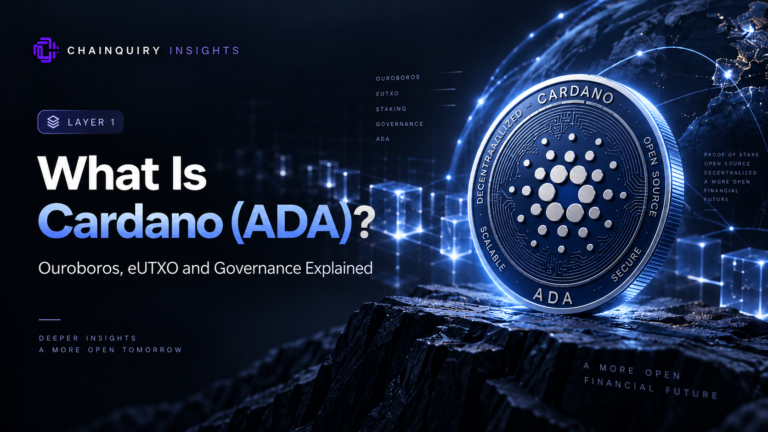
Reference material
EXPLORE MORE
Open-source Layer 1 blockchain combining Scrypt Proof of Work and Proof of Stake, with self-custody wallet software and public network…
Sharded Proof-of-Work Layer 1 with BlockFlow scaling, Ralph smart contracts, Blake3 mining and the native ALPH coin.
Permissionless Layer 1 blockchain using Pure Proof-of-Stake consensus for fast, low-cost transactions and smart contract execution.
PROJECT PULSE
A new telegram link has been added to the project profile.
Telegram link ↗The Chainquiry profile review date was updated to 2026-09-21.
Chainquiry project profile ↗A new discord invite has been added to the project profile.
Discord invite ↗A new block explorer has been added to the project profile.
Block explorer ↗The listed github repository destination has changed.
GitHub repository ↗Get important project changes by email. No account is required for a single-project watch.
Want a full watchlist and notification history? Create a free account.