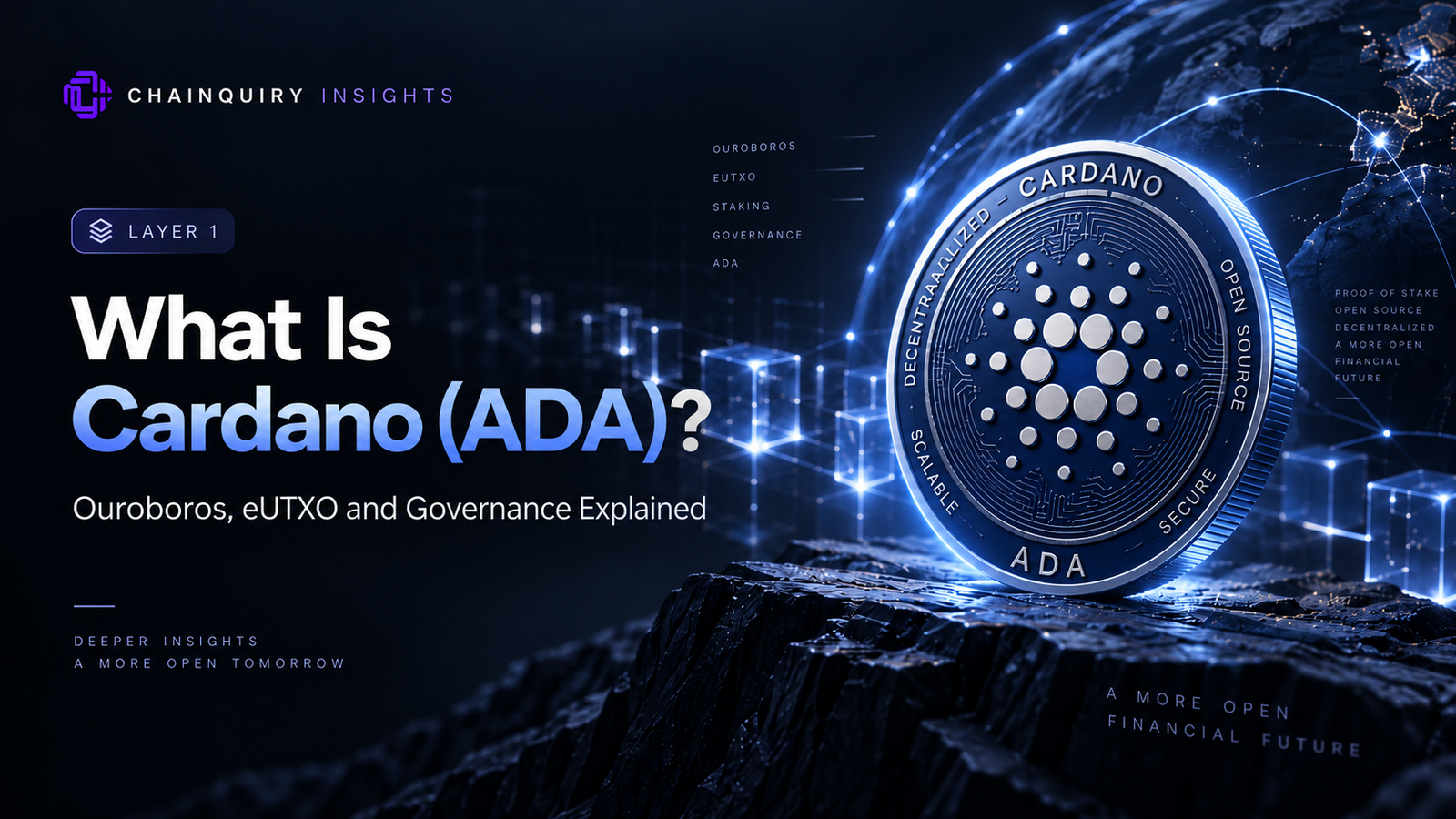
Cardano is an open-source Layer 1 blockchain that uses Proof of Stake to process transactions, secure the network and support smart contracts, native assets and on-chain governance.
Its native cryptocurrency is ada, commonly identified by the ticker ADA.
The Cardano mainnet launched on September 29, 2017. Since then, the protocol has evolved through a series of major upgrades that introduced staking, decentralized block production, native tokens, Plutus smart contracts and community-led governance.
Cardano differs from many smart-contract blockchains in several important ways.
It uses the Ouroboros family of Proof-of-Stake protocols rather than Proof of Work.
Its ledger uses an Extended Unspent Transaction Output model, commonly called eUTXO, instead of the account model used by networks such as Ethereum.
Tokens can also exist natively in the Cardano ledger without requiring an ERC-20-style smart contract.
And since the Chang and Plomin upgrades, Cardano includes a formal on-chain governance system involving ADA holders, delegated representatives, stake pool operators and a constitutional committee.
Understanding Cardano therefore means looking at more than ADA alone.
Cardano vs ADA#
Cardano is the blockchain network.
ADA is its native cryptocurrency.
ADA has several protocol-level roles.
It is used to:
pay transaction fees
participate in staking
delegate stake to block-producing pools
receive staking rewards
make deposits required by certain protocol actions
and participate in Cardano governance
ADA is divided into smaller units called lovelace.
One ADA equals:
1,000,000 lovelace
Both ada and its smallest unit, the lovelace, are named after Ada Lovelace, the 19th-century mathematician and early computing pioneer. Cardano’s original Byron era was named after her father, the poet Lord Byron.
When Did Cardano Launch?#
Development of Cardano began before the mainnet went live.
Input Output, originally known as IOHK, led much of the early protocol research and engineering, while the Cardano Foundation and EMURGO also became major organizations within the wider ecosystem.
The Cardano mainnet launched on September 29, 2017.
That initial phase is known as the Byron era.
Later protocol upgrades progressively changed the network rather than replacing it with separate blockchains.
The Shelley upgrade introduced decentralized staking and stake pools.
Mary introduced native multi-asset functionality.
Alonzo added Plutus smart contracts.
Vasil delivered further ledger and Plutus improvements.
Chang introduced the first stage of Cardano’s modern governance architecture.
Plomin completed the main CIP-1694 governance capabilities in January 2025.
Cardano’s history is therefore better understood as one continuously upgraded blockchain rather than a sequence of independent networks.
What Consensus Mechanism Does Cardano Use?#
Cardano uses Proof of Stake through the Ouroboros family of consensus protocols.
Instead of miners competing to solve computational puzzles, block production is assigned according to stake.
ADA held by users represents stake in the protocol.
That stake can be operated directly through a stake pool or delegated to another pool.
The amount of stake associated with a pool influences its probability of being selected to produce blocks.
Cardano’s production network has used Ouroboros Praos as a core consensus design.
The broader Ouroboros research family also includes later protocol designs and extensions developed for different security and performance objectives.
How Ouroboros Works#
Ouroboros divides time into epochs and slots.
A slot is a short period during which a block may be produced.
Slots are grouped into epochs.
Cardano currently uses one-second slots, while protocol parameters result in an expected block approximately every:
20 seconds
Not every slot contains a block.
For each eligible slot, stake-based leader selection determines which stake pool is allowed to produce a block.
The selected block producer validates transactions, creates the block and broadcasts it to the network.
Other nodes verify the block according to Cardano’s consensus and ledger rules.
What Is a Stake Pool?#
Stake pools are infrastructure operators that participate directly in Cardano block production.
A stake pool operator runs Cardano node software and keeps the infrastructure available so it can produce blocks when selected.
Pools can combine the operator’s own pledged ADA with stake delegated by other holders.
Delegation increases the effective stake associated with a pool without transferring ownership of the delegator’s ADA.
This allows users who do not want to operate their own server infrastructure to participate indirectly in the Proof-of-Stake system.
How ADA Delegation Works#
ADA holders can delegate their staking rights to a stake pool.
The ADA itself remains in the holder’s wallet.
Delegation does not normally lock the coins.
A user can continue spending ADA even while that wallet’s stake is delegated.
The protocol records which pool the stake is associated with and uses that information when calculating stake distribution and rewards.
Delegators can receive staking rewards according to protocol rules, pool performance, fees and other parameters.
Returns are not fixed or guaranteed.
A stake pool must actually participate successfully in the network to generate the rewards from which delegators can receive their share.
Is ADA Staking the Same as Locking Coins?#
No.
Native Cardano delegation is unusual compared with staking systems that require assets to be transferred into a staking contract or locked for a predefined period.
Delegated ADA remains under the owner’s control.
The delegation certificate gives a stake pool the right to represent that stake in leader selection.
It does not give the pool operator permission to spend the user’s ADA.
This distinction reduces custody risk associated with native delegation, although wallet security and pool-selection considerations still remain.
Third-party custodial staking services can use different arrangements and may introduce additional counterparty risks.
How Fast Are Cardano Blocks?#
Cardano’s current consensus parameters target an expected block approximately every 20 seconds.
Transaction inclusion and transaction settlement should not be treated as identical concepts.
A transaction can appear in a block quickly.
As further blocks accumulate, confidence that the transaction will remain in the canonical chain increases.
Ouroboros uses a settlement window in which recent blocks can still theoretically be replaced if the network observes a competing valid chain.
Cardano documentation notes that a high level of confidence develops much earlier, while the protocol’s stronger immutability window is considerably longer.
Applications can therefore choose their confirmation requirements according to the value and risk of the transaction.
What Is eUTXO?#
Cardano uses an Extended Unspent Transaction Output model, or eUTXO.
This is derived from the UTXO model used by Bitcoin.
Under a UTXO system, a wallet balance is represented by unspent outputs created by earlier transactions.
A new transaction consumes one or more existing outputs and creates new outputs.
Each UTXO can only be consumed once.
Cardano extends this model so transaction outputs can contain additional data and interact with scripts.
This allows smart-contract logic to exist while preserving many of the deterministic properties of UTXO-based transaction processing.
eUTXO vs Ethereum Accounts#
Ethereum primarily uses an account-based model.
An Ethereum smart contract maintains mutable state associated with an account.
Cardano instead structures state around individual transaction outputs.
A Cardano transaction declares the inputs it intends to consume and the outputs it will create.
That means much of the effect of a transaction can be determined before it is submitted.
The model can also enable independent transactions to be processed concurrently when they do not attempt to consume the same UTXOs.
The trade-off is that developers need to design applications around the eUTXO model rather than simply reproducing account-based smart-contract patterns.
What Is Plutus?#
Plutus is Cardano’s smart-contract platform.
The Alonzo upgrade activated Plutus smart-contract functionality on mainnet in September 2021.
Plutus scripts validate whether a transaction is allowed to spend a particular output.
Applications can use this model to create decentralized protocols for activities such as:
token exchanges
lending
stablecoins
marketplaces
escrow
governance
games
and other programmable financial or non-financial applications
Plutus has continued evolving through subsequent protocol versions and language updates.
Cardano’s smart-contract environment should therefore not be reduced to the capabilities available when Alonzo first launched.
What Are Cardano Native Assets?#
Cardano supports custom assets directly in its ledger.
This functionality was introduced through the Mary upgrade.
A token does not need an ERC-20-style smart contract simply to exist, be held or be transferred.
Instead, Cardano’s ledger itself understands multiple asset types.
Each native asset is identified through information including its policy ID and asset name.
A minting policy determines when units of that asset can be created or destroyed.
Native assets can represent fungible tokens, unique assets, NFTs and other forms of blockchain-tracked value.
ADA remains distinct because it is the network’s primary asset for fees, staking rewards and protocol deposits.
Are Cardano Tokens Smart Contracts?#
Not necessarily.
A basic Cardano native token can be issued and transferred without requiring a continuously executing token smart contract.
The ledger itself tracks the asset.
Applications can still combine native assets with Plutus scripts.
For example, a decentralized exchange can use smart contracts to control how native tokens are traded.
The token’s existence and transfer accounting, however, are handled natively by the ledger.
This is one of the architectural differences between Cardano and platforms where most custom tokens are represented entirely through token contracts.
How Cardano Transaction Fees Work#
Cardano transaction fees are deterministic.
For ordinary transactions, the minimum fee includes a component based on transaction size and a fixed base component.
Smart-contract transactions can also include execution costs associated with Plutus computation and memory.
Fees are denominated in ADA.
Unlike systems with auction-style gas markets, a user does not normally need to guess a fee in the hope that a validator will prioritize the transaction.
The transaction’s required execution budget and fee can be calculated before it is submitted.
Protocol parameters governing fees can change through Cardano’s governance and upgrade mechanisms.
What Happens to Cardano Transaction Fees?#
Transaction fees do not simply go directly to whichever stake pool produced the individual block.
Fees are accumulated within the protocol and form part of the reward system.
Rewards are calculated across epochs and distributed according to Cardano’s staking and monetary parameters.
This creates a network-wide incentive structure rather than a direct per-transaction tip system like those used by some other blockchains.
Does ADA Have a Maximum Supply?#
Yes.
The maximum ADA supply is:
45,000,000,000 ADA
This maximum is defined at the protocol level.
Not all 45 billion ADA entered circulation at the launch of the network.
Part of the remaining supply exists in Cardano’s reserves and is progressively released through the protocol’s monetary-expansion mechanism.
The Cardano treasury, staking rewards, deposits, fees and circulating balances all form parts of the wider accounting system beneath the maximum supply.
There is no Proof-of-Work mining process creating ADA beyond this limit.
Where Do ADA Staking Rewards Come From?#
Cardano staking rewards are funded from two principal sources:
transaction fees
and
ADA released from protocol reserves
The amount released from reserves declines over time according to Cardano’s monetary policy.
A portion of reward-related funds can also be directed into the Cardano treasury.
The treasury can then fund ecosystem activity through governance-approved withdrawals.
Over the long term, the economic design is intended to rely increasingly on transaction-fee activity as the remaining reserve balance declines.
The reward rate is therefore not permanently fixed.
Does Cardano Burn Transaction Fees?#
Cardano does not use an Ethereum-style mechanism that automatically destroys the base portion of every transaction fee.
Fees instead participate in the protocol’s reward and treasury economics.
Native Cardano assets can have their own minting and burning policies, but those asset-specific rules are separate from ADA’s base monetary system.
ADA’s defining supply constraint is the 45 billion maximum rather than a continuous fee-burning mechanism.
What Is Cardano Governance?#
Cardano now has a formal on-chain governance system built around CIP-1694.
Governance involves several participant groups:
ADA holders
delegated representatives, or DReps
stake pool operators
and
the constitutional committee
ADA holders can delegate governance voting power to a DRep or participate according to the governance mechanisms supported by the protocol.
Different governance actions require approval from different combinations of these bodies.
Governance actions can include matters such as:
hard fork initiation
protocol parameter changes
treasury withdrawals
constitutional changes
committee changes
and motions of no confidence
Voting power for DReps and stake pool operators is stake-weighted, while constitutional committee members vote individually.
What Are DReps?#
DRep stands for delegated representative.
ADA holders can delegate governance voting power to a DRep without transferring ownership of their ADA.
A holder can also register as a DRep and represent themselves or other delegators.
This creates a liquid-democracy model in which users can participate directly or delegate ongoing governance work to another representative.
Governance delegation and staking delegation are related to ADA ownership but serve different purposes.
Delegating stake to a block-producing pool does not automatically mean that the same entity receives the user’s DRep voting power.
What Does the Constitutional Committee Do?#
The constitutional committee evaluates governance actions against the Cardano constitution.
It does not independently control the network.
Its vote is one component of the tripartite governance structure.
Different governance actions require different combinations of constitutional committee, DRep and stake pool operator approval.
The constitution sets principles and guardrails intended to constrain how governance changes are made.
The constitution also preserves the rule that ADA supply must not exceed 45 billion.
What Were Chang and Plomin?#
The Chang upgrade began Cardano’s transition into the Conway governance era.
Chang activated the first major CIP-1694 governance capabilities and moved more protocol decision-making onchain.
The second governance upgrade, originally referred to as Chang #2, was renamed Plomin.
The Plomin hard fork activated on January 29, 2025.
It completed the main CIP-1694 governance capabilities, including the full set of governance actions and the active DRep role.
Following Plomin, community governance can participate directly in decisions covering future hard forks, protocol parameters, treasury withdrawals and other major network actions.
Who Controls Cardano?#
No single company owns the Cardano blockchain.
Input Output has historically been a major research and engineering contributor.
The Cardano Foundation supports areas including ecosystem development, infrastructure and adoption.
EMURGO has also been involved in the ecosystem since its early development.
Intersect operates as a member-based organization supporting governance and continuity of open-source Cardano development.
Stake pool operators independently produce blocks.
ADA holders participate through staking and governance.
DReps and the constitutional committee now hold defined on-chain governance roles.
Cardano’s original pioneer entities have relinquished the genesis keys that gave them special authority during earlier phases of the network.
Practical influence can still differ between organizations, developers, large ADA holders, stake pool operators and governance participants, but protocol decisions are no longer based solely on the original founding entities.
What Is Hydra?#
Hydra is a family of Layer 2 protocols designed for Cardano.
Hydra Head is the first major implementation.
A Hydra Head allows a small group of participants to move UTXOs into an offchain environment and process Cardano-style transactions directly between those participants.
Because the participants do not need to publish every intermediate transaction to Layer 1, a Hydra Head can provide lower latency and higher throughput for suitable use cases.
When participants exit, the final state can be resolved back onto Cardano.
Hydra Head is available for mainnet use, although its documentation continues to describe the software as actively developed and advises users to understand its limitations.
Hydra does not replace Cardano’s base-layer consensus.
What Is Mithril?#
Mithril is another piece of Cardano scaling and infrastructure technology.
It uses stake-based cryptographic signatures to create authenticated snapshots and proofs related to the Cardano blockchain.
A new node can use a trusted Mithril snapshot to obtain a recent blockchain state without replaying the entire history from genesis before reaching that point.
This can reduce bootstrap time for node infrastructure and other applications.
Mithril does not change ordinary ADA transactions or replace Ouroboros consensus.
It acts as complementary infrastructure built around Cardano’s existing stake distribution.
What Is Cardano Working on in 2026?#
Cardano development remains active.
The current cardano-node release series has continued improving Plutus execution, storage, networking and node performance.
Cardano-node 11.1.x also contains groundwork for the planned Dijkstra ledger era.
Experimental support for the Peras consensus extension has entered the node codebase but remains disabled rather than representing the active mainnet consensus protocol.
That distinction is important.
Cardano frequently develops future protocol capabilities inside public node releases before those capabilities are approved and activated on mainnet.
A feature present in experimental code is therefore not automatically a live network feature.
Is Cardano EVM Compatible?#
Cardano’s main smart-contract environment is not based on the Ethereum Virtual Machine.
Plutus and eUTXO use a different execution and accounting model.
An Ethereum smart contract cannot simply be copied onto Cardano Mainnet and expected to behave identically.
Developers can use bridges, sidechains or compatibility layers where available, but those systems introduce their own architecture and trust assumptions.
Cardano’s native design is intentionally distinct from EVM-based networks.
Is Cardano Private?#
No.
Cardano is a public blockchain.
Addresses, transaction outputs, native assets and smart-contract interactions can be inspected through blockchain explorers.
Addresses are pseudonymous rather than automatically containing a user’s real-world identity.
External information can still connect blockchain activity with identifiable people or organizations.
ADA should therefore not be considered a privacy coin.
What Are the Main Risks of Using Cardano?#
Cardano’s protocol design does not eliminate risk.
Smart-contract risk#
Plutus applications can contain programming errors or flawed economic logic.
Wallet risk#
Loss or theft of private keys can permanently remove access to ADA.
Application risk#
A decentralized application can fail even while the Cardano base network continues operating correctly.
Governance concentration#
Voting power is influenced by ADA holdings and delegated stake, so participation and stake distribution affect practical governance influence.
Stake-pool concentration#
Proof-of-Stake security depends partly on the distribution of active stake among independent pool operators.
Layer 2 risk#
Hydra and other scaling systems have architecture and operational requirements beyond ordinary Layer 1 transactions.
Bridge risk#
Assets moved between Cardano and other networks can depend on bridge contracts, validators or custodians.
Market risk#
ADA is a freely traded cryptocurrency whose market value can fluctuate substantially.
Network functionality and price performance are separate questions.
How to Research Cardano Independently#
Cardano publishes a large amount of technical information openly.
Useful primary resources include:
Cardano.org
Cardano Docs
the cardano-node repository
the Cardano Improvement Proposal repository
the Cardano constitution
on-chain governance tools
the Cardano explorer
Hydra documentation
and Mithril documentation
Protocol details change over time, particularly around governance, smart-contract versions and future scaling work.
Current mainnet behavior should therefore be distinguished from research proposals and experimental node features.
For structured network information and official links, see the Cardano (ADA) profile on Chainquiry.
Final Perspective#
Cardano is a Proof-of-Stake Layer 1 blockchain built around a different architecture from both Bitcoin and Ethereum.
Ouroboros determines block production through ADA stake rather than mining.
Its eUTXO ledger extends the transaction-output model with programmable scripts, while Plutus provides the main smart-contract environment.
Native assets can be issued directly through the Cardano ledger without requiring a conventional token contract simply to track balances and transfers.
ADA provides the economic foundation for transaction fees, staking, rewards and governance, with a maximum supply capped at 45 billion.
Cardano’s governance model has also changed substantially.
Chang and Plomin moved the network into the Conway era, where DReps, stake pool operators and the constitutional committee participate in formal on-chain decisions.
At the same time, technologies such as Hydra and Mithril extend Cardano beyond basic Layer 1 transactions, while newer node releases continue preparing future protocol capabilities.
The result is a blockchain whose defining characteristics are not simply Proof of Stake or low energy use, but the combination of Ouroboros consensus, eUTXO accounting, native assets, Plutus smart contracts and increasingly community-directed governance.