
Layer 1 PoW / PoS

Aetheris AETH
Open-source Layer 1 blockchain combining Scrypt Proof of Work and Proof of Stake, with self-custody wallet software and public network…
9 official links Reviewed Sep 2026
StatusLive
LaunchedDec 2025
NetworkAetheris

Payments, tokenized assets and Soroban smart contracts come together on Stellar (XLM), a Layer 1 network secured by the Stellar Consensus Protocol.
Overview
Stellar (XLM) is an open-source Layer 1 blockchain launched in 2014 for payments, asset issuance and financial applications. The network is designed to let users and institutions transfer value, issue digital assets and connect blockchain-based applications with existing financial infrastructure.
Rather than using Proof of Work or Proof of Stake, Stellar reaches agreement through the Stellar Consensus Protocol (SCP). SCP is based on Federated Byzantine Agreement, where validator nodes independently choose trusted groups of other nodes and overlapping quorums collectively agree on the state of the ledger. This allows the network to finalize transactions without cryptocurrency mining.
XLM, also known as lumens, is Stellar’s native asset. It is used to pay transaction fees, satisfy account minimum-balance requirements and provide liquidity between assets on the network. Stellar originally created 100 billion XLM, followed by several years of protocol inflation. Inflation ended in 2019, and a large portion of the supply was subsequently removed permanently. Approximately 50 billion XLM now remain, with no additional lumens scheduled to be created.
Stellar supports native issuance of assets representing currencies, cryptocurrencies, securities and other forms of value. The protocol also includes the Stellar Decentralized Exchange, where assets can be traded through on-chain order books and liquidity pools without requiring a separate exchange protocol.
Programmability is provided through Soroban, Stellar’s integrated smart-contract platform. Soroban contracts are primarily written in Rust and compiled to WebAssembly, allowing developers to build decentralized applications, token systems and financial services directly on the Stellar network.
Stellar also supports anchors and payment infrastructure that connect blockchain assets with traditional currencies through deposits and withdrawals. Its open-source Stellar Core software continues to receive active protocol and security updates, with Stellar Core v28.0.1 released in September 2026.
Technology
Tokenomics
Chainquiry Insights
Explore how Stellar works, from SCP consensus and fast payments to tokenized assets, its native DEX, anchors, Soroban smart contracts and XLM.
Read the article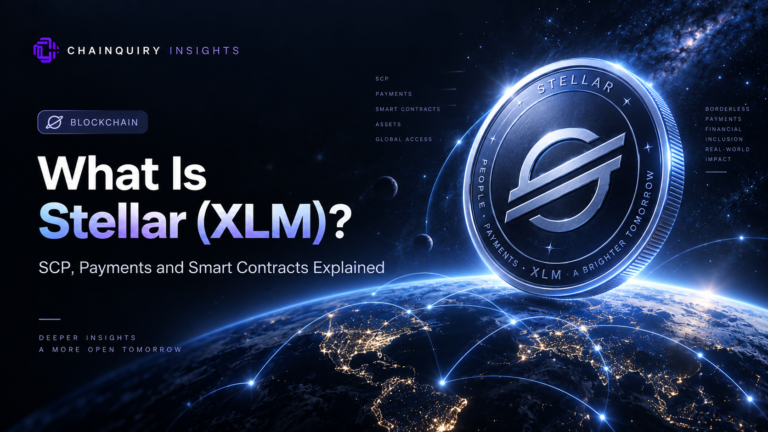
Reference material
EXPLORE MORE
Open-source Layer 1 blockchain combining Scrypt Proof of Work and Proof of Stake, with self-custody wallet software and public network…

Sharded Proof-of-Work Layer 1 with BlockFlow scaling, Ralph smart contracts, Blake3 mining and the native ALPH coin.

Permissionless Layer 1 blockchain using Pure Proof-of-Stake consensus for fast, low-cost transactions and smart contract execution.
PROJECT PULSE
The Chainquiry profile review date was updated to 2026-09-22.
Chainquiry project profile ↗A new block explorer has been added to the project profile.
Block explorer ↗The listed github repository destination has changed.
GitHub repository ↗Get important project changes by email. No account is required for a single-project watch.
Want a full watchlist and notification history? Create a free account.