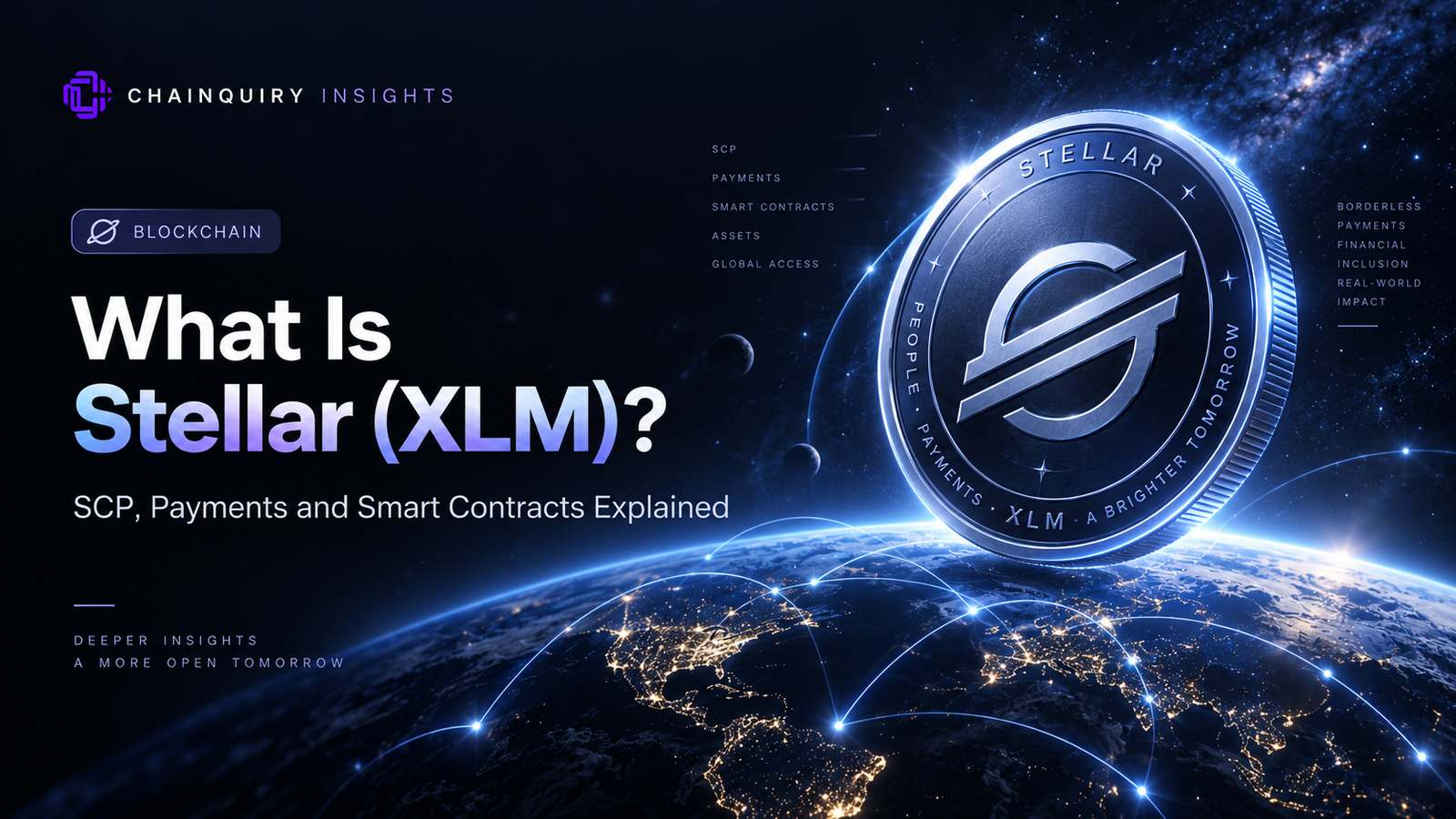
Stellar (XLM) is an open-source Layer 1 blockchain designed for moving and issuing digital value, connecting blockchain applications with traditional financial rails, and supporting programmable financial services.
The network launched in 2014 and today supports payments, fiat-backed assets, tokenization, decentralized trading, on- and off-ramps and smart contracts.
XLM, also known as lumens, is Stellar’s native cryptocurrency. It is used for transaction fees, account reserves, smart-contract resource costs and other network-level functions.
Unlike Bitcoin, Litecoin or Dogecoin, Stellar does not use mining. It also does not use conventional Proof of Stake.
Instead, validators reach agreement through the Stellar Consensus Protocol, or SCP, a federated Byzantine agreement system designed to reach consensus without block rewards or energy-intensive mining.
How Stellar Works#
Stellar maintains a shared public ledger containing accounts, balances, offers, issued assets, smart-contract data and other network state.
Users create digitally signed transactions containing one or more operations. Those operations can include activities such as:
sending XLM
transferring issued assets
creating trading offers
managing trustlines
claiming balances
interacting with liquidity pools
invoking smart contracts
Transactions are broadcast to the network and evaluated by Stellar Core nodes.
Validator nodes then use the Stellar Consensus Protocol to agree on which transaction set becomes part of the next ledger.
Once consensus is reached, the ledger closes and participating nodes apply the agreed state transition.
Stellar ledgers are expected to close approximately every five seconds, although actual timing can vary.
What Is the Stellar Consensus Protocol?#
Stellar Consensus Protocol, or SCP, is the mechanism Stellar validators use to agree on the state of the blockchain.
SCP is based on Federated Byzantine Agreement, or FBA.
This differs fundamentally from Proof of Work and Proof of Stake.
In Proof of Work, influence over block production depends primarily on computational work.
In Proof of Stake, validator participation generally depends on staked assets.
In SCP, validators instead choose which other validators they trust when determining whether agreement has been reached.
Each validator defines a quorum set containing other nodes whose agreement it considers relevant.
Smaller combinations within those quorum sets are called quorum slices.
Agreement emerges when sufficiently overlapping sets of trusted nodes confirm the same transaction set and ledger state.
Does Stellar Use Proof of Stake?#
No.
Stellar does not use conventional Proof of Stake.
Running a validator does not require staking XLM, and validators do not earn newly issued XLM or transaction fees for participating in consensus.
There is also no Proof-of-Work mining competition.
Validators participate because organizations and applications that depend on Stellar benefit from helping maintain a resilient and independently verifiable network.
This makes Stellar’s consensus incentives substantially different from networks where validators or miners participate primarily to earn protocol-issued rewards.
Safety vs Liveness#
One important property of SCP is that it prioritizes safety over liveness.
In blockchain terminology, safety means honest nodes should not finalize contradictory ledger histories.
Liveness means the network continues making progress and producing new ledgers.
If Stellar’s validator trust relationships become sufficiently disrupted, SCP is designed to prefer temporarily stopping consensus rather than allowing different parts of the network to finalize conflicting histories.
This is an important trade-off.
The protocol prioritizes avoiding forks even if that means ledger production can temporarily halt when sufficient agreement cannot be reached.
Stellar’s 2015 Network Upgrade#
Stellar launched in 2014, but the network running today reflects a major redesign completed the following year.
The earliest Stellar implementation used a different consensus architecture.
During 2015, Stellar developed and deployed a new codebase using the Stellar Consensus Protocol designed by Stanford professor David Mazières.
The upgraded network went into production later that year.
Existing holders were able to migrate their balances to the upgraded network.
This history explains why Stellar can correctly trace its launch to 2014 while the current Mainnet configuration and SCP-based architecture date from the 2015 upgrade.
What Is XLM Used For?#
XLM is the native asset of Stellar.
Unlike tokens issued by individual organizations, XLM does not have an external issuer and does not require a trustline.
Its network-level uses include:
paying transaction fees
meeting account minimum-balance requirements
funding ledger reserves
paying smart-contract resource costs and rent
transferring value
providing liquidity where applications or markets choose to use it
XLM can also appear as an intermediary asset in payment paths or decentralized trading.
However, Stellar does not require every cross-border or cross-asset payment to pass through XLM.
The network can route payments through available assets and liquidity paths according to the transaction being performed.
XLM Supply#
Stellar’s supply history is unusual and is worth separating into stages.
When Stellar launched, the original supply was:
100,000,000,000 XLM
For approximately the first five years, Stellar also had a protocol-level inflation mechanism that increased supply by around 1% annually.
That mechanism created approximately 5.44 billion additional XLM.
Validators voted to end network inflation in October 2019.
Soon afterward, the Stellar Development Foundation permanently removed more than 55 billion XLM from accessible supply as part of a restructuring of its holdings.
As of July 2026, Stellar’s official supply data reported total supply of approximately:
50,001,786,840 XLM
Under the current protocol, Stellar does not continuously mint new XLM through mining, staking or inflation.
That makes old descriptions of Stellar as having a permanently inflationary supply outdated.
Are Stellar Transaction Fees Burned?#
No.
Transaction fees on Stellar are paid in XLM, but they are not simply burned with each transaction.
Fees accumulate in a network fee pool.
The fee pool is not controlled by a normal user account, and its contents are currently non-circulating.
Protocol governance could theoretically change how that pool is treated in the future.
Stellar uses transaction fees primarily to discourage spam and help allocate limited ledger capacity during periods of high demand.
How Much Does a Stellar Transaction Cost?#
Stellar uses a base fee measured in stroops.
One stroop is:
0.0000001 XLM
Transactions can contain multiple operations, so the required fee depends partly on how many operations a transaction includes.
During normal conditions, fees can remain very small.
If demand exceeds the available ledger capacity, Stellar can enter surge pricing, where transactions offering higher inclusion fees receive priority.
Smart-contract transactions use a more complex fee structure because computational and storage resources must also be metered.
So while Stellar is designed for inexpensive transfers, transaction costs should not be treated as permanently fixed.
Why Do Stellar Accounts Need XLM Reserves?#
Stellar requires accounts to maintain a minimum balance.
The reserve system helps prevent attackers from cheaply filling the shared ledger with unlimited accounts, trustlines, trading offers and other persistent objects.
The current base reserve is:
0.5 XLM
A basic account requires two base reserves, meaning the current minimum balance for a simple unsponsored Stellar account is:
1 XLM
Additional ledger entries such as trustlines, offers or signers can increase that requirement.
The base reserve is a network parameter and validators can vote to change it.
Stellar also supports sponsored reserves, allowing another account to cover reserve requirements for users or ledger entries.
Asset Issuance on Stellar#
Asset issuance has been a core Stellar capability since its early years.
Organizations can issue digital representations of currencies and other assets directly on the network.
An issued Stellar asset is generally identified by:
an asset code
and
the account that issued it
The same asset code can therefore represent different assets if issued by different accounts.
For example, two organizations could both create assets called USD, but the issuer determines which USD token a user actually holds.
Users generally establish trustlines before holding traditional Stellar-issued assets.
Trustlines explicitly record which issuer and asset an account has chosen to accept.
What Are Trustlines?#
A trustline is a ledger relationship between a Stellar account and an issued asset.
Creating a trustline indicates that the account is willing to hold a specific asset from a specific issuer.
This helps prevent users from receiving arbitrary issuer-created tokens without agreeing to hold them.
Trustlines can also include limits defining how much of an asset an account is willing to hold.
XLM is different.
Because XLM is Stellar’s native asset, it does not require an issuer or trustline.
Smart-contract tokens can also use different mechanisms from Stellar’s traditional trustline-based asset system.
Tokenization on Stellar#
Stellar can be used to represent more than currencies.
Its asset infrastructure can support tokenized forms of value including:
stablecoins
financial assets
commodities
fund shares
loyalty assets
real-world assets
other issuer-defined tokens
Asset issuers can also use controls such as authorization requirements and freezing capabilities where their use case requires them.
These controls belong to the issuer-created asset, not to XLM itself.
That distinction matters when evaluating risks.
Holding an issued asset exposes a user not only to Stellar network risk but also to the organization responsible for issuing or redeeming that asset.
What Are Anchors?#
Stellar uses the term anchor for services connecting blockchain assets with traditional financial rails.
An anchor can accept deposits through mechanisms such as:
bank transfers
mobile money
cash networks
other payment systems
and issue corresponding digital assets to a user’s Stellar account.
The process can also operate in reverse.
A user can return supported tokens to an anchor and receive the corresponding off-chain asset through the anchor’s available withdrawal rails.
Anchors therefore function as on- and off-ramps between Stellar and external financial systems.
They are not part of SCP itself and should not be treated as decentralized components simply because they interact with Stellar.
Users must consider the operational, regulatory and counterparty risks of the individual anchor they use.
Stellar Ecosystem Proposals#
Applications, anchors, wallets, exchanges and asset issuers need standardized ways to communicate.
Stellar Ecosystem Proposals, commonly called SEPs, define interoperable standards for many of these interactions.
Examples include standards for:
publishing asset information
wallet authentication
deposits and withdrawals
cross-border payments
anchor interoperability
These specifications help different financial applications integrate with one another without every provider inventing a completely different interface.
Stellar’s Built-In Decentralized Exchange#
Stellar includes decentralized exchange functionality directly in its ledger.
The Stellar Decentralized Exchange, or SDEX, lets participants create offers to buy and sell assets.
Those offers are stored on-chain in order books.
Because trading functionality exists at the protocol level, applications can access shared liquidity without deploying a completely separate exchange smart contract for every trading pair.
This architecture predates the rise of decentralized exchanges on many later smart-contract networks.
Liquidity Pools#
Stellar also supports automated-market-maker-style liquidity pools.
Users can contribute pairs of supported assets to liquidity pools and receive pool-share assets representing their participation.
Liquidity pools can provide another route for asset swaps in addition to traditional order-book offers.
Stellar’s path-payment system can make use of available liquidity when determining how to convert between assets.
The presence of both order books and liquidity pools means Stellar supports multiple forms of on-chain liquidity within the same broader payment and asset system.
What Are Path Payments?#
Path payments allow a Stellar sender to pay using one asset while the recipient receives another.
The network can search available exchange paths connecting the source asset with the destination asset.
Those paths can make use of market liquidity available through Stellar’s decentralized exchange infrastructure.
For example, someone could potentially send one asset while the recipient receives a different fiat-backed token, provided sufficient compatible liquidity exists.
XLM can participate in such paths, but it does not have to be used as the intermediary for every transaction.
That is why describing XLM simply as a mandatory “bridge currency” is incomplete.
What Is Soroban?#
Soroban is Stellar’s smart-contract platform.
Stellar’s original architecture deliberately focused heavily on payments and native financial operations rather than offering the same general-purpose smart-contract environment associated with Ethereum.
That changed through Protocol 20.
On February 20, 2024, Stellar validators voted to upgrade Mainnet to Protocol 20, introducing Soroban smart-contract functionality to the public network.
The rollout occurred gradually, with network capacity increased in phases.
By March 2024, the smart-contract system had entered its user-ready phase, allowing developers and users to deploy and interact with applications on Mainnet.
How Do Stellar Smart Contracts Work?#
Soroban smart contracts are executed through a WebAssembly-based environment integrated into Stellar.
Developers commonly write contracts in Rust using the Stellar smart-contract SDK.
Contracts can implement application logic beyond Stellar’s built-in payment and asset operations.
Potential uses include:
decentralized finance
custom tokens
marketplaces
lending
payments
identity systems
on-chain financial applications
authentication systems
other programmable services
Contract execution is metered according to the resources it consumes.
This includes computation, ledger access and storage.
Smart-Contract Storage and Rent#
Soroban data has a different storage model from traditional Stellar account entries.
Smart-contract data does not rely on the same XLM base-reserve system used for ordinary account subentries.
Instead, contract entries pay rent based on factors such as:
data size
storage duration
storage type
Persistent, temporary and instance storage can have different lifecycles and requirements.
This resource-metering model is designed to discourage unlimited permanent blockchain-state growth.
Stellar’s Current Protocol Development#
Stellar remains under active development.
The network has undergone numerous protocol upgrades since smart contracts reached Mainnet.
Protocol 27 activated on Mainnet in July 2026 and included additional smart-contract authentication functionality.
Stellar Core 28.0.0 was released in August 2026 with support for the next protocol generation and further performance and security improvements.
Stellar Core 28.0.1 followed on September 1, 2026 with additional stability fixes.
This continued development is important because Stellar today has substantially more functionality than the payment-focused blockchain described in older articles.
Does Stellar Have Mining?#
No.
XLM cannot be mined.
Stellar Core validators do not compete to produce blocks through computational Proof of Work.
There is also no staking reward mechanism where validators receive newly created XLM for locking tokens.
Validators participate in SCP without protocol-level financial rewards.
All current XLM supply ultimately comes from the network’s historical issuance rather than an ongoing miner or validator subsidy.
Who Controls Stellar?#
No single company owns the Stellar blockchain.
Stellar Core software is open source, and independent organizations can operate nodes and validators.
Each validator chooses its own quorum configuration rather than being assigned one by a central protocol administrator.
Major protocol upgrades also require validator agreement.
The Stellar Development Foundation, or SDF, remains an influential organization in the ecosystem.
It funds development, publishes infrastructure and documentation, supports ecosystem programs and maintains substantial XLM holdings under its mandate.
But SDF is not equivalent to the network itself.
A useful example occurred in 2021, when several SDF validators temporarily went offline while enough independent validators remained available for the network to continue processing transactions.
What Is the Stellar Development Foundation?#
The Stellar Development Foundation is a nonprofit organization supporting the growth and development of Stellar.
Its work includes:
open-source development
developer tooling
ecosystem funding
business integrations
policy engagement
education
technical infrastructure
standards development
The Foundation was involved in launching Stellar and remains one of its most prominent ecosystem participants.
Researchers should nevertheless distinguish between statements made by SDF and consensus rules enforced by the Stellar network.
Stellar’s Supply History#
Stellar’s monetary history is very different from Bitcoin-style halving schedules.
The network launched with 100 billion XLM.
An inflation mechanism subsequently increased supply by roughly 1% annually for around five years.
Validators removed that inflation mechanism in 2019.
Approximately 5.44 billion XLM had been generated by inflation by that point.
Later in 2019, SDF permanently removed more than 55 billion XLM from accessible supply.
Official Stellar data reported a total supply slightly above 50 billion XLM in July 2026.
The current protocol does not use continuing mining or staking issuance.
As a result, articles describing Stellar as permanently producing 1% additional XLM per year are now outdated.
Is Stellar a DeFi Blockchain?#
Stellar can support decentralized finance, but describing the entire network simply as “DeFi” is too narrow.
Payments and asset movement remain fundamental parts of its architecture.
Its current capabilities include:
payments
asset issuance
on- and off-ramps
tokenization
native decentralized trading
liquidity pools
smart contracts
DeFi applications
cross-border financial infrastructure
Stellar is therefore better classified as a general financial Layer 1 than as only a DeFi project.
What Are Stellar’s Trade-Offs?#
Stellar’s architecture provides fast settlement and avoids energy-intensive mining, but it has its own trade-offs.
SCP relies on the structure and overlap of validator trust relationships.
If quorum configurations become poorly designed or sufficiently disrupted, the network can stop reaching consensus.
SCP deliberately favors safety over liveness in such conditions.
Issued assets also introduce issuer risk.
A token representing dollars, securities or another real-world asset depends on the organization responsible for issuance and redemption.
Anchors similarly introduce external operational and regulatory risks.
Smart contracts can contain software vulnerabilities even though they execute on Stellar.
And XLM itself remains a volatile cryptocurrency whose market price is not stabilized by the protocol.
Is Stellar Private?#
Stellar is not a privacy-by-default blockchain.
Ledger activity is publicly observable.
Accounts, balances, asset holdings, offers and transactions can generally be inspected through network data and block explorers.
Addresses do not inherently contain a person’s real-world identity, but blockchain activity can become linkable when accounts interact with identifiable exchanges, anchors or other services.
Applications requiring additional privacy therefore need to design around these limitations rather than assuming standard Stellar transfers are anonymous.
How to Research Stellar Independently#
Stellar publishes extensive primary-source material.
The developer documentation explains SCP, XLM, assets, smart contracts, fees, reserves, anchors and network infrastructure.
The Stellar Core repository contains the open-source software implementing the network.
Stellar’s public dashboard provides current XLM supply information.
Block explorers can be used to inspect account, asset and transaction activity directly.
For structured network details and official links, see the Stellar (XLM) profile on Chainquiry.
Final Perspective#
Stellar has changed considerably since launching in 2014.
The early network was primarily discussed as an alternative infrastructure for payments and cross-border transfers.
Modern Stellar is broader.
It combines the Stellar Consensus Protocol with native asset issuance, trustlines, path payments, an integrated decentralized exchange, liquidity pools, financial on- and off-ramps and Soroban smart contracts.
XLM remains the native network asset used for fees, reserves and protocol-level resource requirements, but it should not be confused with every token or currency moving across Stellar.
The network also follows a distinctive consensus model: validators do not mine, do not stake XLM for consensus weight and receive no protocol block rewards.
Understanding those pieces gives a much more accurate picture of Stellar than describing it simply as a fast cross-border-payment cryptocurrency or a “rising star” competing for investor attention.