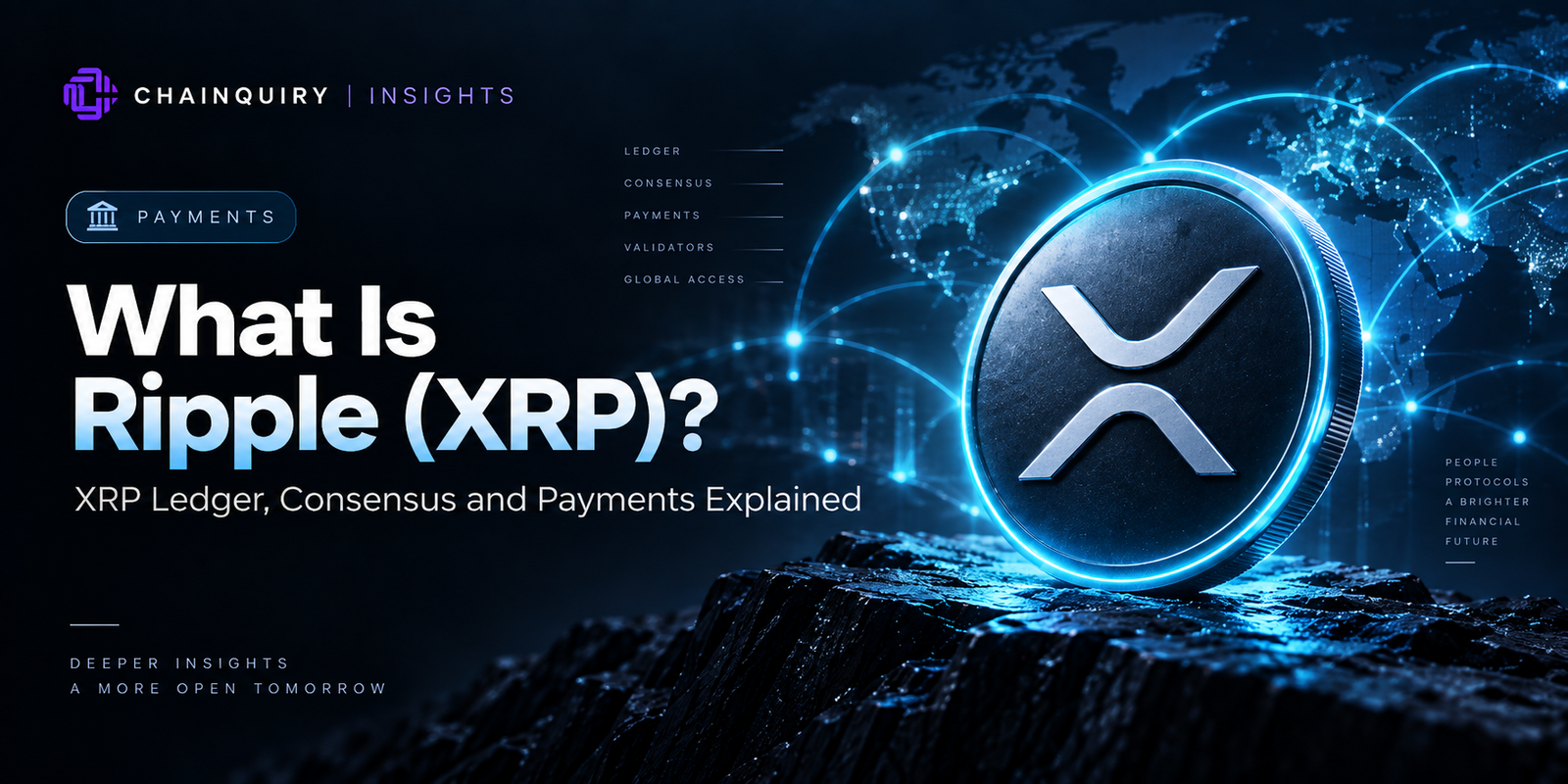
Ripple, XRP and the XRP Ledger are closely connected, but they are not the same thing.
Ripple is a technology company. XRP is a digital asset. The XRP Ledger, commonly shortened to XRPL, is the decentralized Layer 1 blockchain on which XRP exists.
That distinction matters because the three names have often been used interchangeably since the ecosystem’s earliest years. In 2011, David Schwartz, Jed McCaleb and Arthur Britto began developing the ledger. XRPL launched in June 2012, and the company that eventually became Ripple was formed afterward.
Today, XRP functions as the native asset of XRPL, while Ripple is one company building products with and contributing to the broader ecosystem.
Ripple vs XRP vs XRP Ledger#
The easiest way to understand the ecosystem is to separate its three main components.
Ripple is a technology company that develops infrastructure and financial products. Its solutions can use XRP, Ripple USD (RLUSD) and other digital assets.
XRP is the native digital asset of the XRP Ledger. It can be transferred directly between XRPL accounts, is used to pay transaction costs and can act as an intermediary asset in cross-currency payments.
XRP Ledger is the underlying decentralized blockchain network. It maintains accounts, balances, transactions, tokens and other ledger objects through independently operated servers and validators.
Ripple remains an important participant in the ecosystem, but it does not own the XRP Ledger or have unilateral control over its consensus rules.
How the XRP Ledger Works#
The XRP Ledger maintains a continuously updated sequence of ledger versions containing account balances, transactions and other network state.
Users submit digitally signed transactions to the peer-to-peer network. Servers independently apply valid transactions according to XRPL’s protocol rules, while validators participate in consensus to determine which transactions belong in the next validated ledger.
Once the required validator agreement is reached and a ledger is validated, its outcome is considered final. The next ledger then builds on that validated state.
Does XRP Use Proof of Work or Proof of Stake?#
Neither.
XRP is not mined, and the XRP Ledger does not use Proof of Work or conventional Proof of Stake.
Instead, XRPL uses the XRP Ledger Consensus Protocol. Each server chooses a set of validators it expects not to collude, known as its Unique Node List or UNL.
Validators exchange proposals about candidate transactions during multiple rounds of consensus. A supermajority must agree before a ledger version is treated as validated and final.
Under the current protocol, the standard final agreement threshold is 80% of trusted validators. If too many trusted validators disagree or become unavailable, the network is designed to stop making progress rather than finalize conflicting ledger histories.
How Fast Are XRP Transactions?#
The XRP Ledger generally closes and validates a new ledger within several seconds.
Because XRPL does not depend on miners finding probabilistic Proof-of-Work blocks, a validated transaction does not require additional mining confirmations in the way Bitcoin transactions commonly do.
Once a ledger has reached validator supermajority and becomes validated, its contents are considered final.
XRP’s 100 Billion Supply#
XRP does not have an ongoing mining or staking issuance schedule.
All XRP was created when the ledger began, with an original maximum supply of:
100,000,000,000 XRP
No additional XRP can be minted under the XRP Ledger’s existing rules.
The XRPL founders subsequently gifted 80 billion XRP to the company that became Ripple. Ripple has distributed portions of those holdings over time and placed a substantial amount into on-ledger escrow.
The total amount of XRP that can exist does not increase. In fact, XRP’s total supply gradually decreases because network transaction costs are permanently destroyed.
Why Does the XRP Ledger Burn Transaction Fees?#
Every XRP Ledger transaction must specify a small transaction cost.
That XRP is not paid to validators or distributed as a reward. It is permanently destroyed.
The primary purpose of the transaction cost is anti-spam protection. Under normal conditions, the minimum cost for a standard transaction is extremely small, but the required amount can increase when network load rises.
Because fees are burned rather than redistributed, every successful fee-paying transaction reduces the total amount of XRP in existence by a small amount.
XRP as a Bridge Asset#
One of XRP’s original intended uses is moving value between different assets and currencies.
The XRP Ledger supports cross-currency payments that can automatically search available liquidity paths between the asset being sent and the asset the recipient wants to receive.
XRP can act as an intermediary in this process. For example, if converting one issued token directly into another is less efficient, XRPL can potentially route the transaction through XRP when doing so produces a better path.
This bridge functionality is a capability of the XRP Ledger itself rather than proof that every international payment using Ripple technology necessarily uses XRP.
XRP Ledger’s Built-In Decentralized Exchange#
Trading functionality has existed directly inside the XRP Ledger since its earliest years.
XRPL includes a native decentralized exchange based around on-chain order books. Users can create offers to exchange XRP for issued tokens or trade one issued token for another.
Cross-currency payments can consume this liquidity automatically when finding a route between assets.
The network has also added Automated Market Makers, allowing liquidity pools to operate alongside the traditional order-book exchange.
This means several trading and liquidity functions are implemented directly at the protocol level rather than requiring every application to deploy a separate smart-contract exchange.
Tokenization on XRPL#
The XRP Ledger supports assets other than XRP.
Issuers can create fungible tokens representing currencies, stablecoins and other forms of digital value, while XRPL also provides functionality for NFTs and newer Multi-Purpose Tokens.
The protocol includes features aimed at financial asset issuance, such as authorization controls, freezing capabilities, decentralized trading, escrow and payment infrastructure.
More recent development has increasingly focused on tokenized real-world assets and financial applications, including permissioned environments intended to help institutions apply access and compliance requirements to certain on-chain activity.
These issuer controls apply to issued assets. XRP itself is the native asset of the ledger and has different technical properties from tokens created by individual issuers.
Is XRP Controlled by Ripple?#
Ripple owns a significant amount of XRP and has historically been one of the most prominent companies associated with the asset and network.
That does not mean Ripple can independently create additional XRP, rewrite transactions or change the XRP Ledger’s consensus rules.
XRPL servers independently enforce protocol rules, while validators operated by different organizations participate in consensus.
Ripple does publish one of the recommended validator lists used by many servers, while the XRP Ledger Foundation publishes another. Server operators can technically choose their own validators, although sufficient overlap between trusted validator sets is important for maintaining network agreement.
This creates a more nuanced decentralization model than simply saying either “Ripple controls XRP” or “Ripple has nothing to do with XRP.”
Why Do XRP Accounts Need a Reserve?#
The XRP Ledger requires accounts to keep a small amount of XRP in reserve.
The reserve system helps discourage creation of excessive accounts and ledger objects that could unnecessarily increase the shared ledger’s storage requirements.
As of September 2026, the base reserve on mainnet is 1 XRP, with an additional 0.2 XRP owner reserve for many ledger objects.
These values are protocol parameters and can change through the network’s fee-voting process, so they should not be treated as permanent constants.
XRP Is Not Mined#
Another common misconception is that XRP validators earn newly created XRP for confirming transactions.
They do not.
All XRP already exists, and XRPL validation does not produce block rewards. Validators participate in consensus but do not receive transaction fees; transaction costs are destroyed instead.
This gives XRP a fundamentally different security and issuance model from Proof-of-Work cryptocurrencies such as Bitcoin and Litecoin.
What Are the Trade-Offs?#
XRPL’s architecture prioritizes fast settlement, low transaction costs and deterministic finality without Proof-of-Work mining.
Its consensus model also introduces assumptions that differ from Bitcoin-style networks. Servers rely on sufficiently overlapping sets of trusted validators, and the network may stop finalizing new ledgers if the required supermajority cannot be reached.
XRP also remains exposed to cryptocurrency market volatility despite the network’s low transaction costs.
Users holding assets issued on XRPL should additionally distinguish XRP from issuer-created tokens. Tokens can carry issuer-specific risks and may include capabilities such as authorization, freezing or clawback depending on how they are configured.
Finally, holding XRP requires control of cryptographic keys. Transactions that become validated generally cannot be reversed by a central administrator if funds are sent incorrectly or private keys are lost.
Is XRP Ledger Still Being Developed?#
Yes.
XRPL remains under active open-source development.
Its reference server implementation is now named xrpld. Version 3.4.0 was released in September 2026 with protocol updates, bug fixes and continued work on newer financial primitives.
Recent development across the ecosystem has included Multi-Purpose Tokens, permissioned domains and decentralized exchanges, vault infrastructure and lending functionality, alongside ongoing improvements to the core network.
The source code, protocol standards, amendment proposals and release history are publicly available for independent review.
How to Research Ripple and XRP Independently#
When researching XRP, it is useful to separate sources according to what they represent.
Ripple.com is the primary source for information about Ripple the company and its products.
XRPL.org documents the XRP Ledger protocol, consensus system, XRP, network functionality and developer infrastructure.
The XRPL Foundation’s public repositories provide the source code for xrpld, the reference server implementation.
For a structured overview of the asset, network information and official links, see the Ripple (XRP) profile on Chainquiry.
Final Perspective#
The terminology surrounding Ripple and XRP can make the ecosystem seem more confusing than it actually is.
Ripple is a company. XRP is the native digital asset. XRP Ledger is the decentralized Layer 1 blockchain.
XRPL differs substantially from Proof-of-Work networks: XRP was created at genesis rather than mined, validators receive no block rewards, transaction fees are burned, and new ledger versions reach finality through a validator-based consensus process.
Over time, XRPL has also grown beyond straightforward XRP transfers through native token issuance, cross-currency payments, decentralized trading, AMMs and broader tokenization infrastructure.
Understanding those distinctions provides a much more accurate picture than describing Ripple, XRP and XRP Ledger as though they were a single interchangeable product.