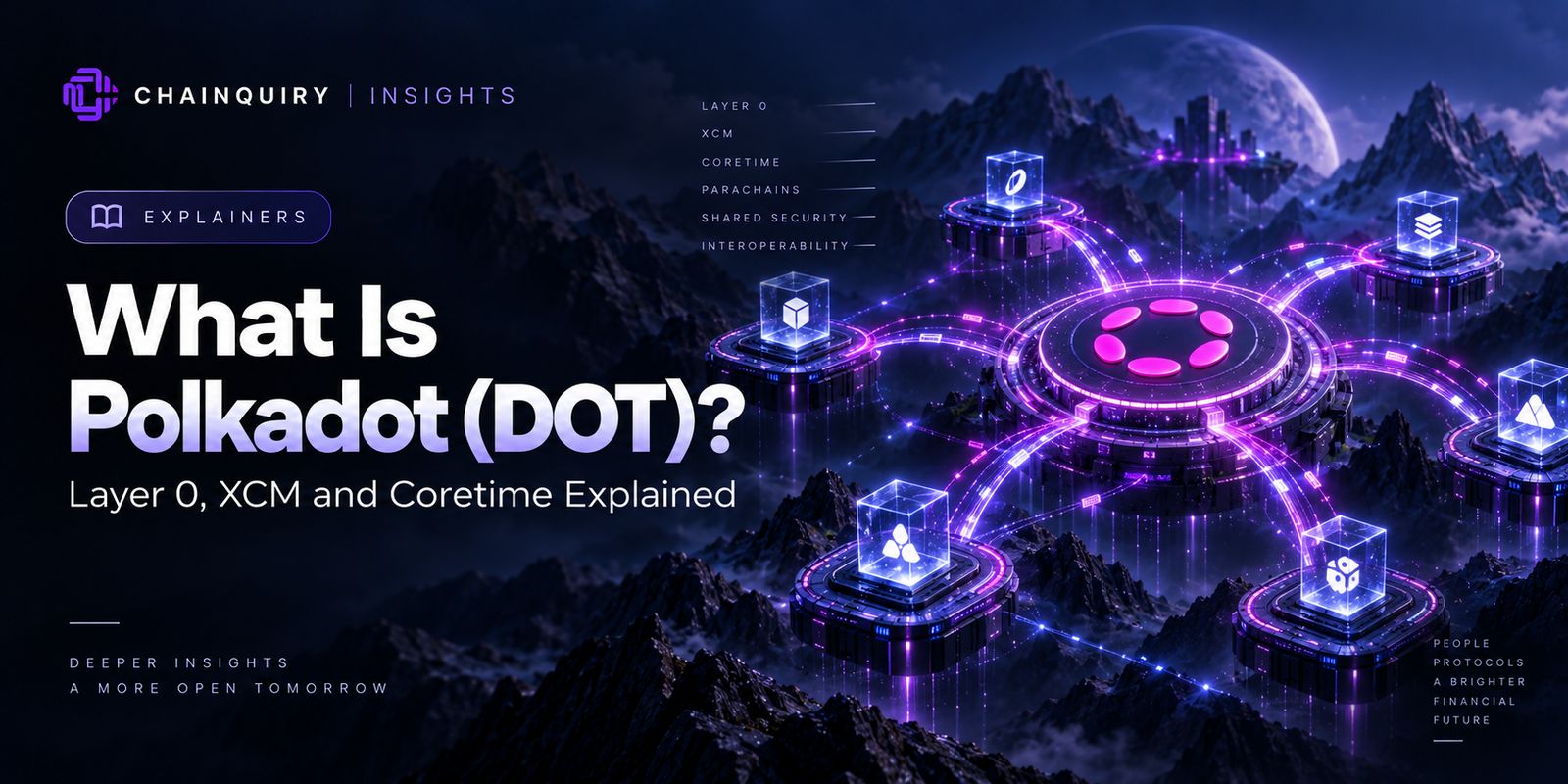
Polkadot is a Layer 0 blockchain protocol designed to connect and secure multiple specialized blockchains rather than requiring every application to compete for execution on a single general-purpose chain.
Its architecture separates shared security, consensus and interoperability from application-specific execution. The central Polkadot network coordinates validators and provides shared security, while connected Layer 1 blockchains can implement their own state-transition logic, transaction formats and application features.
DOT is the native asset of the Polkadot ecosystem. It is used for staking, governance and access to network resources such as coretime.
Polkadot’s original whitepaper was published by Gavin Wood in 2016, and the production network’s genesis block was produced on May 26, 2020. Since then, the architecture has evolved considerably beyond the original parachain-slot model described in early Polkadot material.
Why Is Polkadot Called a Layer 0?#
Most blockchain discussions use the term Layer 1 for networks such as Bitcoin, Ethereum or Solana that directly execute and settle activity on their own base chains.
Polkadot is commonly described as Layer 0 because its core protocol provides infrastructure beneath multiple Layer 1 blockchains.
These connected chains can use Polkadot’s validator set, security model, data availability and cross-chain communication while maintaining their own execution environments.
A DeFi-focused chain, identity network and gaming blockchain, for example, do not need identical runtime logic. Each can optimize its own blockchain while still participating in the wider Polkadot system.
This approach is sometimes described as heterogeneous multichain architecture: different blockchains can perform different jobs while relying on shared underlying infrastructure.
The Relay Chain and Polkadot Hub#
Historically, the center of Polkadot has been known as the Relay Chain.
The Relay Chain deliberately performs relatively little application-level work. Its primary responsibilities include consensus, validator coordination, shared security, data availability and scheduling computational resources for connected chains.
Polkadot’s architecture has continued to evolve, however.
User-facing functionality such as balances, asset operations and other services has increasingly moved away from the Relay Chain onto specialized system chains. Polkadot Hub now acts as a primary entry point for users and application developers, providing services such as assets, staking, governance, identity and smart-contract functionality.
This separation allows the Relay Chain to remain focused on security and coordination while other chains handle application execution.
What Are Parachains?#
Parachains are independent Layer 1 blockchains connected to Polkadot’s shared infrastructure.
Each parachain can define its own:
- transaction rules
- governance system
- token model
- virtual machine
- account structure
- application logic
Instead of every parachain maintaining an entirely separate validator economy, Polkadot validators can participate in securing activity across the network.
Collators maintain individual parachains, gather transactions and produce candidate blocks. Polkadot validators then perform the validation work required by the shared-security model.
The result is different from a conventional blockchain where every application runs inside one execution environment.
Polkadot provides shared infrastructure while allowing specialized chains to remain independently programmable.
How Does Polkadot Consensus Work?#
Polkadot uses Nominated Proof of Stake, or NPoS, as part of its security and validator-selection system.
Validators stake DOT and participate directly in consensus. Nominators can back validators they consider trustworthy using their own stake, allowing the protocol to select an active validator set based on nominated stake and other election constraints.
Polkadot then separates block production from finality.
BABE is responsible for block production.
GRANDPA is responsible for finalizing blocks.
This distinction is important because older descriptions sometimes refer to GRANDPA itself as Polkadot’s entire consensus algorithm. In reality, Polkadot uses a hybrid architecture in which BABE produces blocks while GRANDPA independently determines finality.
GRANDPA can finalize chains of blocks rather than requiring a separate finality decision for every individual block, while BABE can continue producing blocks between finality rounds.
This allows block production and provable finality to operate as related but separate processes.
What Is Shared Security?#
Shared security is one of Polkadot’s defining concepts.
A new standalone blockchain normally needs to attract enough validators, miners or other security participants to defend itself independently.
A Polkadot-connected chain can instead access security supplied by Polkadot’s validator system.
Validators secure the core Polkadot protocol and participate in validating connected chains according to the network’s assignment mechanisms.
This does not mean every parachain has identical risks or application logic. Smart contracts, bridges, governance systems and chain-specific code can still introduce their own vulnerabilities.
Shared security refers primarily to the underlying validation and consensus infrastructure provided through Polkadot.
What Is XCM?#
Cross-Consensus Messaging, or XCM, is Polkadot’s format for communication between different consensus systems.
It allows connected chains and other supported systems to express cross-chain instructions rather than operating as isolated networks.
XCM can support activities such as:
- transferring assets between chains
- interacting with applications on another chain
- remotely executing supported functions
- communicating with system chains
- coordinating multi-chain workflows
XCM itself is a messaging format rather than a conventional token bridge.
That distinction matters. Traditional bridges often rely on separate contracts, validator sets or custodial mechanisms. XCM is designed as a standardized way for consensus systems within and around the Polkadot ecosystem to describe and execute cross-chain intentions.
Interoperability is therefore part of Polkadot’s underlying architecture rather than an application added only after individual blockchains are deployed.
What Happened to Parachain Slot Auctions?#
Early Polkadot architecture required projects seeking continuous parachain access to compete for long-term slots through auctions.
Projects could also conduct crowdloans, allowing supporters to temporarily lock DOT to help a project secure a parachain lease.
That model is now historical.
Polkadot replaced slot auctions with Agile Coretime, turning access to its computational resources into something chains can purchase according to their actual requirements.
This is one of the biggest differences between modern Polkadot and descriptions of the network written during the original parachain-auction era.
What Is Agile Coretime?#
Coretime represents access to Polkadot’s computational cores and shared-security infrastructure.
Under Agile Coretime, projects can obtain network resources in two main ways.
Bulk coretime provides capacity for an extended period, currently up to 28 days, and can be renewed.
On-demand coretime allows projects to purchase access when they need it rather than maintaining continuous capacity.
Bulk coretime can also be divided or shared, giving chains greater flexibility over how they consume Polkadot’s computational resources.
This changes Polkadot from a system built primarily around scarce long-term parachain leases into a more flexible market for secure blockspace.
DOT used to purchase coretime is burned, linking demand for Polkadot’s computational resources to the economics of the native token.
What Is Polkadot Hub?#
Polkadot Hub is becoming an important user- and developer-facing part of the ecosystem.
Rather than requiring every developer to launch a dedicated parachain, Polkadot Hub provides common functionality directly to applications and users.
Current functionality includes asset management, staking, governance, identity services, interoperability and smart-contract infrastructure.
Developers can deploy Ethereum-compatible Solidity contracts through an EVM-compatible execution environment, while Polkadot is also developing PolkaVM-based execution for workloads designed around its own virtual-machine architecture.
Smart contracts deployed through Polkadot Hub can interact with wider Polkadot services through XCM.
This makes modern Polkadot broader than the early description of a network whose primary purpose was simply connecting parachains.
What Is DOT Used For?#
DOT is Polkadot’s native token.
Its principal roles include:
Staking#
Validators and nominators use DOT in Polkadot’s Nominated Proof-of-Stake system to participate in network security.
Governance#
DOT holders can participate in Polkadot’s on-chain governance system through voting and delegation.
Coretime#
DOT is used to purchase computational resources for chains using Polkadot’s coretime market.
Network Activity#
DOT is also used for fees and other protocol-level operations across relevant parts of the Polkadot ecosystem.
These functions mean DOT is tied to both network security and the allocation of Polkadot’s shared infrastructure.
Has DOT Always Had a Maximum Supply?#
No.
This is an important recent change.
For much of Polkadot’s history, DOT was described as an inflationary asset without a fixed maximum supply.
That changed through Polkadot OpenGov.
A governance decision implemented in 2026 introduced a capped issuance model with a maximum supply of:
2,100,000,000 DOT
Instead of continuing the previous unlimited issuance model, new DOT issuance now follows a stepped schedule designed to decrease as supply approaches the 2.1 billion DOT ceiling.
The first scheduled reduction under this model took effect in March 2026.
This means older articles stating that DOT has no maximum supply are now outdated.
Tokenomics can change through Polkadot’s governance system, so current protocol documentation should be checked when researching DOT’s monetary policy.
What Is OpenGov?#
Polkadot uses an on-chain governance system known as OpenGov.
Rather than relying on a conventional company board to approve protocol changes, proposals can move through public referenda governed by predefined tracks and voting rules.
Different types of decisions use different governance tracks. Treasury spending, protocol administration and high-privilege network changes can therefore have different submission requirements, voting periods and approval thresholds.
DOT holders can vote directly or delegate voting power.
Approved proposals can execute on-chain after satisfying the required approval, support and enactment conditions.
OpenGov has significant practical authority. The 2026 change to DOT’s issuance model demonstrates that governance decisions can alter important economic parameters of the network.
Can Polkadot Upgrade Without Hard Forks?#
Polkadot’s runtime is stored as WebAssembly code on-chain.
When governance approves a runtime upgrade, the network can replace that runtime through an on-chain state transition rather than requiring every participant to coordinate around a conventional blockchain hard fork.
Node software still requires maintenance and upgrades where host-level functionality changes, but much of Polkadot’s protocol logic can evolve through runtime upgrades.
This architecture is one reason Polkadot has been able to change major components—including governance and blockspace allocation—without launching replacement networks.
How Does Polkadot Scale?#
Polkadot does not try to route every application’s transaction execution through a single chain.
Instead, multiple chains can process activity in parallel while Polkadot coordinates security, data availability and validation resources.
Agile Coretime allows those chains to consume execution resources according to demand.
Further scaling work includes mechanisms that allow chains to access additional cores and process more activity in parallel when required.
This differs from the simple claim that Polkadot “uses sharding.”
The broader architecture is better understood as multiple specialized chains sharing security and computational resources through Polkadot’s core protocol.
What Are Polkadot’s Trade-Offs?#
Polkadot’s architecture provides flexibility, but it also introduces complexity.
Users may interact with different system chains, parachains, wallets, assets and cross-chain messaging paths rather than one monolithic blockchain.
XCM reduces fragmentation between compatible systems, but users still need to understand which chain currently holds an asset and which application or network service they are using.
NPoS also involves staking risks. Validators can be penalized for certain forms of misbehavior, and nominators must consider validator selection when participating in staking.
Parachains and smart contracts can introduce application-specific risks even when they benefit from Polkadot’s shared security.
Governance is another important consideration. OpenGov provides transparent on-chain decision-making, but large DOT holders and delegated voting power can influence protocol and treasury outcomes.
Finally, Polkadot’s architecture continues to evolve. Documentation from the original parachain-auction era can become outdated as coretime, system chains and newer execution environments replace earlier assumptions.
Is Polkadot Still Being Developed?#
Yes.
Polkadot remains under active open-source development.
The Polkadot SDK provides the framework used to develop the Polkadot network and compatible blockchains, while current developer documentation covers parachains, XCM, Agile Coretime, Polkadot Hub, smart contracts and infrastructure.
The ecosystem has changed substantially from the network described in the original 2016 whitepaper.
Slot auctions have given way to coretime, application-facing functionality has increasingly moved to system chains, smart-contract support has expanded through Polkadot Hub, and DOT’s issuance policy changed through OpenGov in 2026.
That continuing evolution makes the date of technical information especially important when researching Polkadot.
How to Research Polkadot Independently#
Polkadot publishes extensive technical and governance information publicly.
The strongest starting points include the official Polkadot website, developer documentation, Polkadot Wiki, original whitepaper and Polkadot SDK source code.
Governance proposals and protocol changes can also be inspected through the network’s on-chain governance infrastructure rather than relying solely on project announcements.
For a structured overview of DOT, network specifications and official links, see the Polkadot (DOT) profile on Chainquiry.
Final Perspective#
Polkadot is best understood as shared infrastructure for a multi-chain ecosystem rather than simply another smart-contract blockchain.
Its Layer 0 architecture separates network security and coordination from application-specific execution. Nominated Proof of Stake selects the validator set, BABE produces blocks, GRANDPA provides finality, and XCM gives different consensus systems a standardized way to communicate.
The network has also changed significantly since its launch. Long-term parachain slot auctions have been replaced by Agile Coretime, Polkadot Hub has expanded the application’s entry point to the ecosystem, OpenGov governs protocol changes, and DOT now operates under a capped issuance model targeting a maximum supply of 2.1 billion tokens.
Those developments make many older descriptions of Polkadot incomplete.
Understanding modern Polkadot means looking beyond the original idea of parachains and focusing on what the protocol increasingly provides: shared security, interoperable computation and flexible access to blockspace across a network of specialized chains.