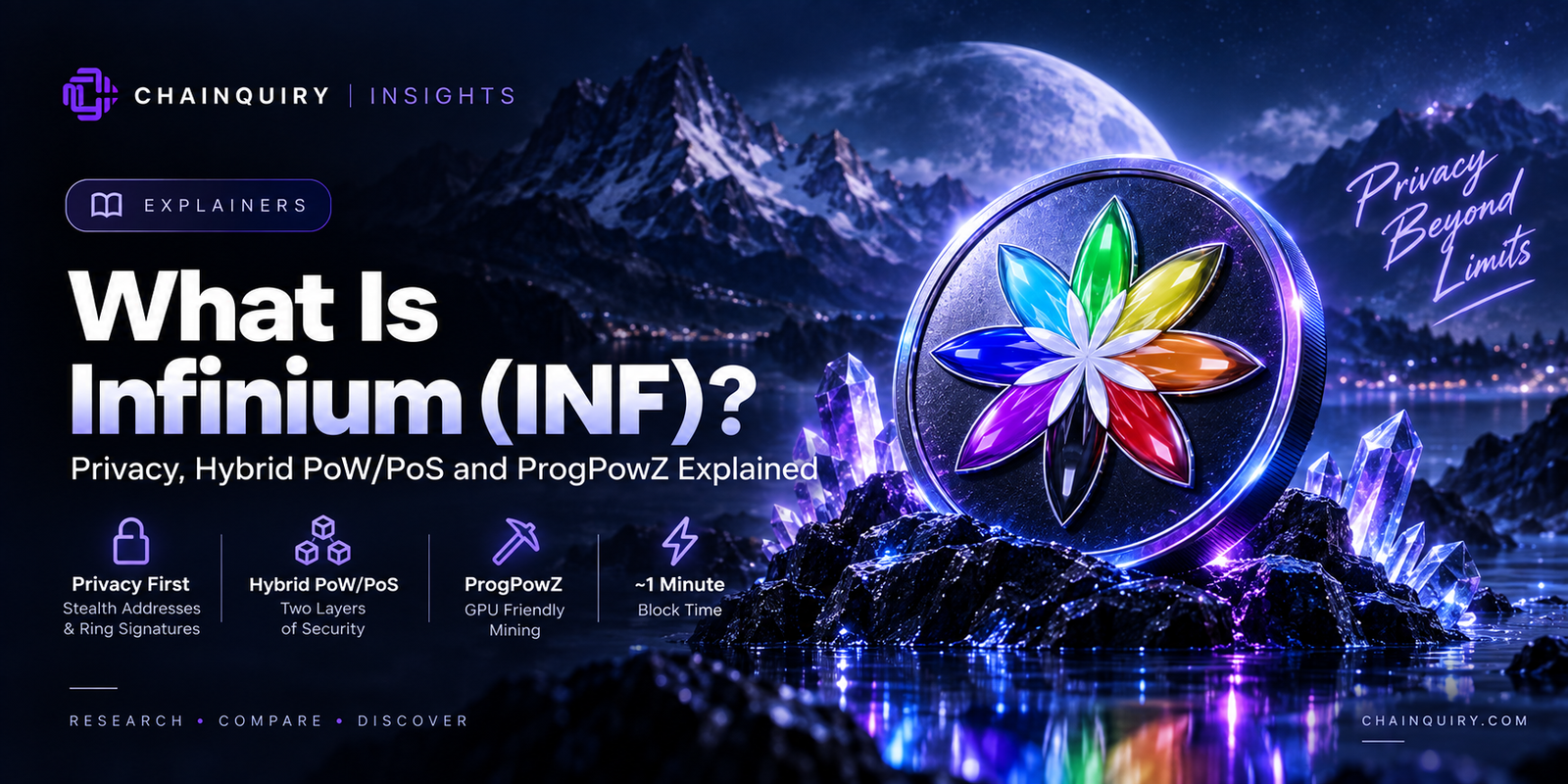
Infinium (INF) is a privacy-focused Layer 1 cryptocurrency built around a hybrid Proof-of-Work and Proof-of-Stake consensus model. The current Infinium network uses ProgPowZ mining, targets one-minute blocks and follows an uncapped monetary policy with a fixed 1 INF block reward.
Infinium also has a longer history than the current network alone suggests.
The project traces its origins to Infinium-8, or INF8, a CryptoNote-derived cryptocurrency that first appeared in 2014. However, the present INF blockchain should not be treated as a simple continuation of that original chain.
According to Infinium’s current documentation, the modern Infinium project is a technological evolution of Infinium-8 but runs on a separate blockchain with its own genesis, emission model and supply structure. Holders of INF8 were offered a swap into the newer INF network rather than having the old chain history copied directly.
That distinction is important when researching Infinium because older articles, wallets, mining algorithms and network specifications may refer to Infinium-8 rather than the current INF blockchain.
Infinium vs Infinium-8#
Infinium-8 was launched in 2014 as a cryptocurrency derived from CryptoNote technology.
Over the following years, the project went through several periods of reduced development and later revival attempts. A new development effort emerged around 2020, introducing updated software and a series of hard forks to the older INF8 network.
The current Infinium project represents a later transition.
Official Infinium documentation describes INF as a separate blockchain from Infinium-8. The project’s newer roadmap records the creation of its genesis block on November 14, 2023, while its technical specifications identify the network release as 2024.
Infinium-8 holders were given the option to exchange their INF8 into the new INF model through a swap. Project documentation states that approximately 63 million coins were swapped.
This means the present Infinium network has historical roots dating to 2014, but its current blockchain architecture and monetary model belong to the newer 2023–2024 network.
How Infinium Works#
Infinium operates as its own Layer 1 blockchain.
Transactions are created and signed through Infinium wallets and broadcast across the peer-to-peer network. Participating nodes independently validate transactions and blocks according to the protocol rules they run.
The network combines Proof of Work and Proof of Stake rather than relying exclusively on one consensus mechanism.
Proof-of-Work miners contribute computational work using the ProgPowZ algorithm.
Proof-of-Stake participants contribute stake and can participate in block production through the network’s staking mechanism.
Both mechanisms contribute to Infinium’s issuance model and security architecture.
Hybrid Proof of Work and Proof of Stake#
Infinium uses a hybrid PoW/PoS consensus system.
Under Proof of Work, miners perform computational work and compete for block rewards.
Under Proof of Stake, coin holders can stake INF and participate in the network without performing the same mining workload.
Infinium’s documentation describes these mechanisms as complementary rather than independent alternatives.
The project argues that attacking the chain would require control across both the Proof-of-Work and Proof-of-Stake components rather than simply acquiring a majority of one resource.
That does not make the network immune to attacks. The practical security of any hybrid system depends on implementation details, distribution of hashpower, distribution of stake, node participation and software correctness.
The important point is that Infinium’s design deliberately combines two different security resources instead of relying entirely on hashrate or entirely on stake.
What Is ProgPowZ?#
Infinium’s Proof-of-Work algorithm is called ProgPowZ.
The project describes ProgPowZ as a mining algorithm developed by Infinium contributors with the goal of keeping mining accessible to consumer hardware.
Current mining documentation supports both CPU and GPU mining, although GPUs are described as substantially more efficient.
Compatible mining software listed by the project includes tools such as SRBMiner-Multi, WildRig, T-Rex and TT-Miner.
Infinium markets ProgPowZ as ASIC-resistant.
That wording should be understood as a design goal rather than a guarantee that specialized hardware could never be developed. ASIC resistance is an economic and technical property that can change as hardware design evolves.
For practical purposes, the current project documentation positions ProgPowZ primarily as a GPU-oriented Proof-of-Work algorithm.
One-Minute Blocks#
Infinium’s current specifications target a block time of approximately:
1 minute
That means the protocol aims to produce a new block roughly once every sixty seconds.
Actual block timing can vary because Proof-of-Work discovery and network conditions are probabilistic.
Shorter target intervals can provide more frequent confirmations, but block interval alone does not determine transaction security, decentralization or final settlement characteristics.
INF Block Rewards#
Current Infinium specifications list a fixed block reward of:
1 INF
The project’s emission documentation states that both the Proof-of-Work and Proof-of-Stake components can generate new INF.
PoW rewards compensate miners contributing computational work.
PoS rewards compensate participants staking coins and participating through the staking system.
Infinium’s documentation describes the block reward as intentionally small relative to the network’s initial supply.
Does Infinium Have a Maximum Supply?#
No.
Infinium does not have a fixed maximum supply.
The current network began with an initial supply of approximately:
70,000,000 INF
New INF continues to enter circulation through the network’s block-reward system.
The protocol uses a fixed nominal reward rather than a supply cap, meaning total supply increases over time.
Because the amount of new issuance remains relatively stable while total supply grows, the percentage inflation rate gradually declines.
Infinium’s own published emission table estimated approximately 71.05 million INF at the beginning of 2026, compared with 70 million at the beginning of 2024.
This makes Infinium’s monetary model fundamentally different from cryptocurrencies such as Bitcoin or Litecoin, where block subsidies decline toward a fixed maximum supply.
Where Did the Initial 70 Million INF Come From?#
The current network did not begin through pure public mining from zero.
Infinium’s documented initial allocation was approximately 70 million INF.
The project states that most of this allocation was reserved for the migration from Infinium-8.
Its published distribution lists:
91% for the INF8 swap
4.5% for founders, team members and contributors
4.5% as a development-related allocation
The swap allocation was intended to allow holders of the older INF8 asset to migrate into the new INF economic model.
This history is important when evaluating Infinium’s supply because the modern network did not launch with the same distribution process as a no-premine cryptocurrency.
How Infinium Handles Privacy#
Privacy is one of Infinium’s central design goals.
The project is derived from CryptoNote-style privacy technology and documents the use of stealth addresses and ring signatures.
Stealth addresses help prevent straightforward linking of recipient addresses across transactions.
Ring signatures are designed to make it more difficult to determine which member of a set of possible inputs actually authorized a transaction.
Infinium describes privacy as enabled by default rather than as a separate optional privacy mode.
However, the project’s own documentation still describes Ring Confidential Transactions, or RingCT, in connection with the planned Infinities hard fork.
That distinction matters.
It would be inaccurate to assume that every privacy feature described in Infinium’s roadmap or documentation is necessarily already active on the live network.
When researching specific privacy guarantees, users should verify which protocol upgrade is currently active rather than relying only on feature descriptions.
What Is Infinities?#
Infinium uses the name Infinities for a planned or evolving staking architecture intended to combine Proof-of-Stake participation with stronger transaction privacy.
Project documentation describes the concept as a privacy-oriented extension of conventional Proof of Stake, including hidden amounts and untraceable staking activity.
The project has also connected RingCT support with the Infinities hard fork.
Because the documentation itself refers to these features in future-oriented terms, Chainquiry treats Infinities as part of Infinium’s planned or evolving architecture rather than assuming every component is currently deployed.
This is especially important when evaluating claims such as “private staking” or hidden staking amounts.
Confidential Assets#
Infinium’s broader roadmap includes confidential assets issued on the Infinium blockchain.
The project describes these as tokens that would inherit privacy mechanisms similar to those used by INF itself.
If fully implemented, this could allow assets issued on Infinium to obscure information that would ordinarily remain public on transparent token platforms.
Users should distinguish between the capability described in project documentation and real-world adoption of confidential assets on the current network.
A protocol feature can exist technically without necessarily having significant application usage.
Ionic Swaps#
Infinium also documents a feature concept called Ionic Swaps.
The project positions Ionic Swaps as an extension of atomic-swap-style exchange mechanisms designed to preserve privacy while exchanging assets.
Atomic swaps generally allow participants to exchange cryptocurrencies without transferring custody to a centralized exchange.
Infinium’s Ionic Swap concept is intended to bring similar cross-asset exchange functionality into its privacy-oriented ecosystem.
As with other advanced Infinium features, users should verify current wallet and network support before assuming a documented feature is available in every production release.
Aliases#
Infinium supports human-readable aliases linked to blockchain addresses.
Instead of requiring users to manually share long cryptographic addresses, an alias such as:
@username
can be associated with a payment address.
Compatible wallets can resolve the alias when creating a transaction.
This improves usability but also introduces another piece of blockchain state that users should understand before relying on it for payments.
Escrow Contracts#
Infinium documentation also describes escrow-style contracts intended to support transactions between counterparties without relying entirely on a centralized intermediary.
The proposed model involves participants providing deposits that can be forfeited under defined conditions if a party behaves dishonestly.
This type of mechanism is designed for peer-to-peer marketplaces and transactions where both sides want stronger enforcement than a simple irreversible transfer.
The presence of this design in project documentation should not be interpreted as proof of widespread marketplace usage.
Auditable Wallets#
Privacy does not always fit every financial use case.
Infinium therefore documents auditable-wallet functionality intended for users or organizations that need to selectively verify financial activity.
An auditable wallet can provide transparency in situations where accounting, compliance or organizational oversight requires information that would otherwise remain private.
This creates an interesting contrast with Infinium’s default privacy orientation: the network aims to support confidentiality while still allowing users to create more transparent workflows when necessary.
Transaction Fees#
Infinium’s current emission documentation specifies a flat transaction fee of:
0.01 INF
Fees help discourage transaction spam and compensate network participants according to the protocol’s rules.
A fixed protocol fee should not be confused with a guaranteed fiat cost because the real-world value of 0.01 INF depends on the market value of INF.
Is Infinium Still Being Developed?#
Public development activity continued into 2026.
The Infinium GitHub organization hosts the core node software, documentation, explorer and supporting infrastructure.
Infinium Core version 1.5.1.200, codenamed Osiris, was released on March 27, 2026.
That release added a new seed node, updated blockchain checkpoints and improved compatibility with Ubuntu 24.04 development environments.
The project’s public documentation and website also remained online in 2026.
However, network activity should be evaluated separately from software availability.
Chainquiry currently classifies the Infinium project as inactive, so users researching the network should verify current peer activity, block production, mining participation and exchange support directly through the explorer and network tools.
What Happened to the Older Infinium Versions?#
That history still matters, but it belongs primarily to Infinium-8.
The original INF8 network appeared in 2014 and experienced periods of limited development.
A later development team revived the project around 2020, introducing new versions and hard forks, including changes to mining algorithms, rewards and network software.
The modern INF project then moved to another model entirely.
Rather than simply continuing the old chain, the developers launched the newer Infinium blockchain and offered INF8 holders a swap.
So the history is best understood as:
Infinium-8 launched in 2014
the project went through multiple revival and modernization attempts
a newer Infinium network was created in 2023–2024
INF8 holders were offered migration into INF
the modern INF chain uses different tokenomics and consensus rules
This avoids treating every historical Infinium specification as though it still describes the current network.
What Are Infinium’s Trade-Offs?#
Infinium’s design involves several trade-offs.
Privacy technology makes transactions less transparent, which can improve financial confidentiality but also makes independent analysis of activity more difficult than on fully transparent blockchains.
Hybrid consensus adds additional security mechanisms but also increases protocol complexity.
ProgPowZ mining requires computational hardware and electricity, while Proof of Stake introduces dependence on how stake is distributed among participants.
The uncapped supply means INF does not provide the fixed-supply monetary model preferred by some cryptocurrency users.
Some advanced features described in the project’s documentation also appear to be planned or evolving rather than universally available today.
Finally, Infinium remains a relatively small network compared with major privacy cryptocurrencies. Security depends not only on cryptographic design but also on real-world hashpower, stake distribution, node diversity, software quality and continued participation.
How to Research Infinium Independently#
Infinium publishes a substantial amount of technical material publicly.
The official documentation provides current network specifications, emission rules, privacy descriptions and mining information.
The GitHub organization contains the Infinium Core source code and release history.
The block explorer can be used to inspect current chain activity when available.
Researchers interested in the project’s history should also distinguish between modern INF documentation and older Infinium-8 Bitcointalk threads and repositories.
For structured project details and current official links, see the Infinium (INF) profile on Chainquiry.
Final Perspective#
Infinium’s story is more complicated than the simple idea of a cryptocurrency that “refused to die.”
Its origins go back to the Infinium-8 privacy coin launched in 2014, but the modern Infinium network is a separate blockchain built around a newer economic and consensus model.
Today’s INF architecture combines Proof of Work and Proof of Stake, uses ProgPowZ mining, targets one-minute blocks and follows an uncapped issuance model beginning from an approximately 70 million INF initial supply.
Privacy remains central to the project’s design through CryptoNote-derived mechanisms such as stealth addresses and ring signatures, while features including Infinities, confidential assets, Ionic Swaps, aliases and escrow systems form part of the wider technical roadmap.
Understanding Infinium therefore requires separating three things:
its 2014 Infinium-8 history
the newer 2023–2024 INF blockchain
and the distinction between features already active today and capabilities still described as planned or evolving.
That gives a much more accurate picture than treating every Infinium version from the last decade as one unchanged network.