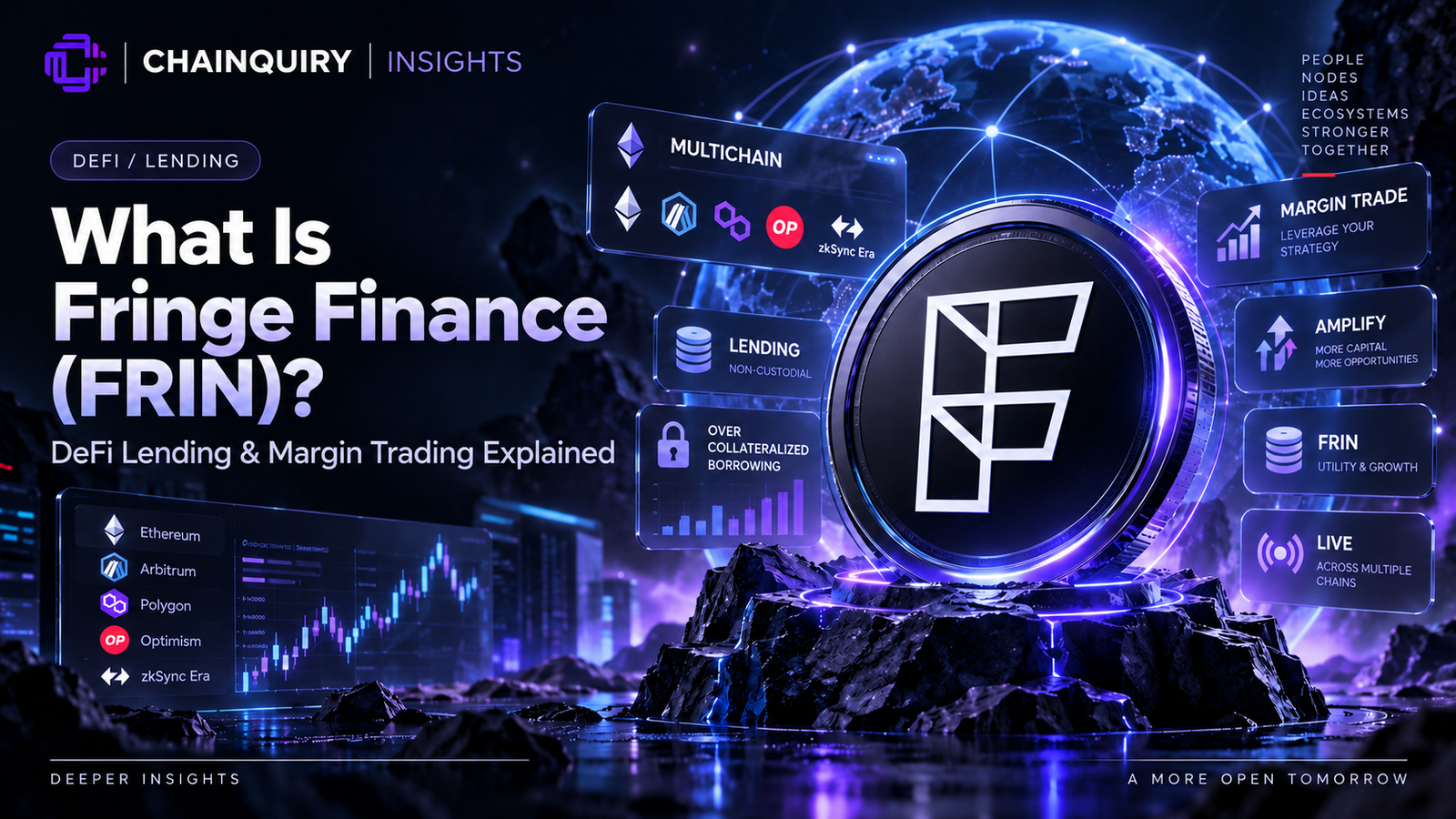
Fringe Finance (FRIN) is a multichain decentralized-finance protocol built around permissionless lending, borrowing and leveraged trading.
The protocol is designed to support a broader range of crypto assets than lending markets focused primarily on the largest cryptocurrencies. Borrowers can deposit approved collateral and take overcollateralized loans, while lenders supply assets to earn interest generated by borrowing activity.
Fringe has expanded considerably since its original lending platform launched in 2022. Its current V2 architecture includes lending, Margin Trade, Amplify, atomic repayments, partial liquidations, LP-token support, ERC-4626 assets and multi-source price infrastructure across several EVM networks.
Its ecosystem token, FRIN, exists on Ethereum and is connected with staking, protocol-fee rewards and planned DAO governance.
Fringe Finance at a Glance#
| Project | Fringe Finance |
| Ticker | FRIN |
| Category | DeFi lending and leveraged trading |
| Current version | Fringe V2 |
| Launch | June 2022 |
| Networks | Ethereum, Arbitrum, Polygon, Optimism, zkSync Era |
| Lending model | Overcollateralized |
| Custody model | Non-custodial |
| FRIN network | Ethereum |
| Token standard | ERC-20 |
| FRIN maximum supply | 1,000,000,000 |
| FRIN contract | 0xC9fE6E1C76210bE83DC1B5b20ec7FD010B0b1D15 |
| Current status | Live |
What Is Fringe Finance?#
Fringe Finance is a decentralized money market designed to let users lend, borrow and take leveraged positions through smart contracts.
Its central idea is relatively simple.
Many DeFi lending protocols concentrate liquidity around highly established assets. Fringe was developed around supporting a wider spectrum of cryptocurrencies, including assets that may have smaller market capitalizations or less conventional collateral profiles.
That does not mean every cryptocurrency can automatically be used.
Fringe uses whitelisted collateral and lending assets, with risk parameters assigned to individual markets.
Its current documentation describes the protocol as non-custodial and permissionless from the user’s perspective: assets are supplied to smart contracts rather than deposited with a conventional centralized lender.
How Does Fringe Lending Work?#
Fringe Lending connects three primary groups:
Lenders supply supported assets to lending pools.
Borrowers deposit approved collateral and borrow against it.
Liquidators help resolve positions that become insufficiently collateralized.
When lenders deposit capital, borrowers can borrow from those pools and pay interest.
Borrowers cannot simply take unsecured loans. They must provide collateral worth more than the amount they borrow, subject to the risk parameters assigned to that collateral.
This is known as overcollateralized lending.
Fringe’s documentation refers to the supplied lending pools as Primary Capital Pools and collateral deposits as Primary Collateral Safes.
What Is Loan-to-Value Ratio?#
Each collateral asset can be assigned a Loan-to-Value Ratio, or LVR.
The LVR determines how much borrowing capacity a particular amount of collateral can support.
For example, an asset worth $1,000 with a 50% LVR would theoretically provide up to $500 of borrowing capacity, before accounting for other protocol conditions.
Fringe does not need to assign the same LVR to every asset.
More volatile or less liquid collateral can be assigned stricter parameters than deeper, more established assets.
This matters because Fringe’s broader-asset strategy introduces an obvious challenge: smaller cryptocurrencies can experience sharper price movements and thinner liquidity.
Collateral parameters and borrowing limits are therefore central to the protocol’s risk model.
What Happens When Collateral Falls in Value?#
A borrower’s position has to remain above the protocol’s required collateralization level.
If the value of the collateral falls sufficiently, the position can become eligible for liquidation.
Liquidators repay part of the debt and receive collateral according to the protocol’s liquidation mechanism.
Fringe V2 uses partial liquidations rather than automatically closing an entire position whenever possible.
The intention is to restore the account to a healthier collateralization level while leaving the remainder of the position intact.
Liquidation is still a major borrower risk.
Using volatile collateral or leveraged positions can cause liquidation even when the user expects the asset’s price eventually to recover.
What Are fTokens?#
When users lend supported assets through Fringe, the protocol uses fTokens to represent lender positions.
Examples include assets such as fDAI corresponding to supplied DAI.
Fringe publishes the contract addresses for its lending tokens and underlying assets in its documentation.
fTokens are relevant to several parts of the ecosystem because they represent deposited lending positions and can also interact with staking and incentive mechanisms.
They should not be confused with FRIN, which is the protocol’s ecosystem token.
What Is Fringe Margin Trade?#
Fringe Margin Trade allows users to take leveraged exposure to a pair of supported assets.
A trader chooses the assets forming the position, provides margin and selects the direction of the trade.
Borrowed capital increases the trader’s exposure beyond the amount supplied as margin.
This can amplify gains if the trade moves in the expected direction.
It also amplifies losses.
Leveraged DeFi positions can become liquidatable when market movements cause the account to breach required collateral levels.
Margin trading should therefore be distinguished from ordinary spot trading, where a user simply exchanges one asset for another without borrowed leverage.
What Is Fringe Amplify?#
Amplify is Fringe’s leveraged-long facility.
Instead of expressing a long/short view across an asset pair, Amplify is designed to increase a user’s exposure to a selected crypto asset.
The user supplies collateral and uses borrowed value to establish a larger long position.
The result is greater market exposure than simply holding the original collateral amount.
Again, leverage works in both directions.
If the asset rises, gains can be magnified. If it falls, losses and liquidation risk can also increase.
Fringe launched Amplify and Margin Trade as part of the protocol’s expansion beyond conventional lending.
Atomic Repayments#
Fringe also supports atomic repayments.
Normally, a borrower repaying a loan would need to separately hold the asset they originally borrowed.
Atomic repayment allows collateral to be used to settle the debt.
The protocol can swap sufficient collateral through external liquidity infrastructure and apply the resulting asset toward the outstanding loan.
This can simplify closing a position because the borrower does not first need to manually acquire the borrowed token.
The feature still depends on adequate market liquidity for the required swap.
Why Does Fringe Support Smaller Crypto Assets?#
One of Fringe Finance’s defining ideas is supporting long-tail crypto assets.
These are assets outside the small group of cryptocurrencies commonly supported by major lending protocols.
Smaller assets present several complications:
- lower trading liquidity
- higher volatility
- fewer reliable price sources
- greater susceptibility to market manipulation
- more difficult liquidations
Fringe attempts to address those differences through individual collateral parameters, borrowing limits, price-oracle design and liquidation controls.
Supporting an asset on Fringe therefore does not mean that the protocol considers that asset low risk.
It means a market has been configured around a particular risk model.
LP Tokens as Collateral#
Fringe V2.5 expanded the protocol’s collateral model to include selected liquidity-provider tokens.
LP tokens represent positions deposited into decentralized-exchange liquidity pools.
Normally, extracting capital from an LP position might require withdrawing the underlying assets and closing the liquidity position.
Fringe’s model allows supported LP tokens to be used as collateral instead.
That potentially lets liquidity providers borrow while maintaining exposure to their existing LP position.
It also introduces additional complexity because an LP token’s value depends on the assets held within the pool and the mechanics of the underlying liquidity position.
ERC-4626 Support#
Fringe V2.5 also introduced support for selected ERC-4626 vault tokens.
ERC-4626 is an Ethereum token standard designed to standardize tokenized yield-bearing vaults.
These tokens can represent claims on assets deposited into yield strategies.
Fringe’s smart-contract documentation includes a dedicated ERC-4626 price provider for evaluating supported vault assets.
Allowing yield-bearing assets to function as collateral can improve capital efficiency because users may retain exposure to the underlying vault strategy while borrowing against the position.
It also means researchers need to consider both Fringe’s risks and the risks of the underlying vault.
Which Networks Does Fringe Finance Support?#
The current Fringe V2 documentation identifies a multichain deployment spanning:
- Ethereum
- Arbitrum
- Polygon
- Optimism
- zkSync Era
The protocol publishes network-specific smart-contract addresses and liquidation infrastructure for these deployments.
These are separate blockchain environments.
A user’s position on one chain should not be assumed to exist automatically on another.
Network selection, contract addresses and available assets should therefore be verified before interacting with the protocol.
How Does Fringe Handle Prices?#
A lending protocol needs reliable asset prices to calculate borrowing capacity and determine when a position should be liquidated.
This is particularly important for Fringe because the platform aims to support assets with different levels of liquidity.
Fringe’s V2 architecture uses multiple price-feed approaches and has documented integrations involving sources such as Pyth and Chainlink.
V2.5 also expanded the model to support pricing based on compatible Uniswap liquidity pools where appropriate.
No oracle architecture can eliminate every form of market risk.
Oracle design instead attempts to reduce the possibility that inaccurate or manipulated market data causes incorrect borrowing or liquidation decisions.
Non-Rehypothecation#
Fringe describes its lending architecture as non-rehypothecating.
Rehypothecation occurs when collateral or deposited assets are reused elsewhere to generate additional returns or support other obligations.
A non-rehypothecating model aims to avoid repeatedly redeploying user assets through additional risk layers.
That does not make a DeFi protocol risk-free.
Smart-contract vulnerabilities, oracle failures, liquidity problems and market volatility remain relevant even when deposited assets are not rehypothecated.
What Is FRIN?#
FRIN is the ecosystem token associated with Fringe Finance.
It is an ERC-20 token on Ethereum.
The official contract is:
0xC9fE6E1C76210bE83DC1B5b20ec7FD010B0b1D15
Etherscan reports a maximum supply of:
1,000,000,000 FRIN.
The token should be distinguished from assets supplied to Fringe lending markets and from fTokens representing lender deposits.
What Is FRIN Used For?#
Fringe documentation gives FRIN several ecosystem roles.
FRIN can be staked through the protocol’s staking system.
The documentation describes a portion of platform fees as being available for distribution to FRIN stakers.
It also describes FRIN staking as part of a future governance model in which stakers can participate in DAO proposals.
The wording matters: current Fringe documentation still describes DAO voting in forward-looking terms — “once the Fringe DAO is live.”
Governance should therefore not be presented as though a fully operational FRIN DAO has already replaced protocol administration.
From BOND to FRIN#
Fringe Finance did not originally use the Fringe name.
The project was previously known as Bonded Finance, with BOND as its token.
In December 2021, the team announced the rebrand from Bonded Finance to Fringe Finance.
BOND holders were subsequently transitioned to FRIN at a 1:1 ratio, with the team stating that the underlying tokenomics would be retained.
This history matters because older articles, wallets and blockchain records may refer to Bonded Finance rather than Fringe.
The current ecosystem token is FRIN.
When Did Fringe Finance Launch?#
The history contains several dates.
The project itself existed earlier as Bonded Finance, while the Fringe branding arrived at the end of 2021.
The core Primary Lending Platform launch was scheduled for 24 June 2022, which is the most useful date for the launch of Fringe as an operating DeFi lending protocol.
Chainquiry therefore treats June 2022 as the project’s operational launch period.
This should not be confused with the later V2 release in 2024.
Fringe V2#
Fringe V2 represented a substantial expansion of the protocol.
The V2 launch added or expanded capabilities including:
- multichain deployment
- a broader selection of supported assets
- Margin Trade
- Amplify
- partial liquidations
- updated price-oracle architecture
- atomic repayments
- decentralized backend infrastructure
- improved interest-rate mechanics
The project announced the production V2 launch for 25 January 2024.
Current Fringe documentation continues to label V2 as the active version.
What Happened to Fringe V1?#
V1 is being deprecated in favor of Fringe V2.
The current documentation explicitly separates:
Fringe V2 — active version
from
Fringe V1 — deprecating
That distinction is important because older articles and documentation may describe functionality differently from the protocol users encounter today.
What About Fringe V3?#
Fringe has also been developing a V3 architecture.
Public V3 plans have included pooled collateral, allowing multiple collateral assets to support a user’s borrowing position collectively rather than tying each position to one isolated collateral deposit.
In April 2025, Fringe described V3 as being in alpha testing while continuing the transition away from V1.
However, the current official documentation still identifies V2 as the active version.
For that reason, V3 should be treated as a development path rather than described as the current production protocol unless Fringe publishes a confirmed production migration.
What Is the USB Stablecoin?#
Fringe documentation also describes USB, a crypto-collateralized stablecoin system.
The design allows users to deposit approved collateral and mint USB against the borrowing capacity created by that collateral.
USB is intended to track the US dollar.
Borrowers pay a stability fee, while the documented model allows USB savers to deposit USB and receive interest funded by those fees.
USB should not be confused with USDC or USDT.
It is a separate stablecoin design associated with Fringe’s own protocol.
Because Fringe documentation across different product versions has historically described USB at different deployment stages, users should verify its current production availability directly in the live application before assuming that every documented facility is enabled on every chain.
Has Fringe Finance Been Audited?#
Yes, Fringe publishes several historical smart-contract audits.
Its audit page identifies:
- CyberUnit — Primary Lending Platform, January 2022
- HashEx — Primary Lending Platform, June 2022
- HashEx — Fringe V2, February 2024
- QuillAudits — Fringe V2.5, August 2024
The V2.5 audit covered areas including LP-token, ERC-4626 and Uniswap V3 support.
An audit should not be interpreted as a guarantee that a DeFi protocol cannot fail or be exploited.
Audits examine particular smart-contract versions and defined areas of code at a particular point in time.
What Risks Does Fringe Finance Have?#
Fringe combines several forms of DeFi risk.
Smart-contract risk#
Protocol contracts can contain vulnerabilities or behave unexpectedly.
Liquidation risk#
Borrowers and leveraged traders can lose collateral when positions fall below required health thresholds.
Oracle risk#
Incorrect or manipulated price information can affect borrowing capacity and liquidations.
Collateral risk#
Some of the assets supported by Fringe can be volatile or relatively illiquid.
Liquidity risk#
A protocol or liquidator may need sufficient external market liquidity to sell collateral or execute atomic repayments.
Network risk#
Fringe operates across several chains, each of which has its own infrastructure and smart-contract environment.
Token risk#
Holding FRIN introduces market and liquidity risks separate from using Fringe’s lending contracts.
Audits and protocol safeguards can reduce some risks but cannot eliminate them.
Is Fringe Finance Still Active?#
Yes.
Chainquiry currently classifies Fringe Finance as Live.
Its official documentation continues to identify Fringe V2 as the active protocol version and publishes current V2/V2.5 contracts, fToken addresses and technical documentation.
The project’s documentation and smart-contract infrastructure therefore remain independently inspectable in 2026.
Users should nevertheless distinguish active protocol infrastructure from the development status of individual roadmap components such as V3 or DAO governance.
What Should You Verify Before Using Fringe?#
Before supplying assets, borrowing or opening a leveraged position, verify:
- the blockchain network
- the official Fringe contract addresses
- whether the asset is supported on that network
- the collateral’s current LVR
- borrowing and lending interest rates
- liquidation thresholds
- available liquidity
- wallet approvals
- whether a feature belongs to V1, V2 or a future version
- whether FRIN governance functionality is currently operational
Use the current Fringe documentation rather than relying on old screenshots or articles.
A protocol can change substantially between software versions.
The Bottom Line#
Fringe Finance is a multichain DeFi protocol built around lending, borrowing and leveraged crypto trading.
Its defining approach is support for a broader range of collateral than lending markets focused only on the largest cryptocurrencies.
Fringe V2 extends that model through five EVM networks and adds Margin Trade, Amplify, atomic repayments, partial liquidations and updated oracle infrastructure. V2.5 further expanded collateral support into areas such as LP tokens and ERC-4626 vault assets.
FRIN is the protocol’s Ethereum-based ecosystem token and can participate in staking and fee-reward mechanisms, while DAO voting remains described as a future governance function in the current documentation.
The protocol’s breadth also creates complexity.
Supporting more networks, collateral types and leveraged products means users need to understand asset-specific LVRs, liquidation mechanics, oracle design and smart-contract risk rather than treating every Fringe market as equivalent.
Frequently Asked Questions#
What is Fringe Finance?#
Fringe Finance is a non-custodial multichain DeFi protocol for lending, borrowing and leveraged trading using supported crypto assets as collateral.
What is FRIN?#
FRIN is the ERC-20 ecosystem token associated with Fringe Finance.
What is the FRIN contract address?#
The Ethereum FRIN contract is:
0xC9fE6E1C76210bE83DC1B5b20ec7FD010B0b1D15
What is the maximum FRIN supply?#
Etherscan identifies a maximum supply of 1 billion FRIN.
Which networks does Fringe Finance support?#
Current V2 documentation covers Ethereum, Arbitrum, Polygon, Optimism and zkSync Era.
What is Fringe Amplify?#
Amplify is a leveraged-long facility that allows users to increase exposure to a supported crypto asset using borrowed capital.
What is Fringe Margin Trade?#
Margin Trade enables leveraged positions across supported asset pairs.
Can LP tokens be used as collateral?#
Selected LP tokens are supported by Fringe V2.5’s collateral architecture.
What are ERC-4626 tokens?#
ERC-4626 tokens represent standardized tokenized vault positions. Fringe V2.5 includes support for selected ERC-4626 assets.
Is Fringe Finance governed by a DAO?#
Fringe documentation describes FRIN stakers participating in DAO voting once the Fringe DAO is live, so DAO governance should still be treated as an evolving component rather than assumed to be fully operational.
Is Fringe V3 live?#
Fringe reported V3 alpha testing in 2025, while its current documentation continues to identify V2 as the active version.
Is Fringe Finance still active?#
Yes. Chainquiry currently classifies Fringe Finance as Live, and its V2 documentation and smart-contract infrastructure remain available.