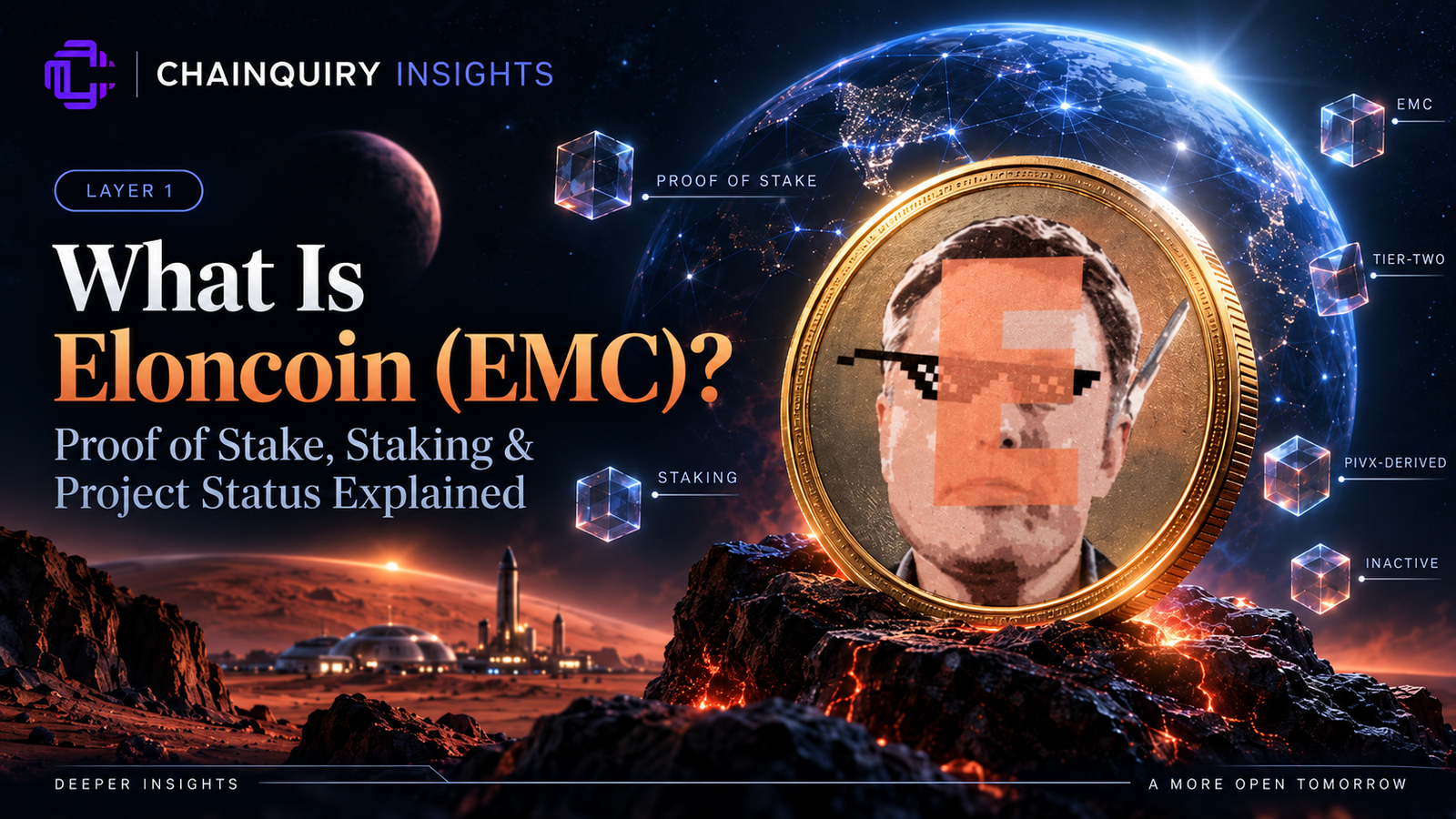
Eloncoin (EMC) is an open-source Proof-of-Stake cryptocurrency launched in June 2021 with a community-focused design, fast block production and its own independent blockchain.
The project used Elon Musk and space-exploration themes in its branding, including the slogan “Mars, here we come!”, but Eloncoin should not be interpreted as an official Elon Musk project or endorsement.
Its native asset, EMC, was used directly on the Eloncoin network rather than existing as an ERC-20 or other externally issued token.
Eloncoin later discussed a migration toward an EVM-compatible version of the network, but Chainquiry could not verify a completed and currently operating EVM migration during its September 2026 review.
The project’s official website is currently unavailable, its main source-code repository has not received recent development activity, and market trackers show no active EMC markets. Chainquiry therefore classifies Eloncoin as Inactive.
Eloncoin at a Glance#
| Project | Eloncoin |
| Ticker | EMC |
| Type | Layer 1 cryptocurrency |
| Network | Eloncoin |
| Consensus | Proof of Stake |
| Launched | June 2021 |
| Codebase | PIVX-derived |
| Native asset | EMC |
| Staking | Yes |
| Tier-two network | Referenced in core documentation |
| Open source | Yes |
| Current status | Inactive |
What Is Eloncoin?#
Eloncoin was designed as an independent cryptocurrency network built around Proof-of-Stake consensus.
Its public source repository describes the project as an open-source, community-driven cryptocurrency focused on lower resource consumption, network participation, fast transactions and wallet usability.
Unlike tokens deployed through smart contracts on Ethereum or BNB Smart Chain, EMC was the native coin of its own network.
This meant users interacted with the network through dedicated Eloncoin wallet and node software.
When Did Eloncoin Launch?#
Eloncoin’s public launch dates to June 2021.
Its Bitcointalk announcement thread was active from mid-June 2021, with early users discussing wallet downloads, staking and network participation shortly after launch.
Eloncoin’s public launch dates to June 2021.
November 2023 should therefore not be treated as Eloncoin’s launch date.
How Did Eloncoin Use Proof of Stake?#
Eloncoin used Proof of Stake, commonly abbreviated PoS, rather than Bitcoin-style Proof-of-Work mining.
Under Proof of Stake, network participants use coins held in an eligible wallet to participate in block creation and network consensus.
The official Eloncoin Core repository explicitly identifies Proof of Stake as a central part of the network’s design.
This meant EMC holders could historically run the wallet and stake their coins rather than purchasing specialized ASIC mining hardware.
The probability and frequency of earning staking rewards depended on factors including the amount of EMC being staked and overall network participation.
Was Eloncoin Mineable?#
Not through conventional Proof-of-Work mining.
Eloncoin’s blockchain was built around Proof-of-Stake consensus.
The terminology can be confusing because early cryptocurrency discussions sometimes use words such as mining, staking and block rewards loosely.
For Eloncoin, staking was the relevant mechanism for participating in block production.
This differs from Bitcoin, where miners compete using computational hashing power.
Why Did Eloncoin Promote Energy Efficiency?#
Proof-of-Stake networks generally avoid the large-scale computational mining process used by Proof-of-Work systems such as Bitcoin.
Eloncoin used this difference as a major part of its original branding.
Its GitHub documentation describes a lower environmental footprint and more equal network participation as central goals of the project.
That general architectural distinction is valid: a wallet participating in Proof of Stake does not perform Bitcoin-style ASIC mining.
However, exact claims about percentage energy savings should be supported by a defined methodology and measurement.
For that reason, Chainquiry does not repeat historical claims that Eloncoin consumed a specific percentage less energy than Bitcoin unless independent evidence is available.
Fast Blocks and the Tier-Two Network#
Eloncoin’s core documentation also emphasized fast transactions.
The repository references both fast block times and a tier-two network intended to support additional transaction functionality.
This architecture reflects Eloncoin’s technical relationship with the PIVX family of cryptocurrency software.
PIVX-derived networks commonly combine Proof of Stake at the blockchain level with a second network layer operated by specialized nodes.
Eloncoin’s codebase and historical support documentation also included features such as Tor connectivity and dedicated full-node wallet software.
Eloncoin and PIVX#
Eloncoin’s software has clear roots in PIVX-derived infrastructure.
Historical community support discussions referred directly to PIVX documentation when explaining features such as Tor configuration, while the project’s GitHub organization contains build-signature infrastructure forked from the PIVX project.
That heritage helps explain several aspects of Eloncoin’s design:
- Proof-of-Stake consensus
- dedicated desktop wallet software
- tier-two network features
- Tor support
- staking-oriented network participation
Eloncoin nevertheless operated as its own cryptocurrency network with EMC as its native asset.
Was Eloncoin a Meme Coin?#
Eloncoin clearly incorporated meme and personality-driven branding.
Its name referenced Elon Musk, its launch materials used space and Mars themes, and its community branding often drew comparisons with Dogecoin.
Technically, however, EMC was more than a token created solely for meme trading.
It had its own blockchain, node software, Proof-of-Stake consensus and wallet implementation.
The most accurate description is therefore a meme-inspired Proof-of-Stake cryptocurrency rather than simply an ERC-20-style meme token.
Was Elon Musk Involved With Eloncoin?#
Chainquiry found no reliable evidence that Elon Musk created, operated or officially endorsed Eloncoin.
The project used his name and space-related imagery as part of its branding.
That distinction is important.
A cryptocurrency using the name, image or themes associated with a public figure does not establish an official relationship with that individual.
Researchers should therefore treat Eloncoin as a community-created cryptocurrency inspired by Elon Musk rather than as an Elon Musk-backed project.
The Unverified Elon Musk Quote#
Older descriptions of Eloncoin circulated a supposed Elon Musk statement comparing Dogecoin and Eloncoin.
Chainquiry could not identify a reliable primary source establishing that Elon Musk made that statement.
It should therefore not be treated as a verified quote or evidence of endorsement.
When evaluating cryptocurrency projects built around prominent individuals or brands, claims of endorsements should always be traced back to an authenticated original source.
Eloncoin Wallet and Staking#
Eloncoin distributed dedicated wallet software for operating a node, storing EMC and participating in staking.
The wallet was based on the project’s open-source core implementation.
Historical discussions show users operating the desktop wallet and participating in staking during the network’s early years.
The software also included documentation for connecting through Tor.
Because Eloncoin is now classified as inactive, old wallet downloads should be handled cautiously.
Users should not assume that historical binaries remain secure, compatible or connected to a functioning network.
What Was the Proposed Eloncoin EVM 2.0?#
Late in the project’s active period, the team announced plans for a transition to an Eloncoin EVM 2.0 chain.
The Bitcointalk announcement stated that the transition would begin around block 1,093,500 and that a coin-swap process was expected through Eloncoin.org.
An EVM-compatible chain would have represented a significant technical change from the original PIVX-derived Proof-of-Stake network.
However, Chainquiry could not locate sufficient current primary evidence during its September 2026 review to establish that this migration was successfully completed and continues operating today.
For that reason, EVM 2.0 should be described as a historical migration plan rather than assumed to be the project’s current network.
Open-Source Development#
Eloncoin’s source code remains publicly available through the EMCoin GitHub organization.
The primary repository is written predominantly in C++ and includes the full-node and wallet implementation.
The repository describes the software as open source under the MIT License.
Public development activity, however, appears to have largely stopped.
GitHub currently shows the main Eloncoin repository last updated in December 2023, while another ecosystem repository received an update in January 2024.
No recent core development comparable to an actively maintained blockchain project was identified during Chainquiry’s September 2026 review.
Is Eloncoin Still Active?#
Chainquiry currently classifies Eloncoin as Inactive.
Several factors contribute to that assessment.
The former official website at eloncoin.org was unavailable during Chainquiry’s latest review.
The project’s main GitHub repository has not seen recent development activity.
CoinPaprika currently reports no active exchanges or markets for EMC, while other market trackers similarly classify the original EMC asset as dead or without current exchange listings.
These indicators do not identify an exact date when the network stopped functioning.
They do, however, make it inappropriate to present Eloncoin as a currently expanding cryptocurrency project.
Be Careful With Other Tokens Named ElonCoin#
Several unrelated cryptocurrency tokens now use names such as ElonCoin or ELONCOIN.
Some of these exist on Ethereum or BNB Smart Chain.
They are not automatically the same asset as Eloncoin (EMC) covered in this article.
The historical project discussed here can be identified by:
Name: Eloncoin
Ticker: EMC
Network: Eloncoin
GitHub organization: EMCoin
Launch: June 2021
Consensus: Proof of Stake
The original EMC was a native blockchain coin and did not require an Ethereum or BNB Smart Chain token contract.
This distinction is particularly important when searching decentralized exchanges, where unrelated assets can reuse similar names.
What Should Researchers Verify?#
Anyone researching historical EMC records should verify:
- that information specifically refers to ticker EMC
- whether a source relates to the original Eloncoin blockchain
- the date of the information
- whether a wallet or service is still operational
- whether an exchange listing remains active
- whether an EVM migration claim was actually completed
- whether a claimed Elon Musk endorsement has a primary source
Old cryptocurrency pages can remain indexed long after their networks, exchanges or wallets stop operating.
Historical availability should therefore not be treated as evidence of current availability.
The Bottom Line#
Eloncoin (EMC) was a community-driven Proof-of-Stake cryptocurrency launched in June 2021.
Its independent blockchain used staking rather than Proof-of-Work mining and incorporated PIVX-derived wallet and network infrastructure, including fast blocks and tier-two functionality.
The project used Elon Musk and Mars-themed branding, but Chainquiry found no evidence of an official relationship with or endorsement by Elon Musk.
Later development discussed moving EMC toward an EVM-compatible second-generation chain, although Chainquiry could not verify an active implementation of that migration in 2026.
The original project’s public infrastructure has since declined. Its official website is unavailable, core development has been dormant since 2023, and current market trackers show no active EMC markets.
Chainquiry therefore classifies Eloncoin as Inactive while preserving its profile and research article as a historical record of the project.
Frequently Asked Questions#
What is Eloncoin (EMC)?#
Eloncoin was an independent Proof-of-Stake cryptocurrency launched in June 2021. EMC was the native asset of the Eloncoin blockchain.
Was Eloncoin created by Elon Musk?#
No reliable evidence indicates that Elon Musk created or officially endorsed Eloncoin. The project was community-created and used Musk-inspired branding.
Was EMC a token?#
The original EMC was a native cryptocurrency on its own blockchain rather than an ERC-20 token.
Did Eloncoin use Proof of Work?#
No. The project’s core repository describes Eloncoin as using Proof-of-Stake consensus.
Could EMC be staked?#
Yes. Staking formed part of the original Eloncoin network and allowed eligible wallet holders to participate in block production.
Is Eloncoin still active?#
Chainquiry currently classifies the original Eloncoin (EMC) project as inactive. Its official website is unavailable, development has been dormant and current market trackers show no active EMC markets.
What was Eloncoin EVM 2.0?#
The project announced plans to migrate toward an EVM-compatible second-generation blockchain. Chainquiry could not verify a currently operating implementation of that migration during its September 2026 review.
Is every ElonCoin token online the same as EMC?#
No. Other unrelated tokens use similar names. The historical Eloncoin covered here used ticker EMC and operated its own Proof-of-Stake blockchain.