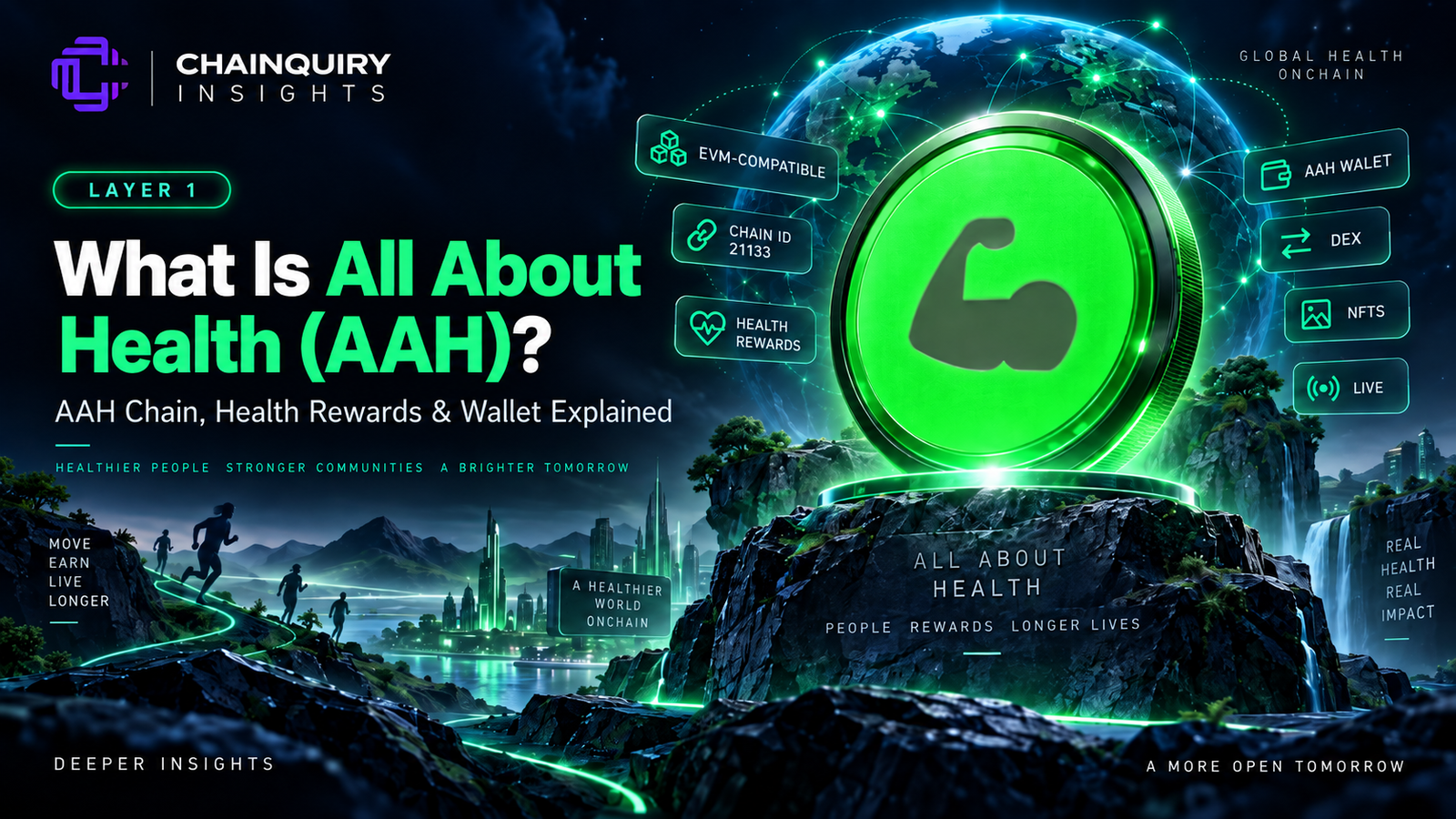
All About Health (AAH) is an EVM-compatible Layer 1 blockchain and digital ecosystem connecting its native AAH coin with health information, activity-based rewards, wallets, decentralized trading, NFTs and other online services.
The project launched its AAH blockchain in 2024 and operates its own mainnet under Chain ID 21133.
AAH has changed considerably since its earliest public descriptions. Initial material focused heavily on decentralized applications and play-to-earn games. The current ecosystem places much greater emphasis on connecting blockchain infrastructure with health information, everyday activities, rewards and services that can use AAH.
That makes modern AAH easier to understand as two connected layers: the AAH blockchain itself and the applications built around it.
All About Health at a Glance#
| Project | All About Health |
| Ticker | AAH |
| Type | Layer 1 blockchain |
| Network | All About Health |
| EVM compatible | Yes |
| Chain ID | 21133 |
| Native asset | AAH |
| Launched | March 2024 |
| Wallet | AAH Wallet + compatible EVM wallets |
| Explorer | AAH Blockscout |
| DEX | AAH DEX |
| Current status | Live |
What Is All About Health?#
All About Health is an independent blockchain ecosystem built around the native AAH cryptocurrency.
AAH is not simply an ERC-20 token deployed on Ethereum.
The project operates its own EVM-compatible network, meaning applications can use Ethereum-style addresses, wallets and smart-contract infrastructure while running on the separate AAH blockchain.
Its mainnet uses:
Chain ID: 21133
The network is publicly listed by ChainList, which identifies AAH as the native currency and links to the project’s Blockscout explorer.
What Does EVM-Compatible Mean?#
EVM stands for Ethereum Virtual Machine.
An EVM-compatible blockchain can support many of the same concepts used by Ethereum applications, including:
- smart contracts
- Ethereum-style wallet addresses
- token contracts
- MetaMask-compatible wallet connections
- decentralized exchanges
- NFTs
- other programmable applications
That does not mean AAH operates on Ethereum.
It means the AAH network follows compatible standards that allow familiar Ethereum ecosystem tooling to work with its own blockchain.
Users must still select the correct AAH network before making a transaction.
AAH Network Configuration#
The most important identifier for the mainnet is:
Chain ID: 21133
The project’s current wallet documentation lists the official RPC as:
AAH can also be added to compatible EVM wallets.
The official site currently references support for wallets including:
- AAH Wallet
- MetaMask
- Rabby
- OKX Wallet
Users should verify network settings from an official source rather than adding RPC information copied from an unknown website.
What Is the AAH Coin?#
AAH is the native cryptocurrency of the All About Health blockchain.
Because it is the network’s native asset, AAH is used directly by the blockchain rather than existing only as a smart-contract token.
The wider project also connects AAH with several ecosystem activities.
The current official site presents uses including:
- wallet transfers
- health and activity rewards
- decentralized exchange activity
- NFT participation
- digital services
- community rewards
- purchases through connected services
Those functions have expanded beyond the simpler coin-and-gaming description associated with the project’s early development.
Health Information and Blockchain#
Health has become the defining theme of the current AAH ecosystem.
The project’s AAH Health section organizes information across areas such as:
- longevity
- medical conditions
- nutrition
- exercise
- brain health
- senior care
- sleep and mental well-being
- bone and joint health
The platform also emphasizes showing sources and evidence levels alongside health information.
This is an important distinction from storing medical records directly on a public blockchain.
The current AAH Health site states that it begins with public health information rather than storing users’ personal medical information as blockchain data.
Blockchain and healthcare can involve particularly sensitive information, so claims about privacy, ownership and storage should always be evaluated according to what data is actually collected and where it is stored.
Health Activities and Rewards#
AAH also connects health-related participation with digital rewards.
The current ecosystem includes health challenges and recurring activities that can provide users with points or AAH-related rewards.
This falls broadly into the HealthFi concept: using cryptocurrency or blockchain-based incentives around health and wellness activity.
However, earning rewards should not be confused with receiving medical treatment or medical advice.
The project’s health-information functions and its blockchain reward system are separate concepts, even when they appear within the same ecosystem.
What Is AAH Oil?#
The current AAH website includes a recurring activity called AAH Oil.
Users can collect AAH Oil periodically as part of the platform’s participation and rewards system.
The official interface currently describes collection opportunities every four hours alongside daily attendance and other activities.
AAH Oil should not automatically be treated as equivalent to the blockchain’s native AAH coin.
Platforms often use internal points, rewards or claim systems before assets are converted, redeemed or used elsewhere.
Users should check the current rules before assuming that an off-chain reward balance represents immediately transferable cryptocurrency.
AAH Wallet#
The ecosystem now includes a dedicated AAH Wallet browser wallet.
Current official documentation describes the wallet as supporting the AAH mainnet under Chain ID 21133.
The project states that private keys and recovery phrases are stored locally rather than on its server.
Its security model separates viewing and account functionality from transactions requiring a wallet signature.
AAH Wallet also connects users with other parts of the ecosystem, including:
- AAH balances
- NFTs
- DEX functions
- bridges
- token purchases
The project continues developing the browser extension, so users should always check which version is officially distributed before installing wallet software.
Can MetaMask Be Used With AAH?#
Yes.
Because AAH is EVM-compatible, the network can be configured in wallets such as MetaMask using its network settings.
The important identifier is:
Chain ID 21133
ChainList currently provides a public entry for All About Health and identifies AAH as the network currency.
Users should still verify RPC and explorer details against official AAH resources before approving transactions.
AAH DEX#
AAH operates a decentralized exchange interface for assets on its blockchain.
The current AAH DEX supports wallet-connected token swaps and displays liquidity-pair information.
Its interface references AAH, WAAH and ecosystem tokens.
The DEX requires a wallet signature when an actual on-chain swap is executed.
That distinction is useful from a security perspective: simply viewing market information should not require control of a user’s private key.
As with any decentralized exchange, users should independently verify token contracts, liquidity and wallet approval requests before signing.
AAH and AUSD#
The AAH ecosystem also references AUSD, identified by the project as AusDDeFi on the AAH network.
The official site describes AUSD as a stable token intended to correspond with USDT within certain AAH exchange and transfer workflows.
Its published AAH-chain contract address is:
0x3adBF8fa04c21517D8E50908305D0413D2A44300
This should not automatically be interpreted as meaning that AUSD has the same issuer, backing structure or guarantees as USDT itself.
Any stable-value token should be evaluated according to its actual issuer, reserves, redemption mechanics and smart-contract design.
NFTs and Token Creation#
The current AAH ecosystem also includes NFT functionality.
Users can access NFT collections and marketplace-related features through the project’s connected services.
AAH additionally provides tools for creating tokens on its EVM-compatible network.
The existence of token-creation tools means additional assets can be issued on AAH without those assets being native coins of the blockchain.
This distinction is similar to the difference between ETH and ERC-20 tokens on Ethereum:
AAH is the native network asset.
Other tokens can exist as smart contracts running on top of the AAH blockchain.
Blockchain Explorer#
AAH maintains a public Blockscout-based blockchain explorer.
The explorer can be used to inspect:
- blocks
- transactions
- addresses
- smart contracts
- token transfers
- transaction fees
- confirmations
Recent indexed explorer records show successful AAH transactions receiving confirmations on the network.
Public explorers are particularly important when evaluating smaller blockchain projects because they allow researchers to distinguish claims made on a website from activity that can actually be observed on-chain.
Smart Contracts#
AAH’s EVM compatibility enables Ethereum-style smart-contract execution.
Its explorer exposes contract data and supports familiar developer interfaces associated with Blockscout and Ethereum JSON-RPC tooling.
This allows applications such as decentralized exchanges, tokens and NFT contracts to operate directly on the AAH blockchain.
The existence of smart-contract capability does not automatically make every contract deployed on a network safe.
Users still need to evaluate individual applications and contract addresses before interacting with them.
From Gaming to a Broader Ecosystem#
AAH’s public focus has evolved since 2024.
Early descriptions emphasized Android games, play-to-earn concepts and applications such as cardAAH, SEAAAH and majakAAH.
The project’s current public site instead gives considerably more prominence to:
- health information
- health challenges
- activity rewards
- wallet infrastructure
- NFTs
- token creation
- DEX functionality
- shopping
- community services
Today, AAH is better understood as a broader blockchain ecosystem spanning health information, rewards, wallets, DeFi, NFTs and digital services rather than primarily as a gaming project.
Its current identity is much broader and increasingly tied to the project’s health-focused branding.
AAH Shop and Real-World Use#
The official site also connects AAH with a shopping environment.
Products displayed through AAH Shop can show an equivalent AAH amount alongside their regular price.
This represents an attempt to give the native asset utility outside purely blockchain-native functions such as gas or swapping.
Real-world cryptocurrency utility depends on practical adoption, merchant availability and the ability to reliably price and settle transactions.
The presence of an integrated shop demonstrates a working ecosystem feature, but it does not by itself establish broader merchant adoption.
Is All About Health Still Active?#
Yes.
Chainquiry currently classifies All About Health as Live.
The project’s official website is operating, its health platform continues publishing and organizing content, the wallet is under active development, the DEX is accessible and its Blockscout explorer continues exposing on-chain records.
That makes the project’s 2026 footprint considerably easier to verify than many smaller blockchain networks whose websites or explorers have disappeared.
What Should You Verify Before Using AAH?#
Before using the AAH blockchain or one of its applications, verify:
- that the network is Chain ID 21133
- the official RPC configuration
- the correct token contract when interacting with non-native assets
- the wallet source before installing software
- smart-contract permissions before signing
- whether a reward is native AAH or an internal platform balance
- liquidity before executing a DEX trade
- the source and limitations of health-related information
Health information should not be treated as a substitute for professional medical care.
Likewise, an ecosystem’s health-oriented purpose does not remove the normal technical and financial risks associated with cryptocurrency and smart contracts.
The Bottom Line#
All About Health (AAH) is an EVM-compatible Layer 1 blockchain built around Chain ID 21133 and its native AAH cryptocurrency.
The project has expanded substantially beyond its original 2024 presentation.
Today, the ecosystem combines blockchain infrastructure with health information, activity rewards, a dedicated wallet, decentralized trading, NFTs, token creation, shopping and other digital services.
The blockchain itself can be independently inspected through its public explorer, while its EVM compatibility allows familiar Ethereum-style wallets and smart-contract tooling to interact with the network.
The most useful way to understand AAH today is therefore not simply as a coin or play-to-earn project.
AAH is the native asset; the AAH network is the underlying blockchain; and the wider All About Health ecosystem connects that infrastructure with health-focused information, rewards and applications.
Frequently Asked Questions#
What is All About Health (AAH)?#
All About Health is an EVM-compatible Layer 1 blockchain and digital ecosystem focused on connecting AAH with health information, rewards and blockchain-based services.
What is the AAH Chain ID?#
The All About Health mainnet uses Chain ID 21133.
Is AAH an ERC-20 token?#
AAH is the native currency of its own blockchain rather than simply an ERC-20 token on Ethereum.
Can AAH use MetaMask?#
Yes. The AAH network is EVM-compatible and can be configured in compatible wallets such as MetaMask.
Does All About Health have its own wallet?#
Yes. The project develops AAH Wallet, a browser wallet designed for the AAH mainnet.
Does AAH have a decentralized exchange?#
Yes. AAH operates a DEX for assets on the AAH network.
Does AAH support NFTs?#
Yes. NFT functionality is part of the current AAH ecosystem.
Is All About Health still active?#
Yes. Chainquiry currently classifies the project as live, and its website, wallet infrastructure, DEX and public explorer remain accessible.
Is AAH a healthcare provider?#
AAH’s current ecosystem provides health information and health-related digital services, but its informational tools should not be treated as a substitute for professional medical advice, diagnosis or treatment.